

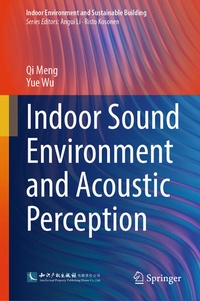
Indoor Sound Environment and Acoustic Perception
Description

This book mainly presents the state-of-the-art development in indoor sound environment. Not simply introducing the research on the acoustic environment or noise level of indoor building, the book considers the differences in the function of buildings and the perception of acoustic environment, as well as the relationship between sound quality and health and behavior. The book includes the multidisciplinary studies in architecture, acoustics, environmental science, psychology, sociology, and management. Therefore, it is used as a guide for government decision-makers, developers, planners, and architects to understand the effects of architectural design on building acoustic environment.
More details
Other editions
Additional editions
Persons
Professor Qi Meng heads the Building Acoustics Group in School of Architecture and Design, Harbin Institute of Technology (HIT), Harbin, China. He has worked in environmental and architectural acoustics for 20 years, with more than 20 research projects supported by National Natural Science Foundation of China (NSFC), Natural Science Foundation of Heilongjiang Province and National Key Laboratories of China. He has more than 100 research papers. His work on acoustic theories, design guidance and products has brought major improvements to the noise control in indoor spaces and soundscape design in urban areas.
Professor Yue Wu heads the Public Buildings and Low-carbon Technologies Group in School of Architecture and Design, Harbin Institute of Technology (HIT), Harbin, China. Her research interests include architectural acoustics and healthy building. She has presided over a number of national, provincial and ministerial projects supported by National Natural Science Foundation of China (NSFC), Natural Science Foundation of Heilongjiang Province. She has published more than 50 journal articles, and participated in the compilation of acoustic and hospital direction standards.
Content
Sound Environment and Acoustic Perception in Commercial Spaces.- Sound Environment and Acoustic Perception in Dinning Spaces.- Sound Environment and Acoustic Perception in Railway Stations.- Sound Environment and Acoustic Perception in Hospitals.- Sound Environment and Acoustic Perception in Living Spaces.
