

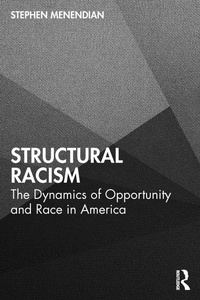
Structural Racism
The Dynamics of Opportunity and Race in America
1st Edition
Published on 30. June 2025
364 pages
978-1-040-36334-8 (ISBN)
Description

This book explains how racial inequality in the United States is produced and perpetuated and what should be done about it. It develops the elusive concept of "structural racism," presenting a precise definition that is clear and comprehensible, and illustrates how it operates methodically and rigorously.
Many other books are long on problems and short on solutions, whereas this book develops the key principles that must ground a structural reform agenda, and then presents a broad-ranging set of interventions organized around ten themes that will reduce racial disparities while expanding opportunity for all.
Unlike most books on race which focus on a particular issue or sector, this book is comprehensive in its scope, encompassing the vital systems that shape racial inequality in contemporary American society: from education and public schools to income and wealth disparities to housing and health care to policing and the criminal justice system. As such, this book is the ideal text for readers seeking to learn more about structural racial inequality in society, how it came to be that way, and what we should do about it, while deepening our understanding and challenging many misguided or simplistic prevailing notions.
In a time of backlash to racial justice and growing doubts about racial equity initiatives, this book is a timely and necessary entry. A must read for advocates, students, policymakers, and researchers alike.
Many other books are long on problems and short on solutions, whereas this book develops the key principles that must ground a structural reform agenda, and then presents a broad-ranging set of interventions organized around ten themes that will reduce racial disparities while expanding opportunity for all.
Unlike most books on race which focus on a particular issue or sector, this book is comprehensive in its scope, encompassing the vital systems that shape racial inequality in contemporary American society: from education and public schools to income and wealth disparities to housing and health care to policing and the criminal justice system. As such, this book is the ideal text for readers seeking to learn more about structural racial inequality in society, how it came to be that way, and what we should do about it, while deepening our understanding and challenging many misguided or simplistic prevailing notions.
In a time of backlash to racial justice and growing doubts about racial equity initiatives, this book is a timely and necessary entry. A must read for advocates, students, policymakers, and researchers alike.
Reviews / Votes
"Structural racism" is a term too easily thrown around nowadays as a substitute for careful thought. If you want to know what it really means, and why understanding its nuances is so important, Stephen Menendian's book is the place to start.Richard Rothstein, Author, The Color of Law: A Forgotten History of How Our Government Segregated America
"While the term "structural racism" is widely evoked in the popular political discourse of race, its precise meaning and conceptual underpinnings have remained sketchy and ill-defined. With this book, we finally have a clear, accessible, and compelling explanation of what structural racism is. Drawing upon illustrative stories of racial inequality across a wide range of institutional sites and practices, Menendian maps the enduring and intractable character of structural racism. He effectively demonstrates how opportunity in the United States is racialized and what this means for the remedies to address it."
Michael Omi, University of California, Berkeley, Co-author, Racial Formation in the United States
"This book on structural racism is much needed in a field where there is already a great deal written on race and racism. With important and consequential discussions about what it is, where we stand, and what remains to be done, Stephen tackles all these issues and many more. He helps us understand how our imprecise and confusing way of thinking and talking about race has often undermined not just our understanding but produced many incomplete and contradictory policy efforts. He shows us that in talking about race we are not just talking about past harms, but the present and the future. He also forcefully makes that case racism today cannot be understood or addressed at an individual level. In this book Stephen is not content to just define the problem, but presents concrete and realistic solutions. As the country continues, at times reluctantly and at times aggressively, to struggle with race, Stephen's work is and will be a 'must' read. This work is thorough, insightful, and deeply illuminating. We owe a dept of gratitude to Stephen for bringing such light to one of the more important issues in our society."
john a. powell, Director of the Othering & Belonging Institute at UC Berkeley, Robert D. Haas Chancellor's Chair in Equity & Inclusion, Professor of Law, African-American, & Ethnic Studies, at the University of California at Berkeley
More details
Edition
1. Auflage
Language
English
Place of publication
London
United Kingdom
Publishing group
Taylor & Francis Ltd
Target group
College/higher education
Professional and scholarly
Illustrations
8 Tables, black and white; 2 Line drawings, black and white; 2 Illustrations, black and white
File size
18,47 MB
ISBN-13
978-1-040-36334-8 (9781040363348)
Copyright in bibliographic data and cover images is held by Nielsen Book Services Limited or by the publishers or by their respective licensors: all rights reserved.
Schweitzer Classification
Other editions
Additional editions
Book
06/2025
1st Edition
Routledge
€47.50
Shipment within 10-20 days
Book
06/2025
1st Edition
Routledge
€193.50
Shipment within 10-20 days
Person
Stephen Menendian is the Assistant Director and Director of Research at the Othering & Belonging Institute at UC Berkeley, where he leads several major initiatives, including projects advising state, local, and federal housing authorities. His research focuses on inequality between social groups, especially in the areas of housing and education, and the design of effective and lawful policy remedies. Stephen is the author of many scholarly publications, journal articles, and other notable books.
Content
Introduction. 1.The Structure of Opportunity. 2.Structural Racial Inequality. 3.The Origins of Structural Racism. 4.Toward a Structural Agenda. 5.Realizing the American Dream. Conclusion.
