

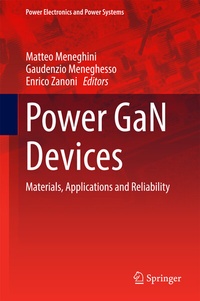
Power GaN Devices
Description

This book presents the first comprehensive overview of the properties and fabrication methods of GaN-based power transistors, with contributions from the most active research groups in the field. It describes how gallium nitride has emerged as an excellent material for the fabrication of power transistors; thanks to the high energy gap, high breakdown field, and saturation velocity of GaN, these devices can reach breakdown voltages beyond the kV range, and very high switching frequencies, thus being suitable for application in power conversion systems. Based on GaN, switching-mode power converters with efficiency in excess of 99 % have been already demonstrated, thus clearing the way for massive adoption of GaN transistors in the power conversion market. This is expected to have important advantages at both the environmental and economic level, since power conversion losses account for 10 % of global electricity consumption.
The first part of the book describes the properties and advantages of gallium nitride compared to conventional semiconductor materials. The second part of the book describes the techniques used for device fabrication, and the methods for GaN-on-Silicon mass production. Specific attention is paid to the three most advanced device structures: lateral transistors, vertical power devices, and nanowire-based HEMTs. Other relevant topics covered by the book are the strategies for normally-off operation, and the problems related to device reliability. The last chapter reviews the switching characteristics of GaN HEMTs based on a systems level approach.
This book is a unique reference for people working in the materials, device and power electronics fields; it provides interdisciplinary information on material growth, device fabrication, reliability issues and circuit-level switching investigation.
More details
Other editions
Additional editions
Persons
Gaudenzio Meneghesso received the Ph.D. degree in electrical and telecommunication engineering from the University of Padova, Padova, Italy, in 1997. In 1995, he was with the University of Twente, Enschede, The Netherlands, with a Human Capital and Mobility fellowship (within the SUSTAIN Network) working on the dynamic behavior of protection structures against electrostatic discharge (ESD). Since 2011, he has been a Full Professor with the Department of Information Engineering, University of Padova.
Enrico Zanoni was born in Verona, Italy, in 1956. He received the Laurea degree in physics (cum laude) from the University of Modena and Reggio Emilia, Modena, Italy, in 1982, after a student internship with the S. Carlo Foundation, Modena. During 1985-1988, he was an Assistant Professor with the Faculty of Engineering, University of Bari, Bari, Italy. From 1988 to 1993, he frequently visited the U.S. and established research collaborations with Bell Laboratories; Hughes Research Laboratories; IBM T. J. Watson Research Center; Massachusetts Institute of Technology, Cambridge, MA, USA; TRW (currently, Northrop Grumman); University of California, Santa Barbara, CA, USA; and many other industrial and academic laboratories. During 1996-1997, he was a Full Professor of industrial electronics with the University of Modena and Reggio Emilia. Heis currently with the University of Padova, Padua, Italy, where he was an Assistant Professor during 1988-1992, an Associate Professor of electronics during 1992-1993, a Full Professor of microelectronics during 1993-1996, and has been a Full Professor of digital electronics with the Department of Information Engineering since 1997.
