

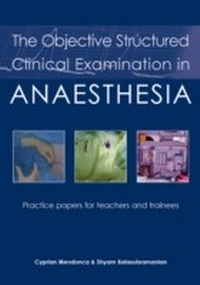
Objective Structured Clinical Examination in Anaesthesia
Practice papers for teachers and trainees
1st Edition
Published on 1. September 2007
398 pages
978-1-908986-20-7 (ISBN)
Description

The Objective Structured Clinical Examination (OSCE) is a highly reliable and valid tool for the evaluation of trainees in anaesthesia. It enables examiners and trainers to assess a number of competencies in an organised way. Performance in the OSCE is considered to be a fair reflection of the level of knowledge and skill attained during anaesthesia training. Apart from having a wide and deep knowledge on the subject, trainees are expected to have the capacity to demonstrate their competency in a short period of time allotted for each station. The authors of this book have a rich experience in successfully conducting OSCE courses in the United Kingdom. The sample OSCE sets in the book closely simulate the style and content of the Royal College of Anaesthetists' examination format. The book contains 100 OSCE stations with answers based on key practical procedures, clinical skills, communication skills, data interpretation, anaesthetic equipment and the management of critical incidents on a simulator. This book will also help candidates all over the world to pass highly competitive postgraduate examinations in anaesthesia. It is an invaluable educational resource for all anaesthetists.
More details
Other editions
Additional editions
Cyprian Mendonca | Shyam Balasubramanian
The Objective Structured Clinical Examination in Anaesthesia
Practice papers for teachers and trainees
Book
08/2007
TFM Publishing Ltd
€66.00
Shipment within 3-4 weeks
Content
- COVER FRONT
- Contents
- Preface
- Foreword
- Acknowledgements
- Abbreviations
- OSCE set 1
- Station 1.1 Anaesthetic equipment: circle absorber
- Station 1.2 Data interpretation: ECG
- Station 1.3 Data interpretation: haemodynamic data
- Station 1.4 Data interpretation: statistics
- Station 1.5 Anatomy: internal jugular vein
- Station 1.6 Communication: awake tracheal intubation
- Station 1.7 Technical skill: cricothyrotomy
- Station 1.8 Clinical examination: assessment of a trauma patient
- Station 1.9 Measuring equipment: pulmonary artery flotation catheter
- Station 1.10 Resuscitation: paediatric resuscitation
- Station 1.11 Anatomy: base of the skull
- Station 1.12 History taking: teeth extraction
- Station 1.13 Simulation: anaphylaxis
- Station 1.14 Monitoring equipment: capnography
- Station 1.15 Clinical safety: diathermy and electrical safety
- Station 1.16 Radiology: chest X-ray
- Station 1.17 History taking: arthroscopy of the knee
- Station 1.18 Communication: awareness under anaesthesia
- Station 1.19 Anatomy: intercostal nerve block
- Station 1.20 Clinical examination: cranial nerves
- OSCE set 2
- Station 2.1 Anaesthetic equipment: Humphrey ADE breathing system
- Station 2.2 Data interpretation: ECG
- Station 2.3 Data interpretation: drug overdose
- Station 2.4 Data interpretation: neuro-observation chart
- Station 2.5 Anatomy: stellate ganglion
- Station 2.6 Communication: brain stem test
- Station 2.7 Technical skill: lumbar puncture for spinal anaesthesia
- Station 2.8 Clinical examination: cardiovascular system
- Station 2.9 Measuring equipment: Wright respirometer
- Station 2.10 Resuscitation: basic life support of a pregnant mother
- Station 2.11 Anatomy: vagus nerve
- Station 2.12 History taking: laparoscopic cholecystectomy
- Station 2.13 Simulation: failed intubation
- Station 2.14 Monitoring equipment: peripheral nerve stimulator
- Station 2.15 Clinical safety: defibrillator
- Station 2.16 Radiology: chest X-ray
- Station 2.17 History taking: varicose veins
- Station 2.18 Communication: suxamethonium apnoea
- Station 2.19 Anatomy: cubital fossa
- Station 2.20 Technical skill: ankle block
- OSCE set 3
- Station 3.1 Anaesthetic equipment: anaesthesia machine check
- Station 3.2 Data interpretation: biochemistry
- Station 3.3 Data interpretation: ECG
- Station 3.4 Data interpretation: coagulation studies
- Station 3.5 Anatomy: neck and thorax
- Station 3.6 Communication: postponed surgery
- Station 3.7 Technical skill: tracheostomy tube exchange
- Station 3.8 Clinical examination: respiratory system
- Station 3.9 Measuring equipment: temperature measurement
- Station 3.10 Resuscitation: atrial fibrillation
- Station 3.11 Anatomy: trigeminal nerve
- Station 3.12 History taking: mastectomy
- Station 3.13 Simulation: ST depression
- Station 3.14 Monitoring equipment: pulse oximeter
- Station 3.15 Clinical safety: administration of blood to a patient
- Station 3.16 Radiology: CT scan of the head
- Station 3.17 History taking: hernia repair
- Station 3.18 Anaesthetic equipment: entonox valve
- Station 3.19 Technical skill: intra-osseous infusion
- Station 3.20 Technical skill: intravenous regional anaesthesia
- OSCE set 4
- Station 4.1 Anaesthetic equipment: Bain breathing system
- Station 4.2 Data interpretation: lung function tests
- Station 4.3 Data interpretation: ECG
- Station 4.4 Data interpretation: vital parameters
- Station 4.5 Anatomy: the orbit and ophthalmic anaesthesia
- Station 4.6 Communication: Jehovah's Witness
- Station 4.7 Technical skill: laryngeal mask airway (LMA) insertion
- Station 4.8 Clinical examination: airway examination
- Station 4.9 Measuring equipment: Bourdon gauge
- Station 4.10 Resuscitation: broad complex tachycardia
- Station 4.11 Anatomy: larynx
- Station 4.12 History taking: tympanoplasty
- Station 4.13 Simulation: post-induction hypotension
- Station 4.14 Monitoring equipment: oxygen analyser
- Station 4.15 Clinical safety: peripheral nerve injury
- Station 4.16 Radiology: chest X-ray
- Station 4.17 History taking: total hip replacement
- Station 4.18 Communication: labour analgesia
- Station 4.19 Clinical skill: cricoid pressure
- Station 4.20 Anatomy: caudal block
- OSCE set 5
- Station 5.1 Anaesthetic equipment: airway equipment
- Station 5.2 Data interpretation: lung function tests
- Station 5.3 Data interpretation: statistics
- Station 5.4 Data interpretation: arterial blood gas result
- Station 5.5 Anatomy: sciatic nerve block
- Station 5.6 Communication: dental injury
- Station 5.7 Technical skill: chest drain insertion
- Station 5.8 Clinical examination: arterial and venous pulses, and pressures
- Station 5.9 Measuring equipment: Severinghaus carbon dioxide electrode
- Station 5.10 Resuscitation: pulseless electrical activity
- Station 5.11 Anatomy: arterial system of the hand
- Station 5.12 History taking: septoplasty
- Station 5.13 Simulation: bronchospasm
- Station 5.14 Monitoring equipment: invasive blood pressure monitoring
- Station 5.15 Clinical safety: patient positioning
- Station 5.16 Radiology: cervical spine X-ray
- Station 5.17 History taking: abdominal hysterectomy
- Station 5.18 Communication: abdominal aortic aneurysm repair
- Station 5.19 Anatomy: spine and vertebrae
- Station 5.20 Technical skill: supraclavicular brachial plexus block
- COVER BACK
