

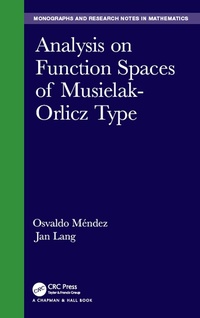
Analysis on Function Spaces of Musielak-Orlicz Type
1st Edition
Published on 21. January 2019
276 pages
978-0-429-52410-3 (ISBN)
Description

Analysis on Function Spaces of Musielak-Orlicz Type provides a state-of-the-art survey on the theory of function spaces of Musielak-Orlicz type. The book also offers readers a step-by-step introduction to the theory of Musielak-Orlicz spaces, and introduces associated function spaces, extending up to the current research on the topic
Musielak-Orlicz spaces came under renewed interest when applications to electrorheological hydrodynamics forced the particular case of the variable exponent Lebesgue spaces on to center stage. Since then, research efforts have typically been oriented towards carrying over the results of classical analysis into the framework of variable exponent function spaces. In recent years it has been suggested that many of the fundamental results in the realm of variable exponent Lebesgue spaces depend only on the intrinsic structure of the Musielak-Orlicz function, thus opening the door for a unified theory which encompasses that of Lebesgue function spaces with variable exponent.
Features
Gives a self-contained, concise account of the basic theory, in such a way that even early-stage graduate students will find it useful
Contains numerous applications
Facilitates the unified treatment of seemingly different theoretical and applied problems
Includes a number of open problems in the area
Musielak-Orlicz spaces came under renewed interest when applications to electrorheological hydrodynamics forced the particular case of the variable exponent Lebesgue spaces on to center stage. Since then, research efforts have typically been oriented towards carrying over the results of classical analysis into the framework of variable exponent function spaces. In recent years it has been suggested that many of the fundamental results in the realm of variable exponent Lebesgue spaces depend only on the intrinsic structure of the Musielak-Orlicz function, thus opening the door for a unified theory which encompasses that of Lebesgue function spaces with variable exponent.
Features
Gives a self-contained, concise account of the basic theory, in such a way that even early-stage graduate students will find it useful
Contains numerous applications
Facilitates the unified treatment of seemingly different theoretical and applied problems
Includes a number of open problems in the area
Reviews / Votes
"The family of Musielak-Orlicz (M-O) spaces mentioned in the title includes not only those of classical Lebesgue and Orlicz type, but also the spaces with variable exponent that have attracted such a great deal of interest in recent years. After a preparatory chapter in which basic facts are established, a detailed study is made of M-O spaces, following which Sobolev spaces based on them are examined. Finally, there is a chapter giving applications, dealing in particularwith the variable exponent p Laplacian.
A particular virtue of the book is that the unified approach adopted to deal with very general circumstances is accomplished by keeping the technicalities firmly subordinate to the main ideas. It is a welcome addition to the number of books dealing with related topics and should be of definite interest to many."
-Professor David Edmunds, University of Sussex
More details
Series
Edition
1. Auflage
Language
English
Place of publication
London
United Kingdom
Publishing group
Taylor & Francis Ltd
Target group
College/higher education
File size
4,54 MB
ISBN-13
978-0-429-52410-3 (9780429524103)
Copyright in bibliographic data and cover images is held by Nielsen Book Services Limited or by the publishers or by their respective licensors: all rights reserved.
Schweitzer Classification
Other editions
Additional editions
Osvaldo Mendez | Jan Lang
Analysis on Function Spaces of Musielak-Orlicz Type
Book
12/2018
1st Edition
Chapman & Hall/CRC
€231.90
Shipment within 15-20 days
Persons
Osvaldo Mendez is an associate professor at University of Texas at El Paso. His areas of research include Harmonic Analysis, Partial Differential Equations and Theory of Function Spaces. Professor Mendez has authored one book and one edited book.
Jan Lang is a professor of mathematics at The Ohio State University. His areas of interest include the Theory of Integral operators, Approximation Theory, Theory of Function spaces and applications to PDEs. He is the author of two books and one edited book.
Jan Lang is a professor of mathematics at The Ohio State University. His areas of interest include the Theory of Integral operators, Approximation Theory, Theory of Function spaces and applications to PDEs. He is the author of two books and one edited book.
Content
1 A path to Musielak-Orlicz spaces
1.1 Introduction
1.2 Banach function spaces
1.2.1 The associate space
1.2.2 Absolute continuity of norm and continuity of norm
1.2.3 Convexity, uniform convexity and smoothness of a norm
1.2.4 Duality mappings and extremal elements
1.3 Modular spaces
1.3.1 Modular convergence and norm convergence
1.3.2 Conjugate modulars and duality
1.3.3 Modular uniform convexity
1.4 The `pn sequence spaces and their properties
1.4.1 Duality
1.4.2 Finitely additive measures
1.4.3 Geometric properties of `pn
1.4.4 Applications: Fixed point theorems on `pn spaces
1.4.5 Further remarks
1.5 Forerunners of the Musielak-Orlicz class: Orlicz spaces, Lp(x) spaces
2 Musielak-Orlicz spaces
2.1 Introduction, De nition and Examples
2.2 Embeddings between Musielak-Orlicz spaces
2.2.1 The <2-condition
2.2.2 Absolute continuity of the norm
2.3 Separability
2.4 Duality of Musielak-Orlicz spaces
2.4.1 Conjugate Musielak-Orlicz functions
2.4.2 Conjugate functions and the dual of L'()
2.5 Density of regular functions
2.6 Uniform convexity of Musielak-Orlicz spaces
2.7 Carath?eodory functions and Nemytskii operators on Musielak-Orlicz spaces
2.8 Further properties of variable exponent spaces
2.8.1 Duality maps on spaces of variable integrability
2.9 The Matuszewska-Orlicz index of a Musielak-Orlicz space
2.9.1 Properties
2.10 Historical notes
3 Sobolev spaces of Musielak-Orlicz type
3.1 Sobolev spaces: de nition and basic properties
3.1.1 Examples
3.2 Separability
3.3 Duality of Sobolev spaces of Musielak-Orlicz type
3.4 Embeddings, compactness, Poincare-type inequalities
4 Applications
4.1 Preparatory results and notation
4.2 Compactness of the Sobolev embedding and the modular setting
4.3 The variable exponent p-Laplacian
4.3.1 Stability of the solutions
4.4 ??-convergence
4.5 The eigenvalue problem for the p-Laplacian
4.6 More on Eigenvalues
1.1 Introduction
1.2 Banach function spaces
1.2.1 The associate space
1.2.2 Absolute continuity of norm and continuity of norm
1.2.3 Convexity, uniform convexity and smoothness of a norm
1.2.4 Duality mappings and extremal elements
1.3 Modular spaces
1.3.1 Modular convergence and norm convergence
1.3.2 Conjugate modulars and duality
1.3.3 Modular uniform convexity
1.4 The `pn sequence spaces and their properties
1.4.1 Duality
1.4.2 Finitely additive measures
1.4.3 Geometric properties of `pn
1.4.4 Applications: Fixed point theorems on `pn spaces
1.4.5 Further remarks
1.5 Forerunners of the Musielak-Orlicz class: Orlicz spaces, Lp(x) spaces
2 Musielak-Orlicz spaces
2.1 Introduction, De nition and Examples
2.2 Embeddings between Musielak-Orlicz spaces
2.2.1 The <2-condition
2.2.2 Absolute continuity of the norm
2.3 Separability
2.4 Duality of Musielak-Orlicz spaces
2.4.1 Conjugate Musielak-Orlicz functions
2.4.2 Conjugate functions and the dual of L'()
2.5 Density of regular functions
2.6 Uniform convexity of Musielak-Orlicz spaces
2.7 Carath?eodory functions and Nemytskii operators on Musielak-Orlicz spaces
2.8 Further properties of variable exponent spaces
2.8.1 Duality maps on spaces of variable integrability
2.9 The Matuszewska-Orlicz index of a Musielak-Orlicz space
2.9.1 Properties
2.10 Historical notes
3 Sobolev spaces of Musielak-Orlicz type
3.1 Sobolev spaces: de nition and basic properties
3.1.1 Examples
3.2 Separability
3.3 Duality of Sobolev spaces of Musielak-Orlicz type
3.4 Embeddings, compactness, Poincare-type inequalities
4 Applications
4.1 Preparatory results and notation
4.2 Compactness of the Sobolev embedding and the modular setting
4.3 The variable exponent p-Laplacian
4.3.1 Stability of the solutions
4.4 ??-convergence
4.5 The eigenvalue problem for the p-Laplacian
4.6 More on Eigenvalues
