

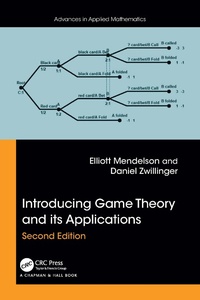
Introducing Game Theory and its Applications
2nd Edition
Published on 2. August 2024
287 pages
978-1-040-09189-0 (ISBN)
Description

This classic text, originally from the noted logician Elliot Mendelson, is intended to be an easy-to-read introduction to the basic ideas and techniques of game theory. It can be used as a class textbook or for self-study.
Introducing Game Theory and its Applications, Second Edition presents an easy-to-read introduction to the basic ideas and techniques of game theory. After a brief introduction, the authors begin with a chapter devoted to combinatorial games--a topic neglected or treated minimally in most other texts. The focus then shifts to two-person zero-sum games and their solutions.
Here the authors present the simplex method based on linear programming for solving these games and develop within this presentation the required background. The final chapter presents some of the fundamental ideas and tools of non-zero-sum games and games with more than two players, including an introduction to cooperative game theory.
The book is suitable for a first undergraduate course in game theory, or a graduate course for students with limited previous exposure. It is useful for students who need to learn some game theory for a related subject (e.g., microeconomics) and have a limited mathematical background. It also prepares its readers for more advanced study of game theory's applications in economics, business, and the physical, biological, and social sciences.
The authors hope this book breeds curiosity about the subject as its design is meant to to satisfy the readers. The book will prepare readers for deeper study of game theory applications in many fields of study.
Introducing Game Theory and its Applications, Second Edition presents an easy-to-read introduction to the basic ideas and techniques of game theory. After a brief introduction, the authors begin with a chapter devoted to combinatorial games--a topic neglected or treated minimally in most other texts. The focus then shifts to two-person zero-sum games and their solutions.
Here the authors present the simplex method based on linear programming for solving these games and develop within this presentation the required background. The final chapter presents some of the fundamental ideas and tools of non-zero-sum games and games with more than two players, including an introduction to cooperative game theory.
The book is suitable for a first undergraduate course in game theory, or a graduate course for students with limited previous exposure. It is useful for students who need to learn some game theory for a related subject (e.g., microeconomics) and have a limited mathematical background. It also prepares its readers for more advanced study of game theory's applications in economics, business, and the physical, biological, and social sciences.
The authors hope this book breeds curiosity about the subject as its design is meant to to satisfy the readers. The book will prepare readers for deeper study of game theory applications in many fields of study.
More details
Series
Edition
2nd edition
Language
English
Place of publication
London
United Kingdom
Publishing group
Taylor & Francis Ltd
Target group
College/higher education
Illustrations
73 Halftones, black and white; 73 Illustrations, black and white
ISBN-13
978-1-040-09189-0 (9781040091890)
Copyright in bibliographic data and cover images is held by Nielsen Book Services Limited or by the publishers or by their respective licensors: all rights reserved.
Schweitzer Classification
Other editions
Additional editions
Elliott Mendelson | Daniel Zwillinger
Introducing Game Theory and its Applications
Book
08/2024
2nd Edition
Chapman & Hall/CRC
€232.00
Shipment within 15-20 days
Elliott Mendelson | Daniel Zwillinger
Introducing Game Theory and its Applications
Book
08/2024
2nd Edition
Chapman & Hall/CRC
€96.60
Shipment within 10-20 days
Persons
Elliott Mendelson is the late professor emeritus at Queens College in Flushing, New York, USA. Dr. Mendelson obtained his bachelor's at Columbia University and his master's and doctoral degrees at Cornell University and was elected afterward to the Harvard Society of Fellows. In addition to his other writings, he is the author of another CRC Press book, Introduction to Mathematical Logic, Sixth Edition.
Dan Zwillinger has more than 35 years of proven technical expertise in numerous areas of engineering and the physical sciences. He earned a PhD in applied mathematics from the California Institute of Technology. He is the editor of CRC Standard Mathematical Tables and Formulas, 33rd Edition and also Table of Integrals, Series, and Products, by Gradshteyn and Ryzhik. He serves as the series editor of the CRC Series of Advances in Applied Mathematics.
Dan Zwillinger has more than 35 years of proven technical expertise in numerous areas of engineering and the physical sciences. He earned a PhD in applied mathematics from the California Institute of Technology. He is the editor of CRC Standard Mathematical Tables and Formulas, 33rd Edition and also Table of Integrals, Series, and Products, by Gradshteyn and Ryzhik. He serves as the series editor of the CRC Series of Advances in Applied Mathematics.
Content
Preface
Introduction
1 Combinatorial games
1.1 Definition of combinatorial games
1.2 Fundamental theorem of combinatorial games
1.3 Nim
1.4 Hex and other games
1.5 Tree games
1.6 Grundy functions
1.7 Bogus Nim-sums
1.8 Chapter summary
2 Two-person zero-sum games
2.1 Games in normal form
2.2 Saddle points and equilibrium pairs
2.3 Maximin and minimax
2.4 Mixed strategies
2.5 2-by-2 matrix games
2.6 2-by-n, m-by-2 and 3-by-3 matrix games
2.7 Linear programming
2.8 Chapter summary
3 Solving two-person zero-sum games using LP
3.1 Perfect canonical linear programming problems
3.2 The simplex method
3.3 Pivoting
3.4 The perfect phase of the simplex method
3.5 The Big M method
3.6 Bland's rules to prevent cycling
3.7 Duality and the simplex method
3.8 Solution of game matrices
3.9 Chapter summary
4 Non-zero-sum games and k-person games
4.1 The general setting
4.2 Nash equilibria
4.3 Graphical method for 2 A- 2 matrix games
4.4 Inadequacies of Nash equilibria & cooperative games
4.5 The Nash arbitration procedure
4.6 Games with two or more players
4.7 Coalitions
4.8 Games in coalition form
4.9 The Shapley value
4.10 The Banzhaf power index
4.11 Imputations
4.12 Strategic equivalence
4.13 Stable sets
4.14 Chapter summary
5 Imperfect Information Games
5.1 The general setting
5.2 Complete information games in extensive form
5.3 Imperfect information games in extensive form
5.4 Games with random effects
5.5 Chapter summary
6 Computer solutions to games
6.1 Zero-sum games - invertible matrices
6.2 Zero sum games - linear program problem (LP)
6.3 Special Linear Programming Capabilities
6.4 Non-zero sum games - linear complementarity problem (LCP)
6.5 Special game packages
6.6 Chapter summary
Appendices
Appendix A Utility theory
Appendix B Nash's theorem
Appendix C Finite probability theory
Appendix D Calculus & Differentiation
Appendix E Linear Algebra
Appendix F Linear Programming
Appendix G Named Games and Game Data
Answers to selected exercises
Bibliography
Index
Introduction
1 Combinatorial games
1.1 Definition of combinatorial games
1.2 Fundamental theorem of combinatorial games
1.3 Nim
1.4 Hex and other games
1.5 Tree games
1.6 Grundy functions
1.7 Bogus Nim-sums
1.8 Chapter summary
2 Two-person zero-sum games
2.1 Games in normal form
2.2 Saddle points and equilibrium pairs
2.3 Maximin and minimax
2.4 Mixed strategies
2.5 2-by-2 matrix games
2.6 2-by-n, m-by-2 and 3-by-3 matrix games
2.7 Linear programming
2.8 Chapter summary
3 Solving two-person zero-sum games using LP
3.1 Perfect canonical linear programming problems
3.2 The simplex method
3.3 Pivoting
3.4 The perfect phase of the simplex method
3.5 The Big M method
3.6 Bland's rules to prevent cycling
3.7 Duality and the simplex method
3.8 Solution of game matrices
3.9 Chapter summary
4 Non-zero-sum games and k-person games
4.1 The general setting
4.2 Nash equilibria
4.3 Graphical method for 2 A- 2 matrix games
4.4 Inadequacies of Nash equilibria & cooperative games
4.5 The Nash arbitration procedure
4.6 Games with two or more players
4.7 Coalitions
4.8 Games in coalition form
4.9 The Shapley value
4.10 The Banzhaf power index
4.11 Imputations
4.12 Strategic equivalence
4.13 Stable sets
4.14 Chapter summary
5 Imperfect Information Games
5.1 The general setting
5.2 Complete information games in extensive form
5.3 Imperfect information games in extensive form
5.4 Games with random effects
5.5 Chapter summary
6 Computer solutions to games
6.1 Zero-sum games - invertible matrices
6.2 Zero sum games - linear program problem (LP)
6.3 Special Linear Programming Capabilities
6.4 Non-zero sum games - linear complementarity problem (LCP)
6.5 Special game packages
6.6 Chapter summary
Appendices
Appendix A Utility theory
Appendix B Nash's theorem
Appendix C Finite probability theory
Appendix D Calculus & Differentiation
Appendix E Linear Algebra
Appendix F Linear Programming
Appendix G Named Games and Game Data
Answers to selected exercises
Bibliography
Index
