

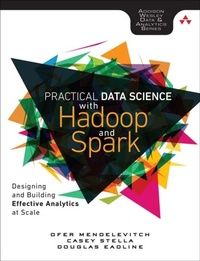
Practical Data Science with Hadoop and Spark
Designing and Building Effective Analytics at Scale
1st Edition
Published on 8. December 2016
256 pages
978-0-13-402972-6 (ISBN)
Description

The Complete Guide to Data Science with Hadoop-For Technical Professionals, Businesspeople, and Students
Demand is soaring for professionals who can solve real data science problems with Hadoop and Spark. Practical Data Science with Hadoop (R) and Spark is your complete guide to doing just that. Drawing on immense experience with Hadoop and big data, three leading experts bring together everything you need: high-level concepts, deep-dive techniques, real-world use cases, practical applications, and hands-on tutorials.
The authors introduce the essentials of data science and the modern Hadoop ecosystem, explaining how Hadoop and Spark have evolved into an effective platform for solving data science problems at scale. In addition to comprehensive application coverage, the authors also provide useful guidance on the important steps of data ingestion, data munging, and visualization.
Once the groundwork is in place, the authors focus on specific applications, including machine learning, predictive modeling for sentiment analysis, clustering for document analysis, anomaly detection, and natural language processing (NLP).
This guide provides a strong technical foundation for those who want to do practical data science, and also presents business-driven guidance on how to apply Hadoop and Spark to optimize ROI of data science initiatives.
Learn
What data science is, how it has evolved, and how to plan a data science career
How data volume, variety, and velocity shape data science use cases
Hadoop and its ecosystem, including HDFS, MapReduce, YARN, and Spark
Data importation with Hive and Spark
Data quality, preprocessing, preparation, and modeling
Visualization: surfacing insights from huge data sets
Machine learning: classification, regression, clustering, and anomaly detection
Algorithms and Hadoop tools for predictive modeling
Cluster analysis and similarity functions
Large-scale anomaly detection
NLP: applying data science to human language
Demand is soaring for professionals who can solve real data science problems with Hadoop and Spark. Practical Data Science with Hadoop (R) and Spark is your complete guide to doing just that. Drawing on immense experience with Hadoop and big data, three leading experts bring together everything you need: high-level concepts, deep-dive techniques, real-world use cases, practical applications, and hands-on tutorials.
The authors introduce the essentials of data science and the modern Hadoop ecosystem, explaining how Hadoop and Spark have evolved into an effective platform for solving data science problems at scale. In addition to comprehensive application coverage, the authors also provide useful guidance on the important steps of data ingestion, data munging, and visualization.
Once the groundwork is in place, the authors focus on specific applications, including machine learning, predictive modeling for sentiment analysis, clustering for document analysis, anomaly detection, and natural language processing (NLP).
This guide provides a strong technical foundation for those who want to do practical data science, and also presents business-driven guidance on how to apply Hadoop and Spark to optimize ROI of data science initiatives.
Learn
What data science is, how it has evolved, and how to plan a data science career
How data volume, variety, and velocity shape data science use cases
Hadoop and its ecosystem, including HDFS, MapReduce, YARN, and Spark
Data importation with Hive and Spark
Data quality, preprocessing, preparation, and modeling
Visualization: surfacing insights from huge data sets
Machine learning: classification, regression, clustering, and anomaly detection
Algorithms and Hadoop tools for predictive modeling
Cluster analysis and similarity functions
Large-scale anomaly detection
NLP: applying data science to human language
All prices
More details
Edition
1. Auflage
Language
English
Place of publication
Boston
United States
Publishing group
Pearson Education (US)
Target group
Professional and scholarly
File size
14,15 MB
ISBN-13
978-0-13-402972-6 (9780134029726)
Copyright in bibliographic data and cover images is held by Nielsen Book Services Limited or by the publishers or by their respective licensors: all rights reserved.
Schweitzer Classification
Other editions
Additional editions
Ofer Mendelevitch | Casey Stella | Douglas Eadline
Practical Data Science with Hadoop and Spark: Designing and Building Effective Analytics at Scale
Designing and Building Effective Analytics at Scale
Book
02/2017
1st Edition
Addison Wesley
€41.49
Shipment within 15-20 days
Persons
Ofer Mendelevitch is Vice President of Data Science at Lendup, where he is responsible for Lendup's machine learning and advanced analytics group. Prior to joining Lendup, Ofer was Director of Data Science at Hortonworks, where he was responsible for helping Hortonwork's customers apply Data Science with Hadoop and Spark to big data across various industries including healthcare, finance, retail and others. Before Hortonworks, Ofer served as Entrepreneur in Residence at XSeed Capital, VP of Engineering at Nor1, and Director of Engineering at Yahoo!.
Casey Stella is a Principal Software Engineer focusing on Data Science at Hortonworks, which provides an open source Hadoop distribution. Casey's primary responsibility is leading the analytics/data science team for the Apache Metron (Incubating) Project, an open source cybersecurity project. Prior to Hortonworks, Casey was an architect at Explorys, which was a medical informatics startup spun out of the Cleveland Clinic. In the more distant past, Casey served as a developer at Oracle, Research Geophysicist at ION Geophysical and as a poor graduate student in Mathematics at Texas A&M.
Douglas Eadline, PhD, began his career as analytical chemist with an interest in computer methods. Starting with the first Beowulf how-to document, Doug has written hundreds of articles, white papers, and instructional documents covering many aspects of HPC and Hadoop computing. Prior to starting and editing the popular ClusterMonkey.net website in 2005, he served as editor?in?chief for ClusterWorld Magazine and was senior HPC editor for Linux Magazine. He has practical hands-on experience in many aspects of HPC and Apache Hadoop, including hardware and software design, benchmarking, storage, GPU, cloud computing, and parallel computing. Currently, he is a writer and consultant to the HPC/analytics industry and leader of the Limulus Personal Cluster Project (http://limulus.basement-supercomputing.com). He is author of the Apache Hadoop (R) Fundamentals LiveLessons and Apache Hadoop (R) YARN Fundamentals LiveLessons videos from Pearson, and is book co-author of Apache Hadoop (R) YARN: Moving beyond MapReduce and Batch Processing with Apache Hadoop 2 and author of Hadoop (R) 2 Quick Start Guide: Learn the Essentials of Big Data Computing in the Apache Hadoop 2 Ecosystem, also from Addison-Wesley, and is author of High Performance Computing for Dummies.
Casey Stella is a Principal Software Engineer focusing on Data Science at Hortonworks, which provides an open source Hadoop distribution. Casey's primary responsibility is leading the analytics/data science team for the Apache Metron (Incubating) Project, an open source cybersecurity project. Prior to Hortonworks, Casey was an architect at Explorys, which was a medical informatics startup spun out of the Cleveland Clinic. In the more distant past, Casey served as a developer at Oracle, Research Geophysicist at ION Geophysical and as a poor graduate student in Mathematics at Texas A&M.
Douglas Eadline, PhD, began his career as analytical chemist with an interest in computer methods. Starting with the first Beowulf how-to document, Doug has written hundreds of articles, white papers, and instructional documents covering many aspects of HPC and Hadoop computing. Prior to starting and editing the popular ClusterMonkey.net website in 2005, he served as editor?in?chief for ClusterWorld Magazine and was senior HPC editor for Linux Magazine. He has practical hands-on experience in many aspects of HPC and Apache Hadoop, including hardware and software design, benchmarking, storage, GPU, cloud computing, and parallel computing. Currently, he is a writer and consultant to the HPC/analytics industry and leader of the Limulus Personal Cluster Project (http://limulus.basement-supercomputing.com). He is author of the Apache Hadoop (R) Fundamentals LiveLessons and Apache Hadoop (R) YARN Fundamentals LiveLessons videos from Pearson, and is book co-author of Apache Hadoop (R) YARN: Moving beyond MapReduce and Batch Processing with Apache Hadoop 2 and author of Hadoop (R) 2 Quick Start Guide: Learn the Essentials of Big Data Computing in the Apache Hadoop 2 Ecosystem, also from Addison-Wesley, and is author of High Performance Computing for Dummies.
Content
Part I: Data Science with Hadoop-An Overview
Chapter 1: Introduction to Data Science
Chapter 2: Use Cases for Data Science
Chapter 3: Hadoop and Data Science
Part II: Preparing and Visualizing Data with Hadoop
Chapter 4: Getting Data into Hadoop
Chapter 5: Data Munging with Hadoop
Chapter 6: Exploring and Visualizing Data
Part III: Applying Data Modeling with Hadoop
Chapter 7: Machine Learning with Hadoop
Chapter 8: Predictive Modeling
Chapter 9: Clustering
Chapter 10: Anomaly Detection with Hadoop
Chapter 11: Natural Language Processing
Chapter 12: Data Science with Hadoop-The Next Frontier
Appendix A: Book Web Page and Code Download
Appendix B: HDFS Quick Start
Appendix C: Additional Background on Data Science and Apache Hadoop and Spark
Chapter 1: Introduction to Data Science
Chapter 2: Use Cases for Data Science
Chapter 3: Hadoop and Data Science
Part II: Preparing and Visualizing Data with Hadoop
Chapter 4: Getting Data into Hadoop
Chapter 5: Data Munging with Hadoop
Chapter 6: Exploring and Visualizing Data
Part III: Applying Data Modeling with Hadoop
Chapter 7: Machine Learning with Hadoop
Chapter 8: Predictive Modeling
Chapter 9: Clustering
Chapter 10: Anomaly Detection with Hadoop
Chapter 11: Natural Language Processing
Chapter 12: Data Science with Hadoop-The Next Frontier
Appendix A: Book Web Page and Code Download
Appendix B: HDFS Quick Start
Appendix C: Additional Background on Data Science and Apache Hadoop and Spark
