

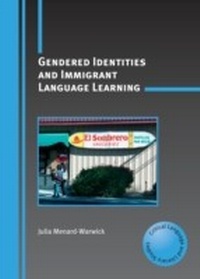
Gendered Identities and Immigrant Language Learning
1st Edition
Published on 29. October 2009
224 pages
978-1-84769-215-3 (ISBN)
Description

Based on participant observation in a California English as a Second Language family literacy program, this ethnographic study examines how the complexly gendered life histories of immigrant adults shaped their participation in both the English language classroom and the education of their children, within the contemporary sociohistorical context of increasing Latin American immigration to the United States. Through outlining the connections between (gendered) identity work and language learning, this study builds theoretical and empirical justification for teachers to negotiate classroom practice with each community of learners, responding to students' individual goals, histories, and lives outside the classroom.
Reviews / Votes
Humorous and irreverent, embarrassed and frustrated, angry and grateful, the participants in Menard-Warwick's study emerge as real people on the pages of this engaging and compassionate book that privileges immigrants' voices and experiences. Investigating the complex interplay between gender, class, ethnicity, and immigration status, Menard-Warwick revitalizes the inquiry into the relationship between gender, power, and second language and literacy learning and makes important connections between sociolinguistic theory and adult ESL teaching practice. -- Aneta Pavlenko, College of Education, Temple University, USA The monograph makes an important contribution to understanding adult immigrant learners' agency and heterogeneity in the restructuring of their gendered identities and their decisions on their education in early 21st century California. First, this research fills in the gaps in second language acquisition research which largely overlooks learners' identities, goals, trajectories and larger contexts of learning. Second, the study contributes in important ways to the language socialisation paradigm since it documents how the personal and family history of adult learners constitutes an important part of the social context of any educational endeavour. Besides, it questions previous findings about the divergence of immigrant children's socialisation from mainstream socialisation at schools. Last but not least, it accounts for the diverse gendered practices and ideologies within the transnational communities of practice in which informants participate through an analysis of the ESL classroom and home literacy practices. -- Maria Rosa Garrido, Universitat Autonoma de Barcelona, Spain * Spanish in Context 9:2, 2012 *All prices
More details
Series
Language
English
Place of publication
Bristol
United Kingdom
Publishing group
Channel View Publications Ltd
Target group
Professional and scholarly
Edition type
Digital original
ISBN-13
978-1-84769-215-3 (9781847692153)
Copyright in bibliographic data and cover images is held by Nielsen Book Services Limited or by the publishers or by their respective licensors: all rights reserved.
Schweitzer Classification
Other editions
Additional editions
Julia Menard-Warwick
Gendered Identities and Immigrant Language Learning
Book
10/2009
Multilingual Matters
€136.50
Shipment within 10-20 days
Julia Menard-Warwick
Gendered Identities and Immigrant Language Learning
Book
10/2009
Multilingual Matters
€42.10
Shipment within 10-20 days
Julia Menard-Warwick
Gendered Identities and Immigrant Language Learning
E-Book
10/2009
Multilingual Matters
€14.49
Available for download
Person
Julia Menard-Warwick is an Associate Professor in the Linguistics department at University of California Davis, where she teaches graduate and undergraduate classes in areas such as language pedagogy, second language literacy and technology, and language and gender. Before beginning doctoral studies in 1999, she taught ESL for ten years at a community college in Washington state (USA), and for one year at a university in Nicaragua. Her on-going research focuses on language pedagogies, bilingual development, cultural identities, and language ideologies in both US and Latin American contexts.
Content
Chapter One: The Social Context of Immigrant Language Learning
Chapter Two: Second Language Learning as Gendered Practice
Chapter Three: Gendered Narratives of Immigrant Language Learners
Chapter Four: The Sociohistorical Construction of Parental Involvement in Education
Chapter Five: Gendered Positioning in ESL Classroom Activities
Chapter Six: Changing Gender Ideologies in Local Communities
Chapter Seven: Gendered Identities and Language Learning: Continuing the Dialogue
References
Appendix A: Discourse transcription conventions
Appendix B: Focal participants' demographics
Appendix C: Data collected on participants
Chapter Two: Second Language Learning as Gendered Practice
Chapter Three: Gendered Narratives of Immigrant Language Learners
Chapter Four: The Sociohistorical Construction of Parental Involvement in Education
Chapter Five: Gendered Positioning in ESL Classroom Activities
Chapter Six: Changing Gender Ideologies in Local Communities
Chapter Seven: Gendered Identities and Language Learning: Continuing the Dialogue
References
Appendix A: Discourse transcription conventions
Appendix B: Focal participants' demographics
Appendix C: Data collected on participants
