

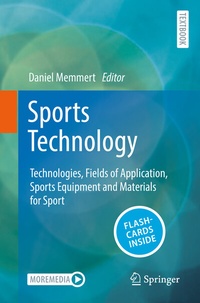
Sports Technology
Description

This textbook aims to encompass the broad diversity of sports technology by featuring contributions from over 30 authors within their respective specialized fields, summarizing the latest insights concisely. The work is structured into five main sections: Data Acquisition Systems, Sports Equipment and Materials, Diagnostics, Evaluation and Communication, and Selected Fields of Application.
Students with a connection to sports science gain a comprehensive understanding of sports technology supported by a carefully designed concept that facilitates easy delivery of learning content. Digital learning cards (SN Flashcards) reinforce the learning effect and ensure optimal exam preparation. For advanced learners, in-depth discussions on topics such as tracking data, digital training assistants, sports floor characteristics, virtual reality in sports, smartphone apps, and diagnostic tools offer additional value.
More details
Other editions
Additional editions
Person
Content
I Data acquisition systems.- Tracking data.- Biomechanical data.- Self-regulated learning employing marker-less movement analyses in the context of university education in sports.- Wearable Technologies.- Diagnosis of motor performance using exoskeletons.- Inertial sensing in sports.- Using Inertial Measurement Units (IMUs) in performance and behavioural analysis.- II Sports equipment and materials.- Controlled sliding as injury prevention.- Mechatronic ski binding.- Aspects and approaches for the development of digital training assistants.- Sports floor characteristics.- III Diagnostics.- Soccerbot360.- Virtual reality.- Video-based human action recognition and its application in dance research.- Sports measuring and information systems and biomechanical feedback training.- Innovative technologies for gait and stance analysis.- Panoramic ultrasound imaging and MyotonPRO.- IV Evaluation and communication.- Feedback systems.- Smartphone Apps.- Movement Sonification - Intermodal Transformation of Movement Data to enhance Motor Learning.- V Selected fields of application.- Metrics in Soccer.- Serious Games.- The Digital Twin - New Opportunities for Diagnostics and Control?.- Vibrations and damping systems in cycling.- Performance Analysis in Soccer.- Esport Assessment.- Video-based decision support for referees in sports games.- Evolutionary Algorithms.
