

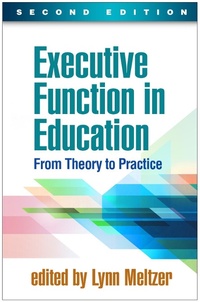
Executive Function in Education
From Theory to Practice
2nd Edition
Published on 19. January 2018
396 pages
978-1-4625-3459-3 (ISBN)
Description

Special educators and classroom teachers, school psychologists, neuropsychologists, developmental and clinical psychologists, and social workers working with 4- to 17-year-olds (grades PreK-12). Serves as a supplemental text in graduate-level courses.
More details
Other editions
Additional editions
Book
04/2018
2nd Edition
Guilford Press
€47.50
Shipment within 15-20 days
Person
Lynn Meltzer, PhD, is President and Director of the Institutes for Learning and Development (ResearchILD and ILD) in Lexington, Massachusetts. She is also an Associate in Education at the Harvard Graduate School of Education and a Fellow and past president of the International Academy for Research in Learning Disabilities. For 29 years, she was Adjunct Associate Professor in the Department of Child Development at Tufts University. Dr. Meltzer is founder and chair of the International Learning Differences Conference, which was established in 1984 and is held at the Harvard Graduate School of Education. Her 40 years of neuropsychological evaluations and clinical consultations with children, adolescents, and adults have emphasized the theory-to-practice cycle of knowledge. She has been an invited speaker at numerous national and international conferences, including that of the International Association for Cognitive Education in Southern Africa. She is also the recipient of numerous awards, including the Outstanding Researcher Award from the Council for Learning Disabilities. Among Dr. Meltzer's extensive publications and presentations are the books Promoting Executive Function in the Classroom, The Power of Peers in the Classroom (coedited with Karen R. Harris), and Executive Function in Education, Second Edition. Together with her ResearchILD colleagues, she developed SMARTS Online, an evidence-based executive function and peer mentoring/coaching curriculum for middle and high school students (www.smarts-ef.org).
Content
I. Theoretical and Conceptual Frameworks
1. Executive Function: Binding Together the Definitions of Attention-Deficit/Hyperactivity Disorder and Learning Disabilities, Martha Bridge Denckla & E. Mark Mahone
2. Hill, Skill, and Will: Executive Function from a Multiple Intelligences Perspective,
Seana Moran & Howard Gardner
3. Executive Capacities from a Developmental Perspective, Jane Holmes Bernstein & Deborah P. Waber
4. The Development of Hot and Cool Executive Function: A Foundation for Learning in the Preschool Years, Andrei D. Semenov & Philip David Zelazo
II. Executive Function in Different Diagnostic Groups: Challenges of Identification and Treatment
5. Executive Function Difficulties and Learning Differences: Assessment for Teaching, Lynn Meltzer, Julie Dunstan-Brewer, & Kalyani Krishnan
6. Nonverbal Learning Disabilities and Executive Function: The Challenges of Effective Assessment and Teaching, Judith A. Stein & Kalyani Krishnan
7. Executive Function in Autism Spectrum Disorder: From Research to Practice, Meghan Miller, Patricia L. Schetter, & Sally Ozonoff
III. Executive Function Processes in Reading and Other Content Areas
A: Reading: Current Findings and Interventions
8. Executive Function and Reading Difficulties: A Tale of Complexity in Diagnosis and Treatment, Jonathan D. Scheff, Neena M. Hudson, Mary Tarsha, & Laurie E. Cutting
9. Working Memory and Reading: Is there Evidence for an Executive Processing Deficit?, H. Lee Swanson & Jennifer E. Kong
10. Self-Regulation and Reading Comprehension: Self-Perceptions, Self-Evaluations, and Effective Strategies for Intervention, Tami Katzir, Vered Markovich, Einat Tesler, & Michal Shany
B. Interventions across the Content Areas
11. Creating Strategic Classrooms and Schools: Embedding Executive Function Strategies in the Curriculum, Lynn Meltzer
12. The Strategic Math Classroom: How Executive Function Impacts Math Learning, Joan Steinberg & Bethany Roditi
13. Self-Regulated Strategy Development in Writing: A Classroom Example of Developing Executive Function Processes and Future Directions, Karen R. Harris, Steve Graham, Linda Mason, Debra McKeown, & Natalie Olinghouse
14. Optimizing Executive Function in the Digital World: Advances in Universal Design for Learning, Samantha G. Daley & David H. Rose
Index
1. Executive Function: Binding Together the Definitions of Attention-Deficit/Hyperactivity Disorder and Learning Disabilities, Martha Bridge Denckla & E. Mark Mahone
2. Hill, Skill, and Will: Executive Function from a Multiple Intelligences Perspective,
Seana Moran & Howard Gardner
3. Executive Capacities from a Developmental Perspective, Jane Holmes Bernstein & Deborah P. Waber
4. The Development of Hot and Cool Executive Function: A Foundation for Learning in the Preschool Years, Andrei D. Semenov & Philip David Zelazo
II. Executive Function in Different Diagnostic Groups: Challenges of Identification and Treatment
5. Executive Function Difficulties and Learning Differences: Assessment for Teaching, Lynn Meltzer, Julie Dunstan-Brewer, & Kalyani Krishnan
6. Nonverbal Learning Disabilities and Executive Function: The Challenges of Effective Assessment and Teaching, Judith A. Stein & Kalyani Krishnan
7. Executive Function in Autism Spectrum Disorder: From Research to Practice, Meghan Miller, Patricia L. Schetter, & Sally Ozonoff
III. Executive Function Processes in Reading and Other Content Areas
A: Reading: Current Findings and Interventions
8. Executive Function and Reading Difficulties: A Tale of Complexity in Diagnosis and Treatment, Jonathan D. Scheff, Neena M. Hudson, Mary Tarsha, & Laurie E. Cutting
9. Working Memory and Reading: Is there Evidence for an Executive Processing Deficit?, H. Lee Swanson & Jennifer E. Kong
10. Self-Regulation and Reading Comprehension: Self-Perceptions, Self-Evaluations, and Effective Strategies for Intervention, Tami Katzir, Vered Markovich, Einat Tesler, & Michal Shany
B. Interventions across the Content Areas
11. Creating Strategic Classrooms and Schools: Embedding Executive Function Strategies in the Curriculum, Lynn Meltzer
12. The Strategic Math Classroom: How Executive Function Impacts Math Learning, Joan Steinberg & Bethany Roditi
13. Self-Regulated Strategy Development in Writing: A Classroom Example of Developing Executive Function Processes and Future Directions, Karen R. Harris, Steve Graham, Linda Mason, Debra McKeown, & Natalie Olinghouse
14. Optimizing Executive Function in the Digital World: Advances in Universal Design for Learning, Samantha G. Daley & David H. Rose
Index
