

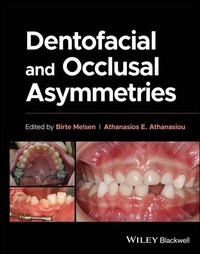
Dentofacial and Occlusal Asymmetries
Description

Comprehensive and accessible resource that covers all crucial aspects of dentofacial and occlusal asymmetries
Dentofacial and Occlusal Asymmetries covers all crucial aspects of asymmetries encountered in the stomatognathic region regarding diagnosis, treatment planning, management, and prognosis. Divided into three core sections, the first part focuses on the etiology of asymmetry and whether it is congenital or acquired through disease or trauma. The second and third sections go on to discuss localization and management, providing information on topics such as interception, correction, and camouflage. Specific sample topics covered in the book include:
- Treatment approaches: interceptive, tooth movements, goal-oriented biomechanics, and jaw repositioning
- Treatment principles: dentofacial orthopedics, camouflage, and orthodontic-surgical treatment
- Localization and problem list: medical and dental history, clinical examination, dental cast analysis, and radiographic/imaging assessment
- Medical, social and psychological aspects: growth disorders and helping children and their families with facial differences
Written by a team of renowned experts in the field, Dentofacial and Occlusal Asymmetries will serve as an invaluable resource to postgraduates in orthodontic, pediatric dentistry, and oral and maxillofacial surgery programs as well as orthodontists, pediatric dentists, pediatricians, and oral and maxillofacial surgeons aiming for optimal results in the diagnosis and management of these complex malocclusions and dentofacial deformities.
More details
Other editions
Additional editions
Persons
Birte Melsen is Visiting Professor of Orthodontics at the College of Dentistry, New York University in the USA and was Professor and Head of Orthodontics at Aarhus University in Denmark.
Athanasios E. Athanasiou is Dean and Professor of Orthodontics at the School of Dentistry, European University Cyprus in Cyprus and Honorary Professor of Orthodontics at Mohammed Bin Rashid University of Medicine and Health Sciences in the UAE. He was Dean, Professor and Head of Orthodontics at the School of Dentistry, Aristotle University of Thessaloniki, Greece.
Content
List of Contributors xiv
1 Introduction 1
Birte Melsen and Athanasios E. Athanasiou
References 3
Part I Etiology 5
2 The Etiology of Dentofacial and Occlusal Asymmetries - An Overview 7
Birte Melsen
Introduction 7
Congenital 7
Postnatally 8
References 14
3 Congenital 15
3.1 Distortion/Malformation 16
Pertti Pirttiniemi
Etiology - Definition 16
Craniosynostosis 16
Plagiocephaly 17
Muscular Torticollis 17
Developmental Dysplasia of the Hip 18
Scoliosis 18
Hemifacial Hyperplasia 18
References 19
3.2 Syndromes and Rare Diseases with Asymmetry in the Craniofacial and Dental Regions 21
Hans Gjørup and Dorte Haubek
Syndromes and Rare Diseases 21
Unilateral Overgrowth of Craniofacial or Dental Structures 22
Unilateral Underdevelopment of Craniofacial or Dental Structures 25
References 33
4 Acquired 37
4.1 Acquired Dentofacial Deformity and Asymmetry 38
Peter B. Stoustrup and Thomas Klit Pedersen
Introduction 39
The Temporomandibular Joint (TMJ) and Its Association with Asymmetric Dentofacial Development 39
Dental Occlusion and Acquired Skeletal and Dental Asymmetries 40
Acquired Dentofacial and Dental Asymmetries 40
Autoimmune Conditions 41
Skeletal Growth Diseases 44
Conditions with Skeletal Undergrowth 44
Conditions with Skeletal Overgrowth 45
Soft-tissue Conditions 46
Temporomandibular Joint (TMJ) Conditions 46
Temporomandibular (TMJ) Disc Displacement (Internal Derangement) 47
Management of Acquired Dentofacial Deformity and Asymmetry 47
Conclusion 50
Acknowledgment 50
References 51
Part II Localization and Problem List 53
5 Examination of Special Features in Patients with Dentofacial and Occlusal Asymmetries 55
Athanasios E. Athanasiou and Birte Melsen
Introduction 55
Head Posture 56
Functional Assessment 58
Photographic Assessment 61
Conclusion 61
References 67
6 Imaging: Craniofacial Asymmetries 69
David C. Hatcher and Vidhya Venkateswaran
Introduction 69
Asymmetry 70
Differential Diagnosis and Decision Tree for a Craniofacial Asymmetry 70
Imaging for Asymmetry 70
Analysis 71
Overall Regional Changes Associated with the Developmental Onset of TMJ Disorders 72
Common Disorders and Associated Local and Regional Changes 74
Conclusions 78
References 81
7 Cephalometric Radiographic Assessment of Facial Asymmetry 82
Guilherme Janson and Aron Aliaga-Del Castillo
Introduction 82
Radiographic Methods for Diagnosis of Asymmetry 82
Concluding Remarks 89
References 89
8 EMG and Ultrasonography of Masticatory Muscles 91
Stavros Kiliaridis
Introduction 91
Understanding the Functional Profile of the Muscle 91
Clinical Methods to Record Masticatory Muscles Functional Capacity 92
Posterior Crossbite with Functional Shift. Effects on Masticatory Muscles? 95
References 96
9 Localization and Problem List - 3-D Face Reconstruction 99
Karine Evangelista, Camila Massaro, Antonio Carlos de Oliveira Ruellas, and Lucia H. Soares Cevidanes
Introduction 99
Facial Asymmetry Diagnosis and Complementary Exams for Facial Asymmetry Localization 100
Image Analysis in CBCT Scans for Skeletal Asymmetry 102
Head Orientation 102
Scroll Through All Cross-Sectional Slices 102
Assessment of the 3D Rendering Viewing from Different Perspectives 104
List of Problems in Skeletal Craniofacial Asymmetries Through 3D Assessment 104
Zygomatic and Maxillary Unilateral Hypertrophy 105
Sinus and Maxillary Hypoplasia 105
Unilateral Condylar Hyperplasia 107
Unilateral Condylar Resorption 109
Craniofacial Macrosomia 110
Asymmetry Localization and Quantification 110
Mirroring and Superimposition 111
Quantification 113
Determining the Asymmetry Directions 114
Final Considerations 114
Acknowledgments 114
References 114
Part III Management 117
10 Treatment Approaches 119
10.1 Very Early Treatment of Dentofacial Asymmetries: Why, When, and How? 120
Ute E.M. Schneider-Moser and Lorenz Moser
Introduction 120
Etiology 121
Diagnostic Evaluation 121
Very Early Treatment for Unilateral Posterior Crossbite with Class I, II, III Malocclusion 123
What if a Class II Subdivision Develops After Early Crossbite Correction? 132
What About Stability of Very Early Crossbite Correction? 141
Summary 141
References 142
10.2 Tooth Movement and Goal-oriented Mechanics in the Treatment of Patients ExhibitingAsymmetry 144
Bhavna Shroff, Steven M. Siegel, Steven J. Lindauer, and Birte Melsen
Introduction 144
Diagnosis - Problem List 145
Molar Rotation (First Order) 147
Molar Tipping (Second Order) 149
Posterior Crossbite (Third Order) 150
Early Loss of Mandibular Deciduous Canines 150
Treatment 152
Correction of Unilateral Molar Rotation 152
Current Mechanics Used to Correct a Class II Subdivision Malocclusion 153
Unilateral Tip-back Mechanics 156
Conclusion 158
References 159
11 Treatment Principles 161
11.1 Dentofacial Orthopedics in the Management of Hemifacial Microsomia and Nager Syndrome Cases 162
Birte Melsen and Athanasios E. Athanasiou
Introduction 162
Case Reports 163
Discussion 171
Conclusion 173
References 173
11.2 Rational Diagnosis and Treatment of Dental Asymmetries 175
Joseph Bouserhal, Nikhillesh Vaiid, Ismaeel Hansa, Zakaria Bentahar, Lea J. Bouserhal, and Philippe J. Bouserhal
Introduction 175
Classification of Dental Asymmetries 176
Diagnosis of Dental Asymmetries 176
Management of Posterior Dental Asymmetries 179
Management of Anterior Dental Asymmetries 181
Conclusions 195
Acknowledgment 195
References 195
12 Orthodontics, Maxillofacial Surgery, and Asymmetries 196
12.1 Dental Arch Shape in Relation to Class II Subdivision Malocclusion 197
Birte Melsen and Padhraig S. Fleming
Introduction 197
Dental Arch Form 197
Case 1 198
Case 2 199
Discussion 199
References 207
12.2 Asymmetric Application of Lingual Arches 208
Kwangchul Choy
Introduction 208
Color Code of the Wire and Force System 209
Shape-driven Concept 209
Force-driven Concept and Definition of Shapes 210
Unilateral Expansion 210
Simulation of Force System 211
Unilateral Tip-back and Unilateral Tip-forward 214
Summary 216
References 219
12.3 Skeletal Anchorage for the Correction of the Canted Occlusal Plane 220
George Anka and Athanasios E. Athanasiou
Treatment of the Canted Occlusal Plane 220
Biomechanics for the Correction of the Canted Occlusal Plane 225
The Trans-Palatal Arch (TPA) Plus Hooks 225
Details of TPA Plus Hooks 231
The Propeller 237
The Ulysses and the Anka-Jorge Plate 240
Extrusion 247
Conclusion 251
References 254
12.4 Managing the Class II Subdivision Malocclusion with Extraction Camouflage: Case Reports 256
Cesare Luzi and Emese Szabò
Introduction 256
Case 1 256
Case 2 259
Conclusions 264
References 268
12.5 The Use of Aligners for Correction of Asymmetries 269
Eugene Chan and M. Ali Darendeliler
Introduction 269
Dental Corrections (Non-extraction Therapies) 270
Dental Corrections (Extraction Therapies) 285
Skeletal Anchorage Therapies 294
Surgical Intervention 309
Conclusions 321
References 328
12.6 TMJ Conditions Causing Facial Asymmetry: Diagnosis and Treatment 329
Larry M. Wolford
Introduction 329
Overdevelopment 329
Unilateral Facial Under-development 335
Adolescent Internal Condylar Resorption (AICR) 336
Reactive Arthritis 338
Trauma 339
TMJ Ankylosis 339
Hemifacial Microsomia (HFM) 341
Connective Tissue/Autoimmune Diseases (CT/AI) 344
References 346
12.7 Distraction Osteogenesis in Maxillofacial Surgery 351
Ioannis Iatrou and Nadia Theologie-Lygidakis
Introduction 351
Biological Basis 351
Staging of Distraction Osteogenesis 352
Indications for Distraction Osteogenesis 352
The Distractors and Their Function 353
Preoperative Patient Evaluation 353
Surgical Procedure 354
Postoperative Procedure - Activation of the Device 358
Complications 359
Orthodontic Collaboration 361
Distraction Osteogenesis and/or Conventional Orthognathic Surgery 362
Conclusion 362
References 362
12.8 Maxillo-mandibular Growth in Hemifacial (or Craniofacial) Microsomia 364
Maria Costanza Meazzini di Seyssel
Introduction - Clinical Appearance 364
Craniofacial Growth in Hemifacial Microsomia 364
Long-term Growth After Distraction Osteogenesis of the Mandible 368
Long-term Results After Costochondral Graft in Growing Patients with Hemifacial Microsomia 368
Clinical and Prognostic Differences in the Orthopedic and Surgical Treatment of Hemimandibular Hypoplasia in Hemifacial Microsomia versus Pseudo-hemifacial Microsomia (or Condylar Coronoid Collapse Deformity) 371
References 377
12.9 Special Treatment Considerations of Face Asymmetries 380
Giampietro Farronato
Introduction 380
Diagnosis 380
Categories of Asymmetry 384
Special Treatment Considerations 393
References 404
12.10 The Vertical Component of Asymmetry: Etiology and Treatment 406
Joseph G. Ghafari
The Three-dimensional Nature of Asymmetry 406
Interaction between Maxillary and Mandibular Asymmetries 407
Unimaxillary Vertical Asymmetry not Affecting the Symmetry of the Other Jaw 411
Conclusion 416
References 416
12.11 Helping Children and Their Families with Facial Differences - Patient Centered Outcomes and Experiences 418
Eleftherios G. Kaklamanos
Introduction 418
The Face as a Functional Structure and as an Element of Identity 419
The Facial Difference from the Patient's Perspective 420
The Facial Difference from the Family Perspective 422
Psychosocial Support for Children and Families 422
References 423
Index 429
1
Introduction
Birte Melsen and Athanasios E. Athanasiou
CHAPTER MENU
Although each person shares with the rest of the population many characteristics, there are enough differences to make each human being a unique individual. Such limitless variation in the size, shape, and relationship of the dental, skeletal, and soft tissue facial structures are important in providing each individual with their identity (Bishara et al. 2001).
Dorland's Medical Dictionary defines symmetry as "the similar arrangement in form and relationships of parts around a common axis or on each side of a plane of the body" (Dorland's Illustrated Medical Dictionary 2000).
The absence of symmetry is asymmetry and is frequently experienced by man in their facial features, both structurally and functionally.
The term symmetry is generally used in two different contexts:
- The first meaning is a precise and well-defined concept of balance or "patterned self-similarity" that can be demonstrated or proved according to the rules of a formal system, namely geometry, physics, or otherwise.
- The second meaning is an imprecise sense of harmonious or esthetically pleasing proportionality and balance reflecting beauty or perfection. As such, symmetry was demonstrated within art by Leonardo Da Vinci in his Vitruvian Man in 1492 (Figure 1.1) (Baudouin and Tiberghien 2004).
Asymmetry has, on the other hand, been part of the features characterizing the unpleasant and the unharmonious (Edler 2001; Rhodes et al. 2001).
Whereas symmetry in art is used to express harmony, beauty, and peace, asymmetrical layouts are generally more dynamic, and by intentionally ignoring balance, the designer can generate tension, express movement, or convey a mood such as anger, excitement, joy, or casual amusement (Komoro et al. 2009).
Facial asymmetry, being a common phenomenon, was probably first observed by the artists of early Greek statuary who recorded what they had found in nature - normal facial asymmetry (Lundstrom 1961).
A perfect facial symmetry is extremely rare and practically all normal faces exhibit a degree of asymmetry (Figure 1.2). As in art, where the side has an importance in the interpretation of a movement displayed on a painting, the two sides of the face may express feelings (Schirillo 2000).
The left side of the face is considered more emotionally expressive and more often connotes more negative emotions than the right side. Also interestingly, artists tend to expose more of their models left cheek than their right. This is significant, in that artists also portray more females than males with their left cheek exposed. These psychological findings lead to explanations for the esthetic leftward bias in portraiture (Schirillo 2000; Powell and Schirillo 2009).
The studies of asymmetry of the craniofacial region can be divided into two categories. One is focusing on facial asymmetry in various populations and its impact on perception of the individual's attractiveness and health. The second category is dealing with the influence of asymmetry on treatment of patients receiving orthodontic treatment or craniofacial surgery.
Studies of various populations belong to the first category, and facial symmetry has been associated with health, physical attractiveness, and beauty of a person. It is also hypothesized as a factor in interpersonal attraction, and relevant research indicates that bilateral symmetry is an important indicator of freedom from disease and worthiness for mating (Edler 2001).
Figure 1.1 Vitruvian Man drawn by Leonardo Da Vinci in 1492 demonstrating the symmetry of the ideal body.
Figure 1.2 Three images where the right face is composed of two right sides, the middle one is the real face, and the left one is composed of two left sides.
Most facial asymmetries among nonpatients are, however, fluctuating meaning that they have no significant influence on the attractiveness of the face. The perception of a face as attractive is more influenced by averageness meaning: what do the persons I like in "my tribe" look like. The beauty ideal is clearly changing with time and between various populations (Rhodes et al. 2001). The impact of averageness was studied by Komoro et al. (2009) who let laypeople evaluate the effect of symmetry and averageness on photographs and found that symmetry had a limited if any influence on attractiveness, thus confirming earlier findings by Baudouin and Tiberghien (2004). In a more recent study, it was found that symmetry on one hand reduced attractiveness by decreasing perceived normality, but on the other hand could also increase attractiveness by promoting the perceived symmetry (Zheng et al. 2021). Furthermore, it has been suggested that completely symmetrical faces might appear unemotional and thus less attractive (Swaddle and Cuthill 1995).
The second category of studies deal with asymmetry in relation to treatment. In reference to the need for treatment, it should be noted that the point at which normal asymmetry becomes abnormal cannot be easily defined and is often determined by the clinician's sense of balance and the patient's perception of the imbalance (Bishara et al. 2001). Minor asymmetry of the craniofacial skeleton and in the dentoalveolar region is often not easily detected. This can be the reason for which the optimal result of an orthodontic treatment cannot be reached since the asymmetry will often interfere with a satisfactory finishing.
The true prevalence of asymmetries in a population has never been described. Methodological limitations related to etiological factors, timing of appearance, degree of severity, progressing characteristics, and individuals' age, have enabled relevant studies only in subgroups of patients with facial asymmetry (i.e. hemofacial microsomia) or dentofacial deformities in university orthodontic clinics.
When studying dentofacial deformity patients at the University of North Carolina, it was found that 34% demonstrated an apparent facial asymmetries. When present, asymmetry affected the upper face in only 5%, the midface (primarily the nose) in 36%, and the chin in 74% (Severt and Proffit 1997).
Recently, Evangelista et al. (2022) performed a review of the prevalence of mandibular asymmetry in different skeletal sagittal patterns and found that there was a significant difference between findings reported from different studies varying from 17.43 to 72.95%, and indicated that the more severe malocclusions exhibited more severe chin deviations than the nonorthodontic population.
Whereas most of the relevant studies have been focusing on facial asymmetry, Sheats et al. (1998) looked into the occlusal status of patients being treated in a graduate clinic and found that in 62% of the patients, the mandibular midline deviated from the facial midline.
An important part of this book will focus on the treatment of patients with various types of facial and dentoalveolar asymmetry focusing on interception, correction, or camouflage. The interception can only be performed for asymmetries related to functional deviations or/and eruption of teeth. Corrections and camouflage in some patients with skeletal asymmetries start at an early age and often continue for the remaining growth period. In adult patients, treatment comprises displacement of teeth and dentoalveolar modeling with goal-oriented biomechanics and orthognathic surgery when needed. For asymmetries with different localization, their etiology and the possible treatment modalities from a biological, biomechanical, and surgical viewpoints will be discussed. In relation to management, generating symmetry is among the goals of most treatment plans. However, when the outcome of orthodontics is assessed, even minor asymmetries are frequently impossible to generate a result that is compatible with ideal morphology and function.
The challenges in dealing with problems related to facial asymmetry are numerous and, to the knowledge of the editors, many of them have not been dealt with systematically. The purpose of this book is to satisfy the need for a comprehensive text on etiology, localization, and treatment of asymmetries within the craniofacial region. It is our hope that this books will cover all aspects of asymmetry starting with localization followed by etiology, congenital, or acquired through disease or trauma. In addition, it is crucial to verify if what is detected is reflecting a static or a developing deviation. Not only the localization and the morphological characteristics are important when categorizing the different types of asymmetries, but also the etiology should be established before a treatment plan can be worked out.
All contributing authors of this publication are prominent colleagues recognized as experts each within their specialization and the assigned subject within face asymmetries. It is our hope that this book will serve as inspiration for the colleague to approach a goal-oriented therapy based on all-inclusive diagnoses, localization of the asymmetry, and the definition of a comprehensive treatment goal.
References
- Baudouin J, Tiberghien G. Symmetry, averageness, and feature size in the facial attractiveness of women. Acta Psychol....
