

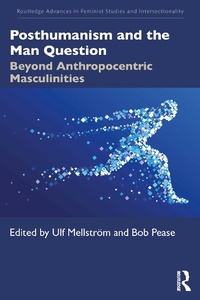
Posthumanism and the Man Question
Beyond Anthropocentric Masculinities
1st Edition
Published on 30. December 2022
260 pages
978-1-000-82429-2 (ISBN)
Description

This book brings together the emerging insights of what posthumanism, new materialism and affect theory mean for 'the man question'. The contributors to this book interrogate the question of how 'Man' as a gendered being is entangled with nature, culture, materiality and corporeality, and they explore ways to unsettle men's sense of sovereignty to decentre anthropocentric masculinity.
Men have to move from the centre of privilege which grants them supremacy before they can open themselves to the decentred, embodied, affective, vulnerable and relational self that is necessary to embrace the posthuman. This book explores the extent to which this is possible.
The book will be of interest to academics, students and scholars across a range of disciplines who are engaging with the intersections of feminist studies with posthumanism and new materialism, especially as they relate to critical studies of men and masculinities. Chapters on fathering, pornography, ageing, affect, embodiment, entanglements with technology and nature and the implications of these issues for changing men and masculinities and the politics of critical masculinity studies' engagement with posthuman feminisms will interest students and academics across these diverse disciplines.
Men have to move from the centre of privilege which grants them supremacy before they can open themselves to the decentred, embodied, affective, vulnerable and relational self that is necessary to embrace the posthuman. This book explores the extent to which this is possible.
The book will be of interest to academics, students and scholars across a range of disciplines who are engaging with the intersections of feminist studies with posthumanism and new materialism, especially as they relate to critical studies of men and masculinities. Chapters on fathering, pornography, ageing, affect, embodiment, entanglements with technology and nature and the implications of these issues for changing men and masculinities and the politics of critical masculinity studies' engagement with posthuman feminisms will interest students and academics across these diverse disciplines.
More details
Series
Edition
1. Auflage
Language
English
Place of publication
London
United Kingdom
Publishing group
Taylor & Francis Ltd
Target group
Professional and scholarly
College/higher education
Illustrations
1 Line drawings, black and white; 5 Halftones, black and white; 6 Illustrations, black and white
ISBN-13
978-1-000-82429-2 (9781000824292)
Copyright in bibliographic data and cover images is held by Nielsen Book Services Limited or by the publishers or by their respective licensors: all rights reserved.
Schweitzer Classification
Other editions
Additional editions
Book
12/2022
1st Edition
Routledge
€60.40
Shipment within 10-20 days
Book
12/2022
1st Edition
Routledge
€207.98
Shipment within 10-20 days
Persons
Ulf Mellstroem is an anthropologist and Professor of Gender Studies at Karlstad University, Sweden. He has published extensively within the areas of masculinity studies, transport and mobility studies, gender and technology, gender, risk and crisis management, engineering studies, globalisation and higher education and South East Asian Studies with a particular focus on Malaysia. He is the founder and editor-in-chief of one of the leading journals dedicated to studies of Men and Masculinities - NORMA: International Journal for Masculinity Studies. His recent book publications include (Forstorp and Mellstroem, 2018) Higher Education, Globalisation and Eduscapes: Towards a Critical Anthropology of a Global Knowledge Society and (Gottzen, Mellstroem and Shefer, 2020) Routledge International Handbook of Masculinity Studies.
Bob Pease is Honorary Professor in the School of Humanities and Social Sciences at Deakin University and Adjunct Professor in the School of Social Sciences at the University of Tasmania. He has published extensively on masculinity politics and critical social work practice, including five books as single author and 15 books as co-editor. His most recent books include Doing Critical Social Work (co-editor, 2016), Men, Masculinities and Disaster (co-editor, 2016), Radicals in Australian Social Work (co-editor, 2017), Critical Ethics of Care in Social Work: Transforming the Politics and Practices of Caring (co-editor, 2018), Facing Patriarchy: From a Violent Gender Order to a Culture of Peace (2019) and Post-Anthropocentric Social Work: Critical Posthuman and New Materialist Perspectives (co-editor, 2021).
Bob Pease is Honorary Professor in the School of Humanities and Social Sciences at Deakin University and Adjunct Professor in the School of Social Sciences at the University of Tasmania. He has published extensively on masculinity politics and critical social work practice, including five books as single author and 15 books as co-editor. His most recent books include Doing Critical Social Work (co-editor, 2016), Men, Masculinities and Disaster (co-editor, 2016), Radicals in Australian Social Work (co-editor, 2017), Critical Ethics of Care in Social Work: Transforming the Politics and Practices of Caring (co-editor, 2018), Facing Patriarchy: From a Violent Gender Order to a Culture of Peace (2019) and Post-Anthropocentric Social Work: Critical Posthuman and New Materialist Perspectives (co-editor, 2021).
Content
1. Introduction: Posthumanism and the Man Question
Part One
Masculinities and Affect: Transgressing the Gendered Emotion Regime
2. The Affective Appeal of Nature for Masculinist Discourse
3. Masculinities Taking Shape: Affect, Posthumanism, Forms
4. Around and Around: Affective Masculinity in Circulation
5. Unsettling Masculinities Through Affect: Philip Roth's Everyman and The Nemesis of Old Age
Part Two
Anthropocentric Masculinities and Entanglements with Bodies, Nature and Technology
6. Boys' Brains on Porn: Affect, Addiction and Cerebral Subjectivity
7. "Confront[ing] the Suspicion" and "Embodied Embedded": New Materialism, Relational Ontologies and Fathering Bodies
8. Challenging Patriarchal, Colonial Patronage in Anthropocentric Engagement with 'Nature Conservation': Narratives of White Male Game Rangers in Southern Africa
9. Emancipation, Connection and Vulnerabilities Among Bodaboda Men in Kampala: New Materialist Perspectives on the Effects of Infrastructural Limits
10. Destabilising Male Privilege: Explorations of the Posthuman in Mary Shelley's Frankenstein (1818) and Jeannette Winterson's Frankisstein (2019)
Part Three
Conversations Between Critical Studies of Men and Masculinities and Feminist Engagements with Posthumanism
11. Embrace or Engagement:? Critical Studies of Men and Masculinities (CSMM) and Feminist Posthumanism/New Materialism
12. Materialism, New Materialism and Critical Studies of Men and Masculinities (CSMM) Looking Back and Looking Forward, Relationally
13. Are Posthumanism and Relational Ontologies Necessarily Emancipatory for Masculinity Studies?
Part Four
Posthuman and New Materialist Ontologies of Becoming for Men
14. Toward Non-Sovereign Masculinities: Complexity, Nature, and New Materialisms
15. Under Construction: Masculinities as a Continuous Process of Assembly and Renovation
16. Postgender Ecological Futures: From Ecological Feminisms and Ecological Masculinities to Queered Posthuman Subjectivities
17. Men Becoming Otherwise: Lines of Flight from 'Man' and Majoritarian Masculinity
Afterword
Part One
Masculinities and Affect: Transgressing the Gendered Emotion Regime
2. The Affective Appeal of Nature for Masculinist Discourse
3. Masculinities Taking Shape: Affect, Posthumanism, Forms
4. Around and Around: Affective Masculinity in Circulation
5. Unsettling Masculinities Through Affect: Philip Roth's Everyman and The Nemesis of Old Age
Part Two
Anthropocentric Masculinities and Entanglements with Bodies, Nature and Technology
6. Boys' Brains on Porn: Affect, Addiction and Cerebral Subjectivity
7. "Confront[ing] the Suspicion" and "Embodied Embedded": New Materialism, Relational Ontologies and Fathering Bodies
8. Challenging Patriarchal, Colonial Patronage in Anthropocentric Engagement with 'Nature Conservation': Narratives of White Male Game Rangers in Southern Africa
9. Emancipation, Connection and Vulnerabilities Among Bodaboda Men in Kampala: New Materialist Perspectives on the Effects of Infrastructural Limits
10. Destabilising Male Privilege: Explorations of the Posthuman in Mary Shelley's Frankenstein (1818) and Jeannette Winterson's Frankisstein (2019)
Part Three
Conversations Between Critical Studies of Men and Masculinities and Feminist Engagements with Posthumanism
11. Embrace or Engagement:? Critical Studies of Men and Masculinities (CSMM) and Feminist Posthumanism/New Materialism
12. Materialism, New Materialism and Critical Studies of Men and Masculinities (CSMM) Looking Back and Looking Forward, Relationally
13. Are Posthumanism and Relational Ontologies Necessarily Emancipatory for Masculinity Studies?
Part Four
Posthuman and New Materialist Ontologies of Becoming for Men
14. Toward Non-Sovereign Masculinities: Complexity, Nature, and New Materialisms
15. Under Construction: Masculinities as a Continuous Process of Assembly and Renovation
16. Postgender Ecological Futures: From Ecological Feminisms and Ecological Masculinities to Queered Posthuman Subjectivities
17. Men Becoming Otherwise: Lines of Flight from 'Man' and Majoritarian Masculinity
Afterword
