

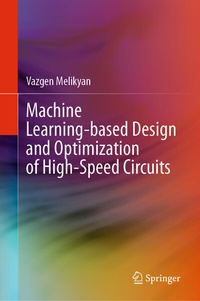
Machine Learning-based Design and Optimization of High-Speed Circuits
Description

This book describes machine learning-based new principles, methods of design and optimization of high-speed integrated circuits, included in one electronic system, which can exchange information between each other up to 128/256/512 Gbps speed. The efficiency of methods has been proven and is described on the examples of practical designs. This will enable readers to use them in similar electronic system designs. The author demonstrates newly developed principles and methods to accelerate communication between ICs, working in non-standard operating conditions, considering signal deviation compensation with linearity self-calibration. The observed circuit types also include but are not limited to mixed-signal, high performance heterogeneous integrated circuits as well as digital cores.
More details
Other editions
Additional editions
Person
Dr. Vazgen Melikyan - Director of Educational Department
Vazgen joined Synopsys in 2004 as Director of Educational Department and is the Head since its establishment. Vazgen holds BS from Yerevan Polytechnic Institute, Ph.D. from Moscow Engineering-Physics Institute, Sc.D. and full Professor from National Polytechnic University of Armenia, Corresponding Member of National Academy of Sciences of Armenia. Vazgen is a member of Program Committee or Head of sessions in various international scientific conferences, Head of Boards in defenses of dissertations. He is the author of 12 monographs, more than 350 scientific and 135 methodical publications, more than 150 courses, had more than 190 reports in international conferences. 72 PhD dissertations have been carried out and successfully defended under his supervision. In addition, he is the President of Program Committee of Annual International Microelectronics Olympiad of Armenia, Head of Armenia's Presidential Award Committee in the sector of science and technology, Executive Secretary of Educational Awards of Armenia in IT sector. Vazgen has been conferred various awards and prizes, including the title of Honorable Scientist of the Republic of Armenia, "President of the Republic Prize" in "Technical Sciences and Information Technologies", "Best Paper" Awards in various international conferences, he is Honorable professor of several universities, including National Research University MIET and European Academy of Armenia.
Content
Introduction.- Means to accelerate transfer of information between integrated circuits.- Design methods of integrated circuits, working under non-standard operating conditions.- Signal transmittance adjustment systems in integrated circuits.- Methods to improve linearity of signal's analog-to-digital conversion with self-calibration.- Design of high performance heterogenous integrated circuits.- 6 Design of digital integrated circuits by improving the characteristics of digital cells.
