

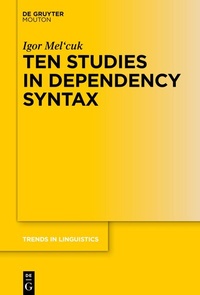
Ten Studies in Dependency Syntax
1st Edition
Published on 10. May 2021
XIV, 444 pages
978-3-11-069481-9 (ISBN)
Description

The monograph presents the Meaning-Text approach applied to the domain of syntax from a typological angle; it deals with several long-standing syntactic problems on the basis of a dependency description.
Its content can be presented in five parts + an Introduction:
The Introduction explains the architecture of the book and sketches the Meaning-Text linguis-tic model, underlying the subsequent discussion.
I. Surface-syntactic relations in the languages of the world, with special studies of subjects and objects.
II. Grammatical voice in the dependency framework: the "passive" construction in Chinese.
III. The relative clause: a calculus and analysis of possible types; the pseudo-relative ("headless") clause.
IV. Binary conjunctions (such as IF ., THEN .), free indefinite pronouns ([He went] nobody knows where), and syntactic idioms.
V. Word order: linearization of dependency structures.
The monograph offers a new perspective in syntactic studies. It is strongly typology-oriented (using the data from typologically diverse languages: English, Russian, Chinese, Korean, Basque, Georgian, etc.) and based on a system of rigorous definitions of the notions involved, which ensures a link with computational linguistics and Natural Language Processing
Its content can be presented in five parts + an Introduction:
The Introduction explains the architecture of the book and sketches the Meaning-Text linguis-tic model, underlying the subsequent discussion.
I. Surface-syntactic relations in the languages of the world, with special studies of subjects and objects.
II. Grammatical voice in the dependency framework: the "passive" construction in Chinese.
III. The relative clause: a calculus and analysis of possible types; the pseudo-relative ("headless") clause.
IV. Binary conjunctions (such as IF ., THEN .), free indefinite pronouns ([He went] nobody knows where), and syntactic idioms.
V. Word order: linearization of dependency structures.
The monograph offers a new perspective in syntactic studies. It is strongly typology-oriented (using the data from typologically diverse languages: English, Russian, Chinese, Korean, Basque, Georgian, etc.) and based on a system of rigorous definitions of the notions involved, which ensures a link with computational linguistics and Natural Language Processing
More details
Series
Language
English
Place of publication
Berlin/Boston
Publishing group
de Gruyter Mouton
Target group
Professional and scholarly
Illustrations
20 s/w Tabellen, 15 s/w Abbildungen, 5 farbige Abbildungen
15 b/w and 5 col. ill., 20 b/w tbl.
File size
17,49 MB
ISBN-13
978-3-11-069481-9 (9783110694819)
Schweitzer Classification
Other editions
Additional editions
Igor Mel'cuk
Ten Studies in Dependency Syntax
Book
04/2025
1st Edition
De Gruyter Mouton
€189.95
Shipment within 7-9 days
Igor Mel'cuk
Ten Studies in Dependency Syntax
Book
12/2022
1st Edition
De Gruyter Mouton
€29.95
Shipment within 7-9 days
Igor Mel'cuk
Ten Studies in Dependency Syntax
E-Book
05/2021
1st Edition
De Gruyter Mouton
€189.95
Available for download
Person
Igor Mel'cuk
, Observatoire de linguistique Sens-Texte, Dept. of Linguistics and Translation, University of Montreal, Canada.
