

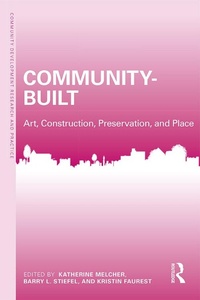
Community-Built
Art, Construction, Preservation, and Place
Published on 25. November 2016
238 pages
978-1-134-82329-1 (ISBN)
Description

Throughout history and around the world, community members have come together to build places, be it settlers constructing log cabins in nineteenth-century Canada, an artist group creating a waterfront gathering place along the Danube in Budapest, or residents helping revive small-town main streets in the United States. What all these projects have in common is that they involve local volunteers in the construction of public and community places; they are community-built.
Although much attention has been given to specific community-built movements such as public murals and community gardens, little has been given to defining community-built as a whole. This volume provides a preliminary description of community-built practices with examples from the disciplines of urban design, historic preservation, and community art.
Taken as a whole, these community-built projects illustrate how the process of local involvement in adapting, building, and preserving a built environment can strengthen communities and create places that are intimately tied to local needs, culture, and community. The lessons learned from this volume can provide community planners, grassroots facilitators, and participants with an understanding of what can lead to successful community-built art, construction, preservation, and placemaking.
Although much attention has been given to specific community-built movements such as public murals and community gardens, little has been given to defining community-built as a whole. This volume provides a preliminary description of community-built practices with examples from the disciplines of urban design, historic preservation, and community art.
Taken as a whole, these community-built projects illustrate how the process of local involvement in adapting, building, and preserving a built environment can strengthen communities and create places that are intimately tied to local needs, culture, and community. The lessons learned from this volume can provide community planners, grassroots facilitators, and participants with an understanding of what can lead to successful community-built art, construction, preservation, and placemaking.
More details
Series
Language
English
Place of publication
London
United Kingdom
Publishing group
Taylor & Francis Ltd
Target group
College/higher education
Professional and scholarly
Product notice
Reflowable
Illustrations
1 Tables, black and white; 4 Line drawings, black and white; 52 Halftones, black and white
File size
7,05 MB
ISBN-13
978-1-134-82329-1 (9781134823291)
Copyright in bibliographic data and cover images is held by Nielsen Book Services Limited or by the publishers or by their respective licensors: all rights reserved.
Schweitzer Classification
Other editions
Additional editions
Katherine Melcher | Barry Stiefel | Kristin Faurest
Community-Built
Art, Construction, Preservation, and Place
Book
12/2016
1st Edition
Routledge
€297.61
Shipment within 10-20 days
Katherine Melcher | Barry Stiefel | Kristin Faurest
Community-Built
Art, Construction, Preservation, and Place
Book
12/2016
1st Edition
Routledge
€83.50
Shipment within 10-20 days
Persons
Katherine Melcher is an Associate Professor of Landscape Architecture at the University of Georgia's College of Environment and Design, U.S. Her research focuses on the interaction between design and community development-in particular, participatory processes in the design of community spaces. Her design work has been featured in Landscape Architecture, Designer/Builder, 1000x Landscape Architecture, and Architecture for Change.
Barry L. Stiefel is an Associate Professor in the Historic Preservation and Communty Planning program at the College of Charleston, U.S. He is interested in how the sum of how local preservation efforts affects regional, national, and multi-national policies within the field of cultural resource management and heritage conservation. Dr. Stiefel has published numerous books and articles.
Kristin Faurest worked as an Associate Professor in the Faculty of Landscape Architecture, Corvinus University of Budapest, Hungary, where she taught and researched in the areas of community-based planning, social justice in spatial planning, and the connections between culture and landscape. Last year she returned to her native U.S. to direct the Portland Japanese Garden's new International Institute for Japanese Garden Arts and Culture in Portland, Oregon.
Barry L. Stiefel is an Associate Professor in the Historic Preservation and Communty Planning program at the College of Charleston, U.S. He is interested in how the sum of how local preservation efforts affects regional, national, and multi-national policies within the field of cultural resource management and heritage conservation. Dr. Stiefel has published numerous books and articles.
Kristin Faurest worked as an Associate Professor in the Faculty of Landscape Architecture, Corvinus University of Budapest, Hungary, where she taught and researched in the areas of community-based planning, social justice in spatial planning, and the connections between culture and landscape. Last year she returned to her native U.S. to direct the Portland Japanese Garden's new International Institute for Japanese Garden Arts and Culture in Portland, Oregon.
Content
Introduction: Defining Community-Built
by Barry L. Stiefel, Kristin Faurest, and Katherine Melcher
Part I: Participation and Empowerment
Community-Built as a Professional Practice
by Katherine Melcher
Kalaka: Four Stories about Community Building in a New Democracy
by Kristin Faurest
Reflections on Community Engagement: Making Meaning of Experience
by Terry L. Clements and C.L. Bohannon
Impacts of Participatory Mural Making on Youth Empowerment
by Tiva Lasiter
Part II: Culture and Identity
Community Eruvin: Architecture for Semi-Public/Private Neighborhood Space
by Barry L. Stiefel
Community-Built and Preserved Material Culture: Square-log Cabins in the Village of Mont-Tremblant, Quebec
by Mariana Esponda Cascajares
Constructing and Preserving History Through Community Art Projects
by Anastasia L. Pratt
Yellow Star Houses: a Community Generated Living History Project in Budapest
by Ildiko Reka Bathory-Nagy
Part III: Local Control of Place
Building Informal Infrastructures: Architects in Support of Bottom-up Community Services and Social Solidarity in Budapest
by Daniela Patti and Levente Polyak
The Main Street Approach to Community Design
by Jeremy C. Wells
Building Streets and Building Community
by Katherine Melcher
Conclusion: Valuing Community-Built
by Kristin Faurest, Barry L. Stiefel, and Katherine Melcher
List of Contributors
by Barry L. Stiefel, Kristin Faurest, and Katherine Melcher
Part I: Participation and Empowerment
Community-Built as a Professional Practice
by Katherine Melcher
Kalaka: Four Stories about Community Building in a New Democracy
by Kristin Faurest
Reflections on Community Engagement: Making Meaning of Experience
by Terry L. Clements and C.L. Bohannon
Impacts of Participatory Mural Making on Youth Empowerment
by Tiva Lasiter
Part II: Culture and Identity
Community Eruvin: Architecture for Semi-Public/Private Neighborhood Space
by Barry L. Stiefel
Community-Built and Preserved Material Culture: Square-log Cabins in the Village of Mont-Tremblant, Quebec
by Mariana Esponda Cascajares
Constructing and Preserving History Through Community Art Projects
by Anastasia L. Pratt
Yellow Star Houses: a Community Generated Living History Project in Budapest
by Ildiko Reka Bathory-Nagy
Part III: Local Control of Place
Building Informal Infrastructures: Architects in Support of Bottom-up Community Services and Social Solidarity in Budapest
by Daniela Patti and Levente Polyak
The Main Street Approach to Community Design
by Jeremy C. Wells
Building Streets and Building Community
by Katherine Melcher
Conclusion: Valuing Community-Built
by Kristin Faurest, Barry L. Stiefel, and Katherine Melcher
List of Contributors
