

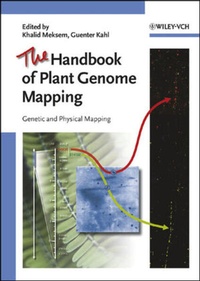
The Handbook of Plant Genome Mapping
Genetic and Physical Mapping
1st Edition
Published on 6. March 2006
XXII, 380 pages
978-3-527-60443-2 (ISBN)
Description

While the complete sequencing of the genomes of model organisms such as a multitude of bacteria and archaea, the yeast Saccharomyces cerevisiae, the worm Caenorhabditis elegans, the fly Drosophila melanogaster, and the mouse and human genomes have received much public attention, the deciphering of plant genomeswas greatly lagging behind. Up to now, only two plant genomes, one of the model plant Arabidopsis thaliana and one of the crop species rice (Oryza sativa) have been sequenced, though a series of other crop genome sequencing projects are underway. Notwithstanding this public bias towards genomics of animals and humans, it is nevertheless of great importance for basic and applied sciences and industries in such diverse fields as agriculture, breeding in particular, evolutionary genetics, biotechnology, and food science to know the composition of crop plant genomes in detail. It is equally crucial for a deeper understanding of the molecular basis of biodiversity and synteny.
The Handbook of Genome Mapping: Genetic and Physical Mapping is the first book on the market to cover these hot topics in considerable detail, and is set apart by its combination of genetic and physical mapping. Throughout, each chapter begins with an easy-to-read introduction, also making the book the first reference designed for non-specialists and newcomers, too.
In addition to being an outstanding bench work reference, the book is an excellent textbook for learning and teaching genomics, in particular for courses on genome mapping. It also serves as an up-to-date guide for seasoned researchers involved in the genetic and physical mapping of genomes, especially plant genomes.
The Handbook of Genome Mapping: Genetic and Physical Mapping is the first book on the market to cover these hot topics in considerable detail, and is set apart by its combination of genetic and physical mapping. Throughout, each chapter begins with an easy-to-read introduction, also making the book the first reference designed for non-specialists and newcomers, too.
In addition to being an outstanding bench work reference, the book is an excellent textbook for learning and teaching genomics, in particular for courses on genome mapping. It also serves as an up-to-date guide for seasoned researchers involved in the genetic and physical mapping of genomes, especially plant genomes.
Reviews / Votes
"...Written by various authors, the text is competently edited, and the figures contribute to understandig. Therfore, I can highly recommend this book for genetic libraries and for everybody teaching this topic and/or working in this field."Journal of Plant Physiology, 164/6
More details
Other editions
Additional editions
Book
02/2005
1st Edition
Wiley-Blackwell
€229.00
Article exhausted; check different version
Persons
Khalid Meksem is Assistant Professor at the Department of Plant, Soil & General Agriculture of Southern Illinois University. After gaining his doctorate at the University of Cologne, Germany, he joined Southern Illinois University at the end of 1996. Dr. Meksem has taught courses on genomics and bioinformatics, as well as molecular genetics. His main research interests focus on
-Genomics tools for soybean: TILLING, developing high throughput tool for gene functional analysis and reverse genetics.
-BAC and physical mapping: physical map construction and integration
-Soybean Cyst Nematode disease resistance genes: Genetic diversity, additional genes for resistance and resistance pathways
-Plant pathogen genomics: Fusarium virguliforme structural and functional genomics, pathogenicity genes identification
-Developing international and national scientific network on structural genomics in plants (Comparative physical mapping) and functional genomics (TILLING)
Alongside registering four patents so far, Khalid Meksem is the associate editor of the Journal of Biomedicine and Biotechnology and a reviewer for a number of International Scientific Journals. He chaired the Functional genomic workshop at the International Plant & Animal Genome Conference in San Diego, and works as a reviewer for several granting agencies, including the National Science Foundation and the US Department of Agriculture.
Günter Kahl is Professor for Plant Molecular Biology at Johann Wolfgang Goethe University, Frankfurt am Main, Germany. After gaining his Ph.D. in plant biochemistry, he spent two postdoctoral years at Michigan State University, East Lansing, USA, joining Professor Joe Varner and Professor James Bonner at the California Institute of Technology, Pasadena. His main research interests focus on
-Gene technology, in particular the genetic and physical mapping as well as the isolation and characterization of plant defence genes and their promoters, and the use of in vitro modified defence genes for the improvement of plant crops via gene transfer.
-Plant genome analysis, in particular the development of molecular marker technologies and informative DNA markers for genomic fingerprinting, the establishment of genetic maps, the use of BAC libraries and physical mapping, and the map-based cloning of agronomically important genes.
-Expression profiling of plant tissues with expression microarrays and high-throughput techniques such as SAGE.
Due to the international nature of this work, Professor Kahl cooperates with a series of research institutions throughout Europe, in Japan, the USA, Syria, India, and South America. In addition, he is currently organizing a series of molecular marker courses in Austria, South America, Asia, Africa and the Middle East. He has also served in expert missions for IAEA, FAO and UNESCO in these and many other countries.
Professor Kahl is the author of more than 250 scientific publications, and is currently CSO at GenXPro, a company specializing in novel technologies in genomics and transcriptomics, located at the Frankfurt Innovation Center for Biotechnology (FIZ), Frankfurt am Main, Germany.
-Genomics tools for soybean: TILLING, developing high throughput tool for gene functional analysis and reverse genetics.
-BAC and physical mapping: physical map construction and integration
-Soybean Cyst Nematode disease resistance genes: Genetic diversity, additional genes for resistance and resistance pathways
-Plant pathogen genomics: Fusarium virguliforme structural and functional genomics, pathogenicity genes identification
-Developing international and national scientific network on structural genomics in plants (Comparative physical mapping) and functional genomics (TILLING)
Alongside registering four patents so far, Khalid Meksem is the associate editor of the Journal of Biomedicine and Biotechnology and a reviewer for a number of International Scientific Journals. He chaired the Functional genomic workshop at the International Plant & Animal Genome Conference in San Diego, and works as a reviewer for several granting agencies, including the National Science Foundation and the US Department of Agriculture.
Günter Kahl is Professor for Plant Molecular Biology at Johann Wolfgang Goethe University, Frankfurt am Main, Germany. After gaining his Ph.D. in plant biochemistry, he spent two postdoctoral years at Michigan State University, East Lansing, USA, joining Professor Joe Varner and Professor James Bonner at the California Institute of Technology, Pasadena. His main research interests focus on
-Gene technology, in particular the genetic and physical mapping as well as the isolation and characterization of plant defence genes and their promoters, and the use of in vitro modified defence genes for the improvement of plant crops via gene transfer.
-Plant genome analysis, in particular the development of molecular marker technologies and informative DNA markers for genomic fingerprinting, the establishment of genetic maps, the use of BAC libraries and physical mapping, and the map-based cloning of agronomically important genes.
-Expression profiling of plant tissues with expression microarrays and high-throughput techniques such as SAGE.
Due to the international nature of this work, Professor Kahl cooperates with a series of research institutions throughout Europe, in Japan, the USA, Syria, India, and South America. In addition, he is currently organizing a series of molecular marker courses in Austria, South America, Asia, Africa and the Middle East. He has also served in expert missions for IAEA, FAO and UNESCO in these and many other countries.
Professor Kahl is the author of more than 250 scientific publications, and is currently CSO at GenXPro, a company specializing in novel technologies in genomics and transcriptomics, located at the Frankfurt Innovation Center for Biotechnology (FIZ), Frankfurt am Main, Germany.
Content
Part I: Genetic Mapping
Mapping Populations and Principles of Genetic Mapping
Molecular Marker Systems for Genetic Mapping
Methods and Software for Genetic Mapping
Single Nucleotide Polymorphisms (SNPs): The detection techniques and their potential
Breeding By Design: Exploiting genetic maps and molecular markers through Marker assisted Selection
PART II: Physical Mapping
Physical Mapping of Plant Chromosomes.
Chromosome Flow Sorting and Physical Mapping
Genomic DNA Libraries and Physical Mapping
Integration of Physical and Genetic Maps
Positional Cloning of Plant Developmental Genes
Whole Genome Physical Mapping: An overview on methods for fingerprinting
Software for Restriction Fragment Physical Maps
Reduced Representation Strategies and Their Application to Plant Genomes
Large Scale DNA Sequencing
Mapping Populations and Principles of Genetic Mapping
Molecular Marker Systems for Genetic Mapping
Methods and Software for Genetic Mapping
Single Nucleotide Polymorphisms (SNPs): The detection techniques and their potential
Breeding By Design: Exploiting genetic maps and molecular markers through Marker assisted Selection
PART II: Physical Mapping
Physical Mapping of Plant Chromosomes.
Chromosome Flow Sorting and Physical Mapping
Genomic DNA Libraries and Physical Mapping
Integration of Physical and Genetic Maps
Positional Cloning of Plant Developmental Genes
Whole Genome Physical Mapping: An overview on methods for fingerprinting
Software for Restriction Fragment Physical Maps
Reduced Representation Strategies and Their Application to Plant Genomes
Large Scale DNA Sequencing
