

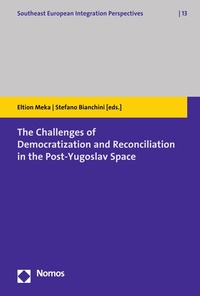
The Challenges of Democratization and Reconciliation in the Post-Yugoslav Space
1st Edition
Published on 14. October 2020
295 pages
978-3-7489-2151-6 (ISBN)
Description

Die Beiträge in diesem Buch analysieren die Herausforderungen in Post-Jugoslawien bezüglich Demokratisierung, Anerkennung und Versöhnung im Rahmen der europäischen Integration. Sie verfolgen einen interdisziplinären Ansatz, indem sie Probleme und Herausforderungen aus verschiedenen Blickwinkeln betrachten, und führen diese erstmals gezielt in einem einzigen Werk zu dieser Region zusammen. Das Buch richtet sich dabei sowohl an Studierende als auch an Wissenschaftler und Forscher, die einen fundierten Zugang zu Post-Jugoslawien erhalten möchten.
More details
Other editions
Additional editions
Eltion Meka | Stefano Bianchini
The Challenges of Democratization and Reconciliation in the Post-Yugoslav Space
Book
10/2020
1st Edition
Nomos
€64.00
Shipment within 7-9 days
Content
- Cover
- Introduction
- Introduction
- A crucial background: why post-socialist transition was replaced by State partition in the Yugoslav federation?
- Why Democratization and Reconciliation?
- Theoretical Underpinnings
- Structure of the Book
- Section 1
- Section 2
- Conclusion
- Questions for students:
- References
- Section 1: Understanding the dilemmas of the post-Yugoslav Space
- Chapter 1: The Search for Meaning and Identity: Nation- and State-Building in the Western Balkans
- Introduction
- Conceptual Framework
- Croatia
- Bosnia and Herzegovina
- Serbia
- Montenegro
- Kosovo
- North Macedonia
- Albania
- Conclusion
- Questions for students:
- References
- Chapter 2: Understanding Democracy
- Introduction
- Historical, philosophical, and political origins of modern democracy
- The concept and meaning of democracy
- Scope and criteria of a democracy
- Importance of political participation
- Preconditions of substantive democracy
- a) Institutional-political preconditions
- b) Socioeconomic and sociostructural preconditions
- c) Sociocultural preconditions
- Conclusion
- Questions for students:
- References
- Chapter 3: The Role of Deliberative and Participatory Democracy in Promoting Reconciliation
- Introduction
- Deliberative and Participatory Models
- Reconciliation and the Citizen
- Democracy and the Citizen
- Rights, Privileges and Duties
- Conclusion
- Questions for students:
- References
- Chapter 4: The role of European integration in the Western Balkans
- Introduction
- Linking Democracy and Reconciliation
- Promoting Democracy and Democratic Values
- Democracy Promotion Through Enlargement
- The EU in the WB
- Conclusion
- Questions for students:
- References
- Chapter 5: Imported Democracy And Its Fragility Without Reconciliation
- The Background: Communist decline and democratic challenges at the end of the 20th century
- The EU and the Western Balkans
- The prospect of integration: can the EU pattern be emulated?
- The main challenges for reconciliation in the Western Balkans
- Conclusion
- Questions for students:
- References
- Section 2: Achieving Democracy and Reconciliation: Controversial paths?
- Chapter 6: Sources and Continuities of Ethno-religious Nationalism in the Western Balkans
- Introduction
- Balkans between two world wars
- Serbian Nationalism
- Albanian Nationalism
- Communism and Nationalism
- Dismemberment of Yugoslavia
- Conclusion
- Questions for students:
- References
- Chapter 7: Justice and Reconciliation: Some Experiences from the ICTY and South Africa
- Introduction
- Justice and Reconciliation in the Western Balkans
- Creation of the ICTY
- What is justice?
- Investigation strategy at the ICTY
- Who is most responsible?
- Checks and balances
- Criticism of the investigation strategy
- Summary of cases finalized at the ICTY
- What about Reconciliation?
- Justice and Reconciliation in South Africa
- Goldstone Commission
- The Truth and Reconciliation Commission
- Was Reconciliation achieved?
- Lessons Learnt from the ICTY and South Africa
- Questions for students:
- References
- Chapter 8: Borders and Boundaries as Obstacles to Reconciliation
- Historical Overview
- Contemporary view of Border and Boundaries
- Borders as Territorial Constructions
- Borders as Identity Demarcations
- Borders as Institutions
- Towards Regional and Cross-Border Cooperation: Bosnia and Herzegovina and Western Balkans
- Conclusion
- Questions for students:
- References
- Chapter 9: Intellectuals between radicalization and reconciliation in the Western Balkans
- Introduction: Who are intellectuals?
- Intellectuals in the Service of National Conflicts
- Conflictual action of intellectuals in Yugoslavia
- The Memorandum of SASA and the Slovenian Memorandum
- Anti-Nationalist Action of Intellectuals
- The Belgrade Circle and the Circle 99
- The Dialogue of Historians
- Declaration on the Common Language
- Conclusion
- Questions for students:
- References
- Chapter 10: Minorities and reconciliation in the Western Balkans
- Minorities, cultural rights, and intergroup relations in the Western Balkans
- Granting stability in deeply (ethnically) divided societies: is power sharing the answer?
- Cultural rights: Use of minority languages in education
- Approaches to ethnic conflict transformation in deeply divided societies: overcoming consociational limits through deliberative practices
- Deliberation and Ethnic Conflict Management
- Conclusion
- Questions for students:
- References
- Chapter 11: Variety and effects of human mobility: "intra", "extra", and "crossing" flows in the region and the democratization process
- Introduction
- The relation between migration and democratization: theoretical reflections
- A region defined by mobility
- Internal mobility
- Regional mobility
- External mobility
- Third-country mobility crossing the region
- Mobility and democratization
- Conclusion
- Questions for students:
- References
- Afterword
- Further readings:
- List of authors
- Index
