

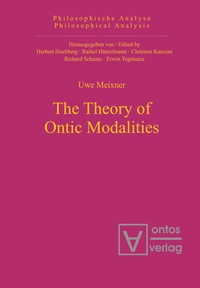
The Theory of Ontic Modalities
Description

This book presents a comprehensive, non-model-theoretic theory of ontic necessity and possibility within a formal (and formalized) ontology consisting of states of affairs, properties, and individuals. Its central thesis is that all modalities are reducible to intrinsic (or "logical") possibility and necessity if reference is made to certain states of affairs, called "bases of necessity." The viability of this Bases-Theory of Modality is shown also in the case of conditionals, including counterfactual conditionals. Besides the ontological aspects of the philosophy of modality, also the epistemology of modality is treated in the book. It is shown that the Bases-Theory of Modality provides a satisfactory solution to the epistemological problem of modality. In addition to developing that theory, the book includes detailed discussions of positions in the philosophy of modality maintained by Alvin Plantinga, David Lewis, Charles Chihara, Graeme Forbes, David Armstrong, and others. Among the themes treated are: possibilism vs. actualism; the theory of essences; conceivability and possibility; the nature of possible worlds; the nature of logical, nomological, and metaphysical possibility and necessity.
More details
Other editions
Additional editions
Content
2 - Contents [Seite 9]
3 - 1 The Problem of Ontic Modalities [Seite 12]
4 - 2 Actualism, Modal Realism, andModal Epistemology [Seite 30]
5 - 3 An Onto-Nomological Theory ofModality [Seite 66]
6 - 4 States of Affairs, Modality,and the Bases-Theory of Necessity [Seite 108]
7 - 5 The Theory of Conditionalsin the Onto-Nomological Theoryof Modality [Seite 162]
8 - 6 Other Theories of Conditionalsversus the Bases-Theoryof Conditionals [Seite 210]
9 - 7 The Onto-Nomological Theoryof Modality Extended:Adding Properties and Individuals [Seite 252]
10 - 8 Properties, Essences,and Actualism (Again) [Seite 312]
11 - Bibliography [Seite 365]
12 - Index [Seite 369]
