

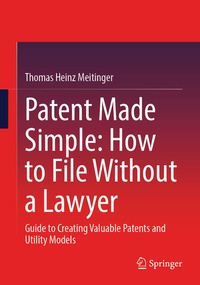
Patent Made Simple: How to File Without a Lawyer
Description

This technical book is designed to help you prepare patent or utility model applications on your own. It explains the required components of an application and provides suggested wording. Numerous practical examples offer additional guidance. The structure of the book follows the recommended process for drafting an application.
First, it describes how to present the state of the art in the application. The state of the art represents the starting point for the creation of the invention. By examining the state of the art, the inventor identifies shortcomings that lead to the invention. These shortcomings define the objective of the invention. This development process of the invention must be reflected in the application.
The next step in drafting the application is a description of the various embodiments of the invention. Finally, the claims are formulated. This sequence has the advantage that the most challenging step-drafting the claims-comes last. By this point, the inventor has a thorough understanding of the different aspects of the invention, which makes writing the claims significantly easier.
More details
Other editions
Additional editions
Person
Dr. Thomas Heinz Meitinger is a German and European patent attorney. After studying electrical engineering in Karlsruhe, he initially worked as a development engineer. Later positions included roles as production manager and technical director in medium-sized companies. Dr. Meitinger regularly publishes scientific articles, writes specialist books on intellectual property law and technical topics, and gives lectures on patent, utility model, trademark, and design law. Dr. Meitinger holds the degrees Dipl.-Ing. (Univ.) and Dipl.-Wirtsch.-Ing. (FH). In addition, he has earned the following master's degrees: LL.M., LL.M., MBA, MBA, M.A., and M.Sc.
Content
Introduction - Why a patent or utility model?.- Timelines - General formal requirements.- Components of an application.- Introductory part of the description.- Drawings - Description of the drawings - Claims.- Public information: the abstract.- Application forms.- Search for prior art.- Employee inventions.- Joint inventorship.- Utility model.- German patent.- European patent - International patent application.- Responding to an official communication.- Template for a patent application.- Template for a response to an official communication.
