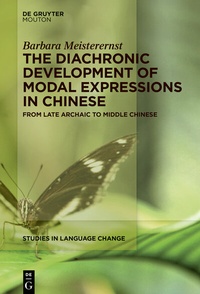
The Diachronic Development of Modal Expressions in Chinese
Description

The present study is the first to apply a syntactic approach to the grammaticalization of Chinese modals, based on hypotheses on cross-linguistic diachronic developments of modals from lexical to functional categories as upward movement on a functional spine. The temporal framework of the study covers Late Archaic and Middle Chinese. Early Middle Chinese is a crucial turning point for the development of Chinese from a more synthetic to a more analytic language. This change is attributed e.g. to the loss of a former morphology, which also affects the modal system. Against this background, the negative cycle of Chinese, the relevance of polarity contexts, and the development of a new system of deontic, epistemic and future markers are analyzed.
In addition to a comprehensive analysis of the syntactic processes involved in the diachronic changes of the Chinese modal system, the study also provides a comparison with the syntax of grammaticalization of the thoroughly discussed Germanic modals. This constitutes a broad basis for further analyses of the changes in the Chinese language during its long written history, but also for cross-linguistic studies on the syntax of grammaticalization and on linguistic universals.
More details
Other editions
Additional editions