

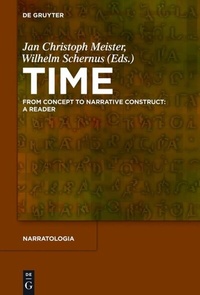
Time
Description

The present volume is targeted at an interdisciplinary audience, i.e. partly at literary scholars/narratologists interested in time theory outside their field, and partly at scholars outside literary studies who in turn would like to learn more about such concepts created in narrative theory. The anthology assembles both English-speaking and German contributions to a narrative theory of time constructs which have thus far not been translated into English, but have - directly or indirectly - inspired the theoretical discourse across disciplines.
The common methodological focus of the articles assembled here concerns the way in which the experience of chronological structure and ordering in (experienced or imagined) phenomena can be traced back to a logic of time "constructs". Narrative time constructs - that is: models of chronological ordering which we generate while processing narratively encoded information - constitute a particularly rich body of examples. How we experience time is directly linked to how we narrate information, and how we re-construct principles of temporal ordering in the narrated content. The logic of narrative time constructs has therefore been of interest not only to narrative theory, but also to philosophy and cognitive science, and more recently to computational approaches toward modelling human time experience.
More details
Other editions
Additional editions
Persons
Content
2 - Acknowledgements [Seite 8]
3 - Foreword [Seite 10]
4 - The Tenses of Verbs [Seite 24]
5 - Time Experience and Personhood [Seite 36]
6 - Constituting Time through Action and Discourse [Seite 52]
7 - Time, Tense and Topology [Seite 72]
8 - The Significance of Time in Narrative Art [Seite 90]
9 - The Timelessness of Poetry [Seite 108]
10 - The Time References of Narration [Seite 124]
11 - Time Structure in the Contemporary Novel [Seite 132]
12 - Story-time and Fact-sequence-time [Seite 166]
13 - The Temporality Effect. Towards a Process Model of Narrative Time Construction [Seite 194]
14 - The Flow of Time in Narrative. An Artificial Intelligence Perspective [Seite 240]
15 - Bibliography: A Guide to Further Reading [Seite 260]
16 - Subject Index [Seite 276]
17 - Name Index [Seite 280]
