

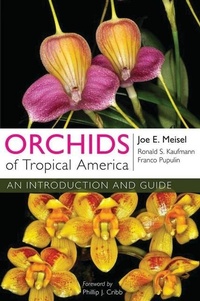
Orchids of Tropical America
An Introduction and Guide
1st Edition
Published on 15. December 2015
276 pages
978-0-8014-5492-9 (ISBN)
Description

"The authors of this introductory text are acknowledged experts on tropical American orchids with decades of combined experience of orchids in both the wild and culture. You could not find a better trio of enthusiasts and specialists to introduce you to the wonderful and occasionally bizarre world of tropical American orchids."-from the Foreword by Phillip J. Cribb
Orchids of Tropical America is an entertaining, informative, and splendidly illustrated introduction to the orchid family for enthusiasts and newcomers seeking to learn about more than 120 widespread orchid genera. Joe E. Meisel, Ronald S. Kaufmann, and Franco Pupulin bring alive the riot of colors, extraordinary shapes, and varied biology and ecology of the principal orchid genera ranging from Mexico and the Caribbean to Bolivia and Brazil. Orchids, likely the most diverse family of plants on earth, reach their peak diversity in the tropical countries of the Western Hemisphere, including, for example, more than 2,500 species in Brazil and 4,000 in Ecuador. The book also highlights reserves in the American tropics where travelers can enjoy orchids in the wild.Whether you journey abroad to see these unique plants, raise them in your home, or admire them from afar, this book offers fascinating insights into the diversity and natural history of orchids. Beyond the plant and flower descriptions, Orchids of Tropical America is packed with informative stories about the ecology and history of each genus. Pollination ecology is given in detail, with an emphasis on how floral features distinctive to the genus are linked to interaction with pollinators. This book also features information on medicinal and commercial uses, notes on the discoverers, and relevant historical data.The easy-to-use identification system permits quick recognition of the most common orchid groups in Central and South America. Genus descriptions are given in plain language designed for a nonscientific audience but will prove highly useful to advanced botanists as well. Descriptions focus on external morphology, and great care has been taken to ensure the guide is useful in the field without reliance on microscopes or dissections. Equally valuable as a field guide, a desktop reference, or a gift, Orchids of Tropical America will make an excellent addition to any orchid lover's library.Visit the website for this book at www.orchidsoftropicalamerica.com.
Orchids of Tropical America is an entertaining, informative, and splendidly illustrated introduction to the orchid family for enthusiasts and newcomers seeking to learn about more than 120 widespread orchid genera. Joe E. Meisel, Ronald S. Kaufmann, and Franco Pupulin bring alive the riot of colors, extraordinary shapes, and varied biology and ecology of the principal orchid genera ranging from Mexico and the Caribbean to Bolivia and Brazil. Orchids, likely the most diverse family of plants on earth, reach their peak diversity in the tropical countries of the Western Hemisphere, including, for example, more than 2,500 species in Brazil and 4,000 in Ecuador. The book also highlights reserves in the American tropics where travelers can enjoy orchids in the wild.Whether you journey abroad to see these unique plants, raise them in your home, or admire them from afar, this book offers fascinating insights into the diversity and natural history of orchids. Beyond the plant and flower descriptions, Orchids of Tropical America is packed with informative stories about the ecology and history of each genus. Pollination ecology is given in detail, with an emphasis on how floral features distinctive to the genus are linked to interaction with pollinators. This book also features information on medicinal and commercial uses, notes on the discoverers, and relevant historical data.The easy-to-use identification system permits quick recognition of the most common orchid groups in Central and South America. Genus descriptions are given in plain language designed for a nonscientific audience but will prove highly useful to advanced botanists as well. Descriptions focus on external morphology, and great care has been taken to ensure the guide is useful in the field without reliance on microscopes or dissections. Equally valuable as a field guide, a desktop reference, or a gift, Orchids of Tropical America will make an excellent addition to any orchid lover's library.Visit the website for this book at www.orchidsoftropicalamerica.com.
Reviews / Votes
Though not a guide to cultivation or a botanical catalog, [Orchids of Tropical America] would be an excellent introductory guide to use in the field, and nonbotanists would welcome its clear, nontechnical language.(CHOICE)
More details
Language
English
Place of publication
Ithaca
United States
Publishing group
Cornell University Press
Edition type
Digital original
Illustrations
488 color photographs, 1 table, 36 charts, 1 map, 488 farbige Abbildungen
488 color photographs, 1 table, 36 charts, 1 map - 488 Illustrations, color
ISBN-13
978-0-8014-5492-9 (9780801454929)
Copyright in bibliographic data and cover images is held by Nielsen Book Services Limited or by the publishers or by their respective licensors: all rights reserved.
Schweitzer Classification
Other editions
Additional editions
Joe E. Meisel | Ronald S. Kaufmann | Franco Pupulin
Orchids of Tropical America
An Introduction and Guide
Book
12/2014
Comstock Publishing Associates
€80.60
Shipment within 10-20 days
Joe E. Meisel | Ronald S. Kaufmann | Franco Pupulin
Orchids of Tropical America
An Introduction and Guide
Book
12/2014
Comstock Publishing Associates
€28.50
Shipment within 10-20 days
Persons
Joe E. Meisel is Vice President of the Ceiba Foundation for Tropical Conservation. Ronald S. Kaufmann is Associate Professor of Marine Science and Environmental Studies at the University of San Diego. Franco Pupulin is Orchid Curator at the Lankester Botanical Garden in San Jose, Costa Rica. Phillip J. Cribb is Honorary Research Fellow at the Kew Royal Botanic Gardens. He is the author of The Genus Cypripedium.
Content
Foreword by Phillip J. Cribb
Introduction1. Orchid Ecology, Diversity, and Conservation
Biology and Ecology
Diversity and Distribution
Conservation2. Orchid Identification
What Is an Orchid?
Illustrated Glossary of Key Orchid Characteristics
How to Use This Guide
Identification Guide to Major Orchid Genera3. Orchid Genus Accounts
Structure and Terminology
Acineta through Zygopetalum4. Where to See Orchids: Nature Reserves and Conservation Sites
Map of Tropical America
Conservation Sites by CountryBibliography
Index
Introduction1. Orchid Ecology, Diversity, and Conservation
Biology and Ecology
Diversity and Distribution
Conservation2. Orchid Identification
What Is an Orchid?
Illustrated Glossary of Key Orchid Characteristics
How to Use This Guide
Identification Guide to Major Orchid Genera3. Orchid Genus Accounts
Structure and Terminology
Acineta through Zygopetalum4. Where to See Orchids: Nature Reserves and Conservation Sites
Map of Tropical America
Conservation Sites by CountryBibliography
Index
