

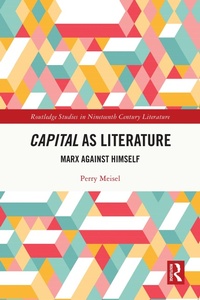
Capital as Literature
Marx Against Himself
1st Edition
Published on 6. May 2026
200 pages
978-1-040-82660-7 (ISBN)
Description

Studies of Marx, particularly of his masterwork Capital (1867), are as a rule tutelary-they attempt to explain him. Even literary readers of Marx from Raymond Williams to Fredric Jameson seek to secure Marxist tenets by means of Marxian style. 'Capital' as Literature: Marx Against Himself departs from this tradition by reading Capital as literary in its own right rather than as political economy with style as its filigree rather than its focus. Here Marx emerges in a different light. If literature is writing that calls whatever is settled into question, then Marx's writing is literature, not because of its revolutionary program, but because Marx's rhetoric, particularly its key trope of chiasmus, undoes the coherence of the notions it propounds, especially in Capital. Marx's chiasmatic style turns Capital into a mise en abyme and Marx's enterprise into an example of what it describes rather than its foil or antidote: the structure of capital itself. Capital, like capital, is a self-begetting production machine whose fungibility as a form is one and the same with the money economy it unravels. 'Capital' as Literature: Marx Against Himself shows how this irony unfolds and what the implications are for epistemology, cultural studies, and literary criticism.
Reviews / Votes
This is Perry Meisel at his best. Meisel's 'Capital' as Literature rivals Louis Althusser and his school's Reading 'Capital' by enabling a new reading of its epistemological structure beyond its ideological concerns and political impact. After his groundbreaking studies of Freudian discourse, Meisel offers a thrilling new insight into an unresolved lingering question, the origins of a postmodern aesthetics with Marx as primal witness to its hidden workings.--Anselm Haverkamp, Ludwig Maximilians University, Munich
Perry Meisel's staggering capacity for close reading brilliantly shifts our view of Marx from that of a fierce social advocate--though he is always that-- to one of a self-aware and self-questioning writer in conversation with himself. 'Capital' as Literature will unsettle classical Marxists while drawing a new and different kind of reader into the orbit of Marx's appeal.
--Roi Tartakovsky, Tel Aviv University
More details
Series
Edition
1. Auflage
Language
English
Place of publication
London
United Kingdom
Publishing group
Taylor & Francis Ltd
Target group
College/higher education
Professional and scholarly
File size
2,53 MB
ISBN-13
978-1-040-82660-7 (9781040826607)
Copyright in bibliographic data and cover images is held by Nielsen Book Services Limited or by the publishers or by their respective licensors: all rights reserved.
Schweitzer Classification
Other editions
Additional editions
Book
04/2026
1st Edition
Routledge
€230.27
Shipment within 15-20 days
Person
Perry Meisel, Professor of English at New York University for over 40 years until his retirement in 2016, has written on literature, music, theory, and culture since the 1970s. His articles have appeared in The New York Times Book Review, The Village Voice, Partisan Review, The Nation, The Atlantic, Raritan, October, and many other publications. He is the author of Criticism After Theory from Shakespeare to Virginia Woolf (2022), The Myth of Popular Culture (2010), The Literary Freud (2007), The Cowboy and the Dandy (1999), The Myth of the Modern (1987), The Absent Father (1980), and Thomas Hardy (1972). He is coeditor, with Haun Saussy, of Saussure's Course in General Linguistics (Columbia, 2011), and coeditor, with Walter Kendrick, of Bloomsbury/Freud: The Letters of James and Alix Strachey, 1924-25 (Basic Books, 1985). He is also the editor of Freud: A Collection of Critical Essays (Prentice-Hall, 1981). He received his B.A. Summa cum laude from Yale in 1970. He also received his M.Phil. (1973) and Ph.D. (1975) from Yale. He is the recipient of Yale's Wrexham Prize and Thomas G. Bergin Cup and research grants from the National Endowment for the Humanities and the Spencer Foundation. He is a member of Phi Beta Kappa and PEN and has been a Fellow of the New York Institute for the Humanities and the Institute for the History of Psychiatry at Weill-Cornell Medical College.
Content
Chapter 1 Introduction: Marx's Counterplot
Chapter 2 A Passage from Capital
Chapter 3 Not by Bread Alone: Use as Exchange
Chapter 4 Marx and Subjectivity
Chapter 5 "Duplex Form" and the Structure of Surplus Value
Chapter 6 Marx and Detail: Capital as a Production Machine
Chapter 7 The Stain of Time: Derrida, Ruskin, Adorno
Chapter 8 The Literary Marx
Coda A Philology of Fetishism: A Psychoanalytic Supplement to Marx
Chapter 2 A Passage from Capital
Chapter 3 Not by Bread Alone: Use as Exchange
Chapter 4 Marx and Subjectivity
Chapter 5 "Duplex Form" and the Structure of Surplus Value
Chapter 6 Marx and Detail: Capital as a Production Machine
Chapter 7 The Stain of Time: Derrida, Ruskin, Adorno
Chapter 8 The Literary Marx
Coda A Philology of Fetishism: A Psychoanalytic Supplement to Marx
