

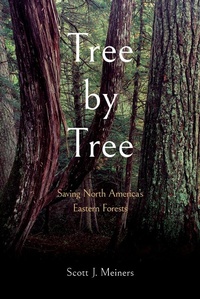
Tree by Tree
Saving North America's Eastern Forests
Published on 15. September 2023
246 pages
978-1-5017-7128-6 (ISBN)
Description

Tree by Tree is a warning and a toolkit for the future of forest recovery. Scott J. Meiners investigates the critical biological threats endangering tree species native to the forests of eastern North America, providing a needed focus on this plight. Meiners suggests that if we are to save our forests, the first step is to recognize the threats in front of us.
Meiners focuses on five familiar trees-the American elm, the American chestnut, the eastern hemlock, the white ash, and the sugar maple-and shares why they matter economically, ecologically, and culturally. From outbreaks of Dutch elm disease to infestations of emerald ash borers, Meiners highlights the challenges that have led or will lead to the disappearance of these trees from forests. In doing so, he shows us how diversity loss often disrupts intricately balanced ecosystems and how vital it is that we pay more attention to massive changes in forest composition.
With practical steps for the conservation of native tree species, Tree by Tree offers the inspiration and insights we need to begin saving our forests.
Meiners focuses on five familiar trees-the American elm, the American chestnut, the eastern hemlock, the white ash, and the sugar maple-and shares why they matter economically, ecologically, and culturally. From outbreaks of Dutch elm disease to infestations of emerald ash borers, Meiners highlights the challenges that have led or will lead to the disappearance of these trees from forests. In doing so, he shows us how diversity loss often disrupts intricately balanced ecosystems and how vital it is that we pay more attention to massive changes in forest composition.
With practical steps for the conservation of native tree species, Tree by Tree offers the inspiration and insights we need to begin saving our forests.
More details
Language
English
Place of publication
Ithaca
United States
Publishing group
Cornell University Press
Product notice
Reflowable
Illustrations
9 b&w line drawings, 5 maps - 5 Maps - 9 Line drawings, black and white
ISBN-13
978-1-5017-7128-6 (9781501771286)
Copyright in bibliographic data and cover images is held by Nielsen Book Services Limited or by the publishers or by their respective licensors: all rights reserved.
Schweitzer Classification
Other editions
Additional editions
Book
09/2023
Comstock Publishing Associates
€24.00
Shipment within 15-20 days
Person
Scott J. Meiners is Professor of Biological Sciences at Eastern Illinois University.
Content
Introduction: First, Some Context
1. American Elm-Ulmus americana
2. American Chestnut-Castanea dentata
3. Eastern Hemlock-Tsuga canadensis
4. White Ash-Fraxinus americana
5. Sugar Maple-Acer saccharum
6. Other Trees with Other Challenges
7. The Next in Line
8. Accumulating Impacts-Putting It All Together
Conclusion: Protecting Our Forests' Future
1. American Elm-Ulmus americana
2. American Chestnut-Castanea dentata
3. Eastern Hemlock-Tsuga canadensis
4. White Ash-Fraxinus americana
5. Sugar Maple-Acer saccharum
6. Other Trees with Other Challenges
7. The Next in Line
8. Accumulating Impacts-Putting It All Together
Conclusion: Protecting Our Forests' Future
