

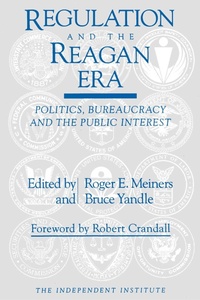
Regulation and the Reagan Era
Politics, Bureaucracy and the Public Interest
Published on 1. July 2017
304 pages
978-1-59813-299-1 (ISBN)
Description

Was the so-called "Reagan Revolution" a disappointment regarding the federal systems of special-interest regulation? Many of that administration's friends as well as its opponents think so. But under what criteria? To what extent? And why?
When Ronald Reagan was elected in 1980, the popular belief was that the size of government would be cut and that some of the regulatory excesses of the prior decade would be rolled back. However, the growth of the federal government continued throughout the Reagan presidency and no agencies were phased out.
What were the apparently powerful forces that rendered most of the bureaucracy impervious to reform? In this book, professional economists and lawyers who were at, or near, the top of the decision-making process in various federal agencies during the Reagan years discuss attempts to reign in the bureaucracy. Their candid comments and personal insights shed new light on the susceptibility of the American government to bureaucratic interests.
This book is required reading for anyone wishing to understand the true reasons why meaningful, effective governmental reform at the federal level is so difficult, regardless of which political party controls the White House or Congress.
When Ronald Reagan was elected in 1980, the popular belief was that the size of government would be cut and that some of the regulatory excesses of the prior decade would be rolled back. However, the growth of the federal government continued throughout the Reagan presidency and no agencies were phased out.
What were the apparently powerful forces that rendered most of the bureaucracy impervious to reform? In this book, professional economists and lawyers who were at, or near, the top of the decision-making process in various federal agencies during the Reagan years discuss attempts to reign in the bureaucracy. Their candid comments and personal insights shed new light on the susceptibility of the American government to bureaucratic interests.
This book is required reading for anyone wishing to understand the true reasons why meaningful, effective governmental reform at the federal level is so difficult, regardless of which political party controls the White House or Congress.
More details
Other editions
Additional editions
Roger E. Meiners | Bruce Yandle | Robert Crandall
Regulation and the Reagan Era
Politics, Bureaucracy and the Public Interest
Book
01/1989
Independent Institute,U.S.
€19.00
Shipment within 3-4 weeks
Persons
Roger E. Meiners is the John and Judy Goolsby and E.M. (Manny) Rosenthal Chair in Economics and Law at the University of Texas at Arlington, Research Fellow at the Independent Institute, Fellow of the George W. Bush Institute, and Senior Fellow at the Property and Environment Research Center. Having received his Ph.D. in economics from Virginia Tech and J.D. from the University of Miami, he has served as Director of the Center for Policy Studies at Clemson University, a faculty member at Texas A & M University and Emory University, Director of the Atlanta Regional Office of the Federal Trade Commission, Associate Director of the Law and Economics Center at Emory University, and a Member of the South Carolina Insurance Commission.
Bruce Yandle is Alumni Distinguished Professor of Economics, Emeritus and Dean Emeritus, Clemson University. He received his Ph.D. in economics from Georgia State University. He has been Senior Economist on the staff of the President's Council on Wage and Price Stability, Executive Director of the Federal Trade Commission, and Visiting Professor at the Montpellier University Law School in France.
Robert W. Crandall is Senior Fellow in Economic Studies at Brookings Institution and former Chairman of Criterion Economics. He received his Ph.D. in economics from Northwestern University, and he has served as Acting, Deputy and Assistant Director of the Council on Wage and Price Stability; and Faculty Member at George Washington University, Northwestern University, University of Maryland, and Massachusetts Institute of Technology. Dr. Crandall's expertise is in antitrust policy, automobile industry, environmental policy, industrial organization, regulation and deregulation, steel industry, and telecommunications.
Bruce Yandle is Alumni Distinguished Professor of Economics, Emeritus and Dean Emeritus, Clemson University. He received his Ph.D. in economics from Georgia State University. He has been Senior Economist on the staff of the President's Council on Wage and Price Stability, Executive Director of the Federal Trade Commission, and Visiting Professor at the Montpellier University Law School in France.
Robert W. Crandall is Senior Fellow in Economic Studies at Brookings Institution and former Chairman of Criterion Economics. He received his Ph.D. in economics from Northwestern University, and he has served as Acting, Deputy and Assistant Director of the Council on Wage and Price Stability; and Faculty Member at George Washington University, Northwestern University, University of Maryland, and Massachusetts Institute of Technology. Dr. Crandall's expertise is in antitrust policy, automobile industry, environmental policy, industrial organization, regulation and deregulation, steel industry, and telecommunications.
Content
- Intro
- Title Page
- Copyright
- Contents
- Foreword
- Notes on Contributors
- Part I Regulation and Deregulation
- 1 Regulatory Lessons from the Reagan Era: Introduction
- 2 A Review of the Economics of Regulation: The Political Process
- Part II Regulation and the Reagan Era
- 3 Regulatory Reform under Reagan-The Right Way and the Wrong Way
- 4 Consumer Protection at the FTC during the Reagan Administration
- 5 Antitrust Policy in the Reagan Administration: Pyrrhic Victories?
- 6 Deregulating Telecommunications
- 7 Privatization of Federal Lands: What Did Not Happen
- 8 Deregulation at the U.S. International Trade Commission
- 9 Civil Aeronautics Board Sunset: Sunrise at the Department of Transportation?
- Part III Politics, Regulation, and Bureaucracy
- 10 Sub Rosa Regulation: The Iceberg beneath the Surface
- 11 Regulation, Taxes, and Political Extortion
- 12 The Unpredictable Politics behind Regulation: The Institutional Basis
- 13 A User's Guide to the Regulatory Bureaucracy
- 14 The Anxious Course: Achieving Change in Washington, D.C.
