

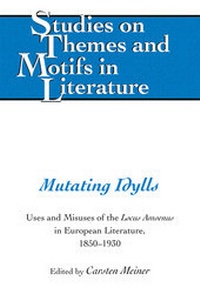
Mutating Idylls
Description

Mutating Idylls examines the surprising presence of the antique literary topos of the idyllic landscape, the locus amoenus, in European literature from the latter half of the nineteenth century. The book sets out to identify how this topos, which generally has no place in politically and socially realistic and naturalist literature, actually does have a role to play. Chapters on central nineteenth-century authors such as Flaubert, Zola, Fontane, Verga, Hamsun, Austen, Eliot, Wilde, Jiménez, Cernuda, and Galdós demonstrate both the presence and the multiple refunctionalizations of the locus amoenus. The theoretical aim of Mutating Idylls is to rehabilitate the notion of literary topos. This feature is present in the introduction as a possibility in literary studies today. The chapters all argue in the direction of a notion of topos, which is more flexible than the one Curtius defines along the lines of formula or cliché. In this way, the book intervenes in at least three major fields of study: nineteenth-century studies, classical philology, and literary theory. Through empirical analyses covering diverse authors who all, more or less unconsciously, use the locus amoenus, Mutating Idylls offers a new understanding of the culture of writing in the nineteenth century and contributes to literary theory a rehabilitation of the important notion of the topos.
More details
Other editions
Additional editions
Person
Carsten Meiner is Professor of French Literature and Culture at the University of Copenhagen. He earned his PhD in philosophy and aesthetics from the Université de Paris VIII in 2001. His research concerns "commonplaces"-topoi-in modern French literature. He has authored and co-edited books in both French and English.
Content
Foreword - Carsten Meiner and Peter Borum: Introduction: The History and Theory of the Locus Amoenus - Maria Damkjær: Landscape on Pause: Strong Feelings and the Locus Amoenus in Nineteenth-Century British Literature - Frode Lerum Boasson: Pleasure Is Not Fun: The Locus Amoenus in Knut Hamsun - Katrine Helene Andersen: The Locus Amoenus in Nineteenth-Century Spanish Literature: From Meadows to Gardens: Doña Perfecta as a Micro-representation of a Topological Development - Pia Schwarz Lausten: In the Shade of the Chestnut Trees: The Locus Amoenus in Giovanni Verga's Writing - Michael Høxbro Andersen: Defective Pleasant Places: The Locus Amoenus in Gustave Flaubert's Madame Bovary - Charles Lock: Derelictions of Contentment: The Locus Amoenus in Nineteenth-Century Landscape Painting - Birthe Hoffmann: The Locus Amoenus as a (Hetero-)utopia of Human Existence in Theodor Fontane's Novel On Tangled Paths - Julio Jensen: Locus Amoenus and the Modern Spirit. A Topos of Melancholy in Three Spanish-Language Authors: Juan Ramón Jiménez, Luis Cernuda, and Julio Cortázar - Carsten Meiner: Naturalizing Deviant Pleasure: Loci Amoeni in Zola - Contributors.
