


Design Thinking Research
Description

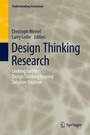
Extensive research conducted by the Hasso Plattner Design Thinking Research Program at Stanford University in Palo Alto, California, USA, and the Hasso Plattner Institute in Potsdam, Germany, has yielded valuable insights on why and how design thinking works. Researchers have identified metrics, developed models, and conducted studies, which are featured in this book, and in the previous volumes of this series.
Offering readers a closer look at design thinking, and its innovation processes and methods, this volume covers topics ranging from understanding success factors of design thinking to exploring the potential that lies in the use of digital technologies. Furthermore, readers learn how special-purpose design thinking can be used to solve thorny problems in complex fields, such as the health sector or software development.
Thinking and devising innovations are inherently human activities - so is design thinking. Accordingly, design thinking is not merely the result of special courses or of being gifted or trained: it is a way of dealing with our environment and improving techniques, technologies and life. As such, the research outcomes compiled in this book should increase knowledge and provide inspiration to all seeking to drive innovation - be they experienced design thinkers or newcomers.
More details
Other editions
Additional editions
Persons
Larry Leifer is professor of Mechanical Engineering at Stanford University, CA, USA. Dr. Leifer's engineering design thinking research is focused on instrumenting design teams to understand, support, and improve design practice and theory. Specific issues include: design-team research methodology, global team dynamics, innovation leadership, interaction design, design-for-wellbeing, and adaptive mechatronic systems. Dr. Leifer has taught Design Innovation for decades and continues to redesign the course ever year with new methodologies and technologies. Once a design student himself at Stanford University, he has started many design initiatives at Stanford including the Smart-Product Design Program, Stanford-VA Rehabilitation Engineering Center, Stanford Learning Laboratory, and most recently the Center for Design Research (CDR). A member of the Stanford faculty since 1976, his research themes include: creating collaborative engineering environments for distributed product innovation teams, instrumentating that environment for design knowledge capture, indexing, reuse, and performance assessment, and design-for-wellbeing, socially responsible and sustainable engineering.
