

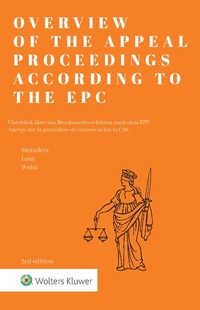
Overview of the Appeal Proceedings according to the EPC
Published on 28. February 2020
448 pages
978-94-035-2090-2 (ISBN)
Description

Overview of the Appeal Proceedings According to the EPC Third Edition Hugo Meinders, Philipp Lanz & Gerard Weiss About this book: Overview of the Appeal Proceedings According to the EPC helps in understanding the nature of the appeal proceedings before the Boards of Appeal. The previous editions of this book made an effort to explain in brief introductory terms how appeal proceedings work and how the Boards of Appeal function. This edition deals with the New Rules of Procedure adopted by the BoAC2 and approved by the Administrative Council which entered into force on 1 January 2020. About one in a hundred European patent cases end up before a Board of Appeal. The appeal reviews the decision of a first instance department of the European Patent Office. The appeal proceedings are substantially different from the first instance proceedings; they are a judicial review and not necessarily a continuation of the administrative first instance proceedings. This first aspect is even more pronounced since 1 January 2020, with the changes in the Rules of Procedure of the Boards of Appeal. What's in this book: This book provides an easily readable overview of the appeal proceedings in the three official languages of the European Patent Office (EPO): English, German and French, including the (New) Rules of Procedure of the Boards of Appeal and the Enlarged Board of Appeal. It covers amongst others the following: (new) requirements on filing an appeal; the possible actions of the Board; the stricter treatment of late filings of the parties; and the conduct of oral proceedings and the issue of the decision. This book gives an up-to-date account of the most important issues of the appeal proceedings at the Boards of Appeal of the EPO. How this will help you: This book is intended as a reference book for applicants in ex-parte (examination appeal) proceedings, or patent proprietors or opponents in inter-partes (opposition appeal) proceedings, as appellants or respondents, or party as of right. It facilitates in finding an answer to issues that a party may encounter. Editors: Hugo Meinders, Philipp Lanz & Gerard Weiss
More details
Other editions
Additional editions
Hugo Meinders | Philipp Lanz | Gerard Weiss
Overview of the Appeal Proceedings according to the EPC
Book
02/2020
3rd Edition
Kluwer Law International
€116.56
Shipment within 15-20 days
Content
- Intro
- Title Page
- Copyright Page
- About the authors
- Overview of the Appeal Proceedings According to the EPC
- Abbreviations
- Contents
- Preface
- 1. Introduction
- 2. The Boards of Appeal
- 2.1. Organisation and independence of the Boards of Appeal
- 2.2. Legal framework
- 3. Decisions subject to appeal
- 4. Effect of the appeal
- 5. Who is entitled to appeal?
- 6. Which Board hears which case?
- 7. Formal requirements on an appeal
- 7.1. Notice of appeal
- 7.2. Statement of grounds of appeal
- 8. Substantive requirements on an appeal: Statement of grounds
- 8.1. Judicial review of the first instance decision
- 8.2. Admissibility of the appeal
- 8.3. New rules of procedure Art. 12(2) and 12(3)
- 8.4. Formal requirements on the statement of grounds
- 8.5. New rule of procedure Art. 12(4)
- 8.6. New rule of procedure Art. 12(5)
- 8.7. New rule of procedure Art. 12(6)
- 9. Interlocutory revision
- 10. Reply to the statement of grounds
- 10.1. Cases with statement of grounds filed before 1 January 2020
- 10.2. Cases with statement of grounds filed after 1 January 2020
- 10.3. Further general remarks
- 11. Later filings
- 11.1. Summons or communication under Rule 100(2) EPC notified before 1 January 2020
- 11.2. Situation after 1 January 2020
- 11.2.1 Submission is filed after 1 January 2020, no summons or communication under Rule 100(2) EPC notified yet
- 11.2.2 Further submission was already filed before 1 January 2020, no summons or communication under Rule 100(2) yet notified (situation after 1 January 2020)
- 11.2.3 Summons or communication under Rule 100(2) has been notified after 1 January 2020, filing of a further submission thereafter
- 12. Actions of the Board
- 12.1. Nature of the appeal proceedings
- 12.2. Formalities check
- 12.3. How much time can a Board member or Chair spend on a case?
- 12.3.1 Time implications for the technically qualified member (rapporteur)
- 12.3.2 Time implications for the Chair and the legally qualified member
- 12.4. Substantive examination
- 12.5. How to react to a summons with a preliminary opinion
- 12.6. How to react to a summons without a preliminary opinion
- 13. Oral proceedings
- 13.1. Date for oral proceedings
- 13.2. Language at oral proceedings
- 13.3. Preparing for oral proceedings
- 13.3.1 Ex-parte (examination appeal) proceedings
- 13.3.2 Inter-partes (opposition appeal) proceedings
- 13.4. Conduct of oral proceedings
- 13.4.1 Ex-parte (examination) proceedings
- 13.4.2 Inter-partes (opposition) proceedings
- 13.5. Miscellaneous matters regarding oral proceedings
- 14. Reasoned written decision
- 15. Remittal to the department of first instance
- 15.1. Remittal to grant
- 15.2. Remittal to maintain in amended form
- 15.3. Remittal for further prosecution - ex-parte proceedings
- 15.4. Remittal for further prosecution - inter-partes proceedings
- 15.5. Immediate remittal for fundamental deficiencies in first instance
- 16. Special issues
- 16.1. Withdrawal of the appeal
- 16.2. Intervention
- 16.3. Citing case law
- 16.4. Fundamental deficiencies in the first instance proceedings
- 16.5. Costs
- 16.6. Absence from oral proceedings
- 16.7. Transfer of party status
- 16.8. Interruption and suspension of the proceedings
- 16.8.1 Interruption of the proceedings
- 16.8.2 Suspension (stay) of the proceedings
- 16.9. Parties to the appeal proceedings
- 16.9.1 Third party observations and accompanying persons
- 16.9.2 Opposition proceedings
- 16.9.3 Requests of the non-appealing party - 'reformatio in peius'
- 16.10. The Enlarged Board of Appeal
- 16.11. Petition for review
- 16.12. Proceedings for removal of a member of the Boards of appeal
- 16.13. Disciplinary Board of Appeal
- 17. Further reading
- Rules of Procedure of the Boards of Appeal, version 2020
- Rules of Procedure of the Boards of Appeal, version 2007
- Rules of procedure of the Enlarged Board of Appeal
- Index
- Überblick über das Beschwerdeverfahren nach dem EPÜ
- Abkürzungen
- Inhalt
- Vorwort
- 1. Einleitung
- 2. Die Beschwerdekammern
- 2.1. Organisation und Unabhängigkeit der Beschwerdekammern
- 2.2. Rechtlicher Rahmen
- 3. Beschwerdefähige Entscheidungen
- 4. Wirkung der Beschwerde
- 5. Wer ist zur Beschwerde berechtigt?
- 6. Welche Kammer ist für welchen Fall zuständig?
- 7. Formale Voraussetzungen der Beschwerde
- 7.1. Beschwerdeschrift
- 7.2. Beschwerdebegründung
- 8. Materielle Voraussetzungen der Beschwerde: Beschwerdebegründung
- 8.1. Gerichtliche Überprüfung der erstinstanzlichen Entscheidung
- 8.2. Zulässigkeit der Beschwerde
- 8.3. Art. 12 (2) und 12 (3) der Verfahrensordnung 2020
- 8.4. Formale Anforderungen an die Beschwerdebegründung
- 8.5. Art. 12 (4) der Verfahrensordnung 2020
- 8.6. Art. 12 (5) der Verfahrensordnung 2020
- 8.7. Art. 12 (6) der Verfahrensordnung 2020
- 9. Abhilfe
- 10. Beschwerdeerwiderung
- 10.1. Fälle mit vor dem 1. Januar 2020 eingereichter Beschwerdebegründung
- 10.2. Fälle mit nach dem 1. Januar 2020 eingereichter Beschwerdebegründung
- 10.3. Weitere allgemeine Hinweise
- 11. Späteres Vorbringen
- 11.1. Ladung oder Mitteilung nach Regel 100 (2) EPÜ zugestellt vor dem 1. Januar 2020
- 11.2. Situation nach dem 1. Januar 2020
- 11.2.1 Weiteres Vorbringen eingereicht vor dem 1. Januar 2020, Ladung zur mündlichen Verhandlung oder Mitteilung nach Regel 100 (2) EPÜ noch nicht zugestellt
- 11.2.2 Weiteres Vorbringen eingereicht vor dem 1. Januar 2020, Ladung zur mündlichen Verhandlung oder Mitteilung nach Regel 100 (2) EPÜ noch nicht zugestellt (Situation nach dem 1. Januar 2020
- 11.2.3 Ladung zur mündlichen Verhandlung oder Mitteilung nach Regel 100 (2) EPÜ zugestellt nach dem 1. Januar 2020, das weitere Vorbringen erfolgt danach
- 12. Maßnahmen der Beschwerdekammer
- 12.2. Formalprüfung
- 12.3. Wieviel Zeit hat ein Kammermitglied oder ein Vorsitzender für einen Beschwerdefall zur Verfügung?
- 12.3.1 Zeitliche Implikationen für das technisch vorgebildete Mitglied (Berichterstatter)
- 12.3.2 Zeitliche Implikationen für den Vorsitzenden und das rechtskundige Mitglied
- 12.4. Sachprüfung
- 12.5. Reaktion auf eine Ladung zur mündlichen Verhandlung mit vorläufiger Einschätzung
- 12.6. Reaktion auf eine Ladung zur mündlichen Verhandlung ohne vorläufige Einschätzung
- 13. Mündliche Verhandlung
- 13.1. Tag der mündlichen Verhandlung
- 13.2. Verhandlungssprache während der mündlichen Verhandlung
- 13.3. Vorbereitung der mündlichen Verhandlung
- 13.3.1 Ex Parte-(Prüfungsbeschwerde-) Verfahren
- 13.3.2 Inter partes-(Einspruchsbeschwerde-) Verfahren
- 13.4. Durchführung der mündlichen Verhandlung
- 13.4.1 Ex parte-(Prüfungsbeschwerde-) Verfahren
- 13.4.2 Inter partes-(Einspruchsbeschwerde-) Verfahren
- 13.5. Sonstiges die mündliche Verhandlung betreffend
- 14. Begründete schriftliche Entscheidung
- 15. Zurückverweisung an die Verwaltungsinstanz
- 15.1. Zurückverweisung mit der Anordnung zur Patenterteilung
- 15.2. Zurückverweisung mit der Anordnung, das Patent in geänderter Fassung aufrechtzuerhalten
- 15.3. Zurückverweisung zur weiteren Entscheidung - ex parte-Verfahren
- 15.4. Zurückverweisung zur weiteren Entscheidung - inter partes-Verfahren
- 15.5. Unverzügliche Zurückverweisung aufgrund eines wesentlichen Verfahrensfehlers in der Entscheidung des Organs der Verwaltungsinstanz
- 16. Einzelaspekte und besondere Fallkonstellationen
- 16.1. Rücknahme der Beschwerde
- 16.2. Beitritt
- 16.3. Verweis auf und Zitierung von Rechtsprechung
- 16.4. Wesentliche Verfahrensfehler in der Entscheidung des Organs der Verwaltungsinstanz
- 16.5. Kosten
- 16.6. Nichterscheinen zur mündlichen Verhandlung
- 16.7. Übertragung der Beteiligtenstellung
- 16.8. Unterbrechung und Aussetzung des Verfahrens
- 16.8.1 Unterbrechung des Verfahrens
- 16.8.2 Aussetzung des Verfahrens
- 16.9. Verfahrensbeteiligte
- 16.9.1 Einwendungen Dritter und Begleitpersonen
- 16.9.2 Einspruchsverfahren
- 16.9.3 Anträge nicht beschwerdeführender Beteiligter - 'reformatio in peius'
- 16.10. Die Große Beschwerdekammer
- 16.11. Überprüfungsverfahren
- 16.12. Amtsenthebungsverfahren
- 16.13. Beschwerdekammer in Disziplinarangelegenheiten
- 17. Literaturhinweise
- Verfahrensordnung der Beschwerdekammern, Fassung von 2020
- Verfahrensordnung der Beschwerdekammern, Fassung von 2007
- Verfahrensordnung der Großen Beschwerdekammer (VOGBK)
- Index
- Aperçu sur la procédure de recours selon la CBE
- Abréviations
- Table des Matiéres
- Avant-propos
- 1. Introduction
- 2. Les chambres de recours
- 2.1. Organisation et indépendance des chambres de recours
- 2.2. Cadre juridique
- 3. Décisions susceptibles de recours
- 4. Effet du recours
- 5. Qui a le droit de former recours ?
- 6. Quelle chambre de recours est chargée d'examiner quelle affaire ?
- 7. Conditions de forme relatives au recours
- 7.1. Acte de recours
- 7.2. Mémoire de recours
- 8. Conditions de fond relatives au recours
- 8.1. Contrôle juridictionnel de la décision de première instance
- 8.2. Recevabilité du recours
- 8.3. Nouveau règlement de procédure : art. 12(2) et 12(3)
- 8.4. Conditions de forme du mémoire de recours
- 8.5. Nouvelle règle de procédure : art. 12(4)
- 8.6. Nouvelle règle de procédure : art. 12(5)
- 8.7. Nouvelle règle de procédure : art. 12(6)
- 9. Révision préjudicielle
- 10. Réponse au mémoire de recours
- 10.1. Recours en instance avec mémoires de recours déposés avant le 1er janvier 2020
- 10.2. Recours en instance avec mémoires de recours déposées après le 1er janvier 2020
- 10.3. Autres remarques générales
- 11. Dépôts tardifs
- 11.1. Citation à la procédure orale ou notification au titre de la règle 100(2)CBE signifiées avant le 1er janvier 2020
- 11.2. Situation après le 1er janvier 2020
- 11.2.1 Un écrit a été produit après le 1er janvier 2020
- ni une citation à une procédure orale ni une notification au titre de la règle 100(2) CBE n'ont encore été signifiées
- 11.2.2 Un nouvel écrit a déjà été produit avant le 1er janvier 2020
- ni une citation à la procédure orale ni une notification au titre de la règle 100(2) CBE n'ont encore été signifiée (situation à compter du 1er janvier 2020)
- 11.2.3 La citation à une procédure orale ou la notification au titre de la règle 100(2) CBE a été signifiée avant le 1er janvier 2020
- un nouvel écrit est produit par après
- 12. Actions de la chambre
- 12.1. Nature de la procédure de recours
- 12.2. Contrôle des formalités
- 12.3. Combien de temps un membre ou un président de chambre peut-il consacrer à une affaire ?
- 12.3.1 Implications en termes de temps pour le membre technicien (rapporteur)
- 12.3.2 Implications en termes de temps pour le président et le membre juriste
- 12.4. Examen quant au fond
- 12.5. Comment réagir à une notification jointe à la citation ?
- 12.6. Comment réagir à une citation à laquelle une opinion provisoire n'a pas été jointe ?
- 13. Procédure orale
- 13.1. Date de la procédure orale
- 13.2. Langue de la procédure orale
- 13.3. Préparation à la procédure orale
- 13.3.1 Procédure ex-parte (recours sur examen)
- 13.3.2 Procédure inter-partes (recours sur opposition)
- 13.4. Déroulement de la procédure orale
- 13.4.1 Procédure ex-parte (procédure sur examen)
- 13.4.2 Procédure inter-partes (procédure sur opposition)
- 13.5. Sujets divers concernant la procédure orale
- 14. Décision écrite motivée
- 15. Renvoi à la première instance
- 15.1. Renvoi pour délivrance
- 15.2. Renvoi pour maintien sous forme modifiée
- 15.3. Renvoi pour suite à donner - procédure ex-parte
- 15.4. Renvoi pour suite à donner - procédure inter-partes
- 15.5. Renvoi immédiat pour des motifs liés à un vice de procédure
- 16. Questions particulières
- 16.1. Retrait du recours
- 16.2. Intervention
- 16.3. Comment citer la jurisprudence
- 16.4. Vices majeurs dans la procédure devant la première instance
- 16.5. Frais
- 16.6. Absence à la procédure orale
- 16.7. Transfert de la qualité de partie
- 16.8. Interruption et suspension de la procédure
- 16.8.1 Interruption de la procédure
- 16.8.2 Suspension de la procédure
- 16.9. Les parties à la procédure de recours
- 16.9.1 Observations des tiers et personnes accompagnantes
- 16.9.2 La procédure d'opposition
- 16.9.3 Requêtes de la partie non-requérante - « reformatio in pejus »
- 16.10. La Grande Chambre de recours
- 16.11. Requête en révision
- 16.12. Procédure pour relever de ses fonctions un membre des chambres de recours
- 16.13. La chambre de recours en matière disciplinaire
- 17. Littérature
- Règlement de procédure des chambres de recours 2020
- Règlement de procédure des chambres de recours 2007
- Règlement de procédure de la Grande Chambre de recours
- Index
