

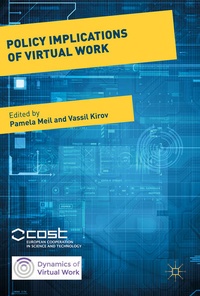
Policy Implications of Virtual Work
Description

This collection presents an array of policy debates and implications emerging from virtual work. The authors cover a range of areas, including: conceptual debates, measuring virtual work; discourses and levels of policy intervention; the role of the sharing and collaborative economy; and resultant challenges for organized labour, law and regulation.
The authors of the chapters analyse the ways in which processes of digitalization leading to virtual work impact so many aspects of our lives: the way we buy, sell, network, communicate, participate, create, consume, and, of course, the way we work. In turn they focus on the subsequent implications for the future of work as well as the viability of existing social protection systems.
The developments examined here are salient for both policy stakeholders and for the academic community in areas such as labour sociology, industrial relations, gender studies, political economy, and economic geography.
Reviews / Votes
"An extremely impressive, absorbing and highly readable and recommended collection of essays about contemporary and emerging work patterns. I certainly learned a great deal from the book, and I believe it will set the tone for different debates to come about the issues explored." (John Michael Roberts, British Journal of Industrial Relations, Vol. 56 (2), June, 2018)More details
Other editions
Additional editions
Persons
Pamela Meil is Senior Research Fellow and member of the board of governors at the Institute for Social Science Research, Germany.
Vassil Kirov is Associate Professor at the Bulgarian Academy of Sciences and Associate Researcher at ETUI.
