

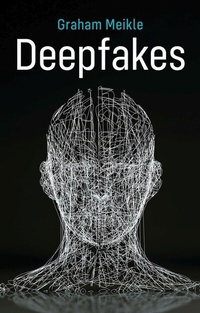
Deepfakes
Description

What happens when we can no longer believe what we see? Show the AI technologies that create deepfakes enough images of a celebrity or a politician and they will generate a convincing video in which that person appears to say and do things they have never actually said or done. The result is a media environment in which anyone’s face and image can be remixed and manipulated.
Graham Meikle explains how deepfakes (synthetic media) are made and used. From celebrity porn and political satire to movie mash-ups and disinformation campaigns, this book explores themes of trust and consent as face-swapping software becomes more common. Meikle argues that deepfake videos allow for a new perspective on the taken-for-granted nature of contemporary media, in which our capacity to remix and share content increasingly conflicts with our capacity to trust. The book analyses how such videos deepen the social media environment in which the public and the personal converge, and in which all human experience becomes data to be shared.
Timely, clear, and accessibly written, this is an essential text for students and scholars of media, communication, cultural studies, and sociology as well as general readers.
Graham Meikle is Professor of Communication and Digital Media at the University of Westminster.
More details
Other editions
Person
Content
Introduction
Chapter 1 What Are Deepfakes?
Chapter 2 Synthetic Porn
Chapter 3 Remix Aesthetics and Synthetic Media
Chapter 4 Manipulating Trust
Conclusion
References
Index
1
What Are Deepfakes?
When Apple launched its first iPhone to use facial recognition, the company's usual theatrical event made much of the device's sophisticated array of AI applications. Apple's Tim Cook and Phil Schiller explained how its Face ID system offered facial recognition technology for unlocking the device. Their presentation showed off the phone's sophisticated TrueDepth camera system, and its use of digital imaging sensors, ambient light detection, and infrared dot-projection technology to achieve facial recognition. They also boasted of the new iPhone's use of neural networks, and demonstrated Augmented Reality applications of its facial recognition technology.
In contrast, neither man said anything about making phone calls. Indeed, it would have been surprising if phone calls had been a focus of the launch presentation, despite the word phone being the heart of the product's name. Contemporary smartphones are not best understood as being phones at all, and so the emphasis instead was on technological developments that might seem esoteric to many users (neural networks?). Smartphones recall Arthur C. Clarke's indelible observation that 'Any sufficiently advanced technology is indistinguishable from magic' (1999: 2). But what this iPhone example shows is how such sophisticated AI systems are now also very much a taken-for-granted part of everyday life and daily communication. Powerful neural networks drive the facial recognition devices that we carry around in our hands, and enable the conversational technologies that are Siri and Alexa (Bunz & Meikle 2018). AI applications such as natural language processing, speech recognition, and computer vision are now intimately bound up with our daily experiences of work, travel, shopping, entertainment, and communication (Elliott 2019, 2022).
Communication is the making of meanings. It's something everyone can do but it's also harder than it looks. We might try to nurture a particular meaning in a particular person or to blast it at a whole population. But the outcome is never certain. Meanings have to be made, in part by the creator of a message and in part by those receiving and interpreting that message. Of course, often we accept the meaning suggested by the creator of a message, by the director of a film, or the writer of a caption explaining a photograph in a news story. But this is a messy and often contested process (Hall 2019 [1973]). The very need for that photograph's caption points to some of the complexity of this process of making meanings: a photograph may not mean much without a caption to suggest how we should read it (and indeed the photo can perform the same favour for the caption). In such processes of shaping and steering and suggesting, and in the responses and interpretations of those reading, watching, or listening, is communication, the making of meanings. We don't just take meanings, we make them. Deepfakes are first of all a communication phenomenon: they are about new ways of making meanings, and they are also about challenges to settled understandings of how meanings get made.
All the examples in that last paragraph are of mediated communication: films, photographs, and news stories. Of course, much other communication is face-to-face, involving conversation, facial expressions, gestures, and body language. Those are all activities that work best when we are in the same space together at the same time. But all of us also spend hours every day communicating across different or distant spaces (a Zoom chat with a friend overseas) and different times (catching up with that box set everyone loved last year). For this we need media: systems that enable us to communicate across space or across time or both (Carey 1989; Thompson 1995; Hartley 2008; Wark 2012). Those systems have economic and technological elements: media involve industries and institutions that develop to use the possibilities offered by technological innovations. Those innovations, and those industries and institutions, shape each other, as some possibilities are pursued and others excluded. Those systems also have social and regulatory dimensions, and cultural ones: particular kinds of texts, and particular kinds of audience or user behaviour, from the shared attention of a major live TV event (Dayan & Katz 1992) to the daily Babel of a trending hashtag (Losh 2020). And of course media can also refer to the texts or images produced by those systems. So when we talk about synthetic media, we can mean the images or audio or videos that are produced by AI processes. Our experiences of media and communication are changing in profound ways as AI processes for generating and acting upon data now join the more familiar media forms that I've used for examples in this paragraph.
One example that captures all the above aspects of media is the ways that social media platforms have drawn the cultural practices of their users into their business models and the further refinement of their technological interfaces. This is crucial for the development of synthetic media too. Jean Burgess and Nancy Baym show how grassroots Twitter users developed improvements, enhancements, refinements, and add-ons that came to define many of that platform's central uses, such as the hashtag, the @-reply, and the retweet: 'Even the noun "tweet" to describe a post to the site and the verb "to tweet" to describe the act of posting such a contribution were user inventions' (2020: 33). Each of those initiatives came from cultural negotiations among Twitter users as they worked out how best to use this platform to make and share meanings with others. Burgess and Baym then show how Twitter the company absorbed these grassroots practices into its business model and into the architecture of the app: by trademarking terms, encoding user workarounds as proprietary software features, and repositioning elements of everyday Twitter culture as 'engagement metrics'. Synthetic media, similarly, are being developed through networks of interactions between different kinds of users, all trying to exploit the potential of these new technological possibilities. As we will see in this book, the uses and meanings of deepfakes are being developed in particular cultural contexts, and come to embody and express particular ideas about the world. One of these ideas is that all human experience is now media content or data that can be manipulated and remixed without meaningful consent.
Digital media express media texts and images as numbers, as zeros and ones. This makes them programmable (Manovich 2001). Once an image is expressed as numbers, then we can do maths with it. We can edit it, run it through filters, copy it, share it, perform all kinds of complex algorithmic operations on that image. This enables everyday remix creativity. Social media have made the remix impulse into an everyday practice for billions of people. Choosing a filter on Instagram is a moment of remix as we rework that existing image for its new context. Sharing a video to a WhatsApp group is also a moment of remix as we move that video from one context to another, changing the meanings that can be made from both that video and that WhatsApp chat. The entire platform of TikTok can be understood as a vast remix competition.
These senses of communication, media, and digital media, then, are all necessary to understanding how deepfakes are approached in this book. All have been shaped in the twenty-first century by the convergence of media content, telecommunications, and computing (Meikle & Young 2012). Computers have grown more powerful, and more and more devices of all kinds have been connected. Media texts and images produced, circulated, and received on ubiquitous and networked digital devices have become part of everyday life in new ways. The term Big Data describes the sheer volume of digital data (words, sounds, images, videos). It also captures the speed at which they are created and circulated; their granular detail and capacity to identify and connect individuals; their capacity to be combined, remixed, and scaled up to new levels; and the ever-increasing computational and telecommunications power available to process them (Lupton 2020; Kitchin 2022).
A term like Big Data can get a bit abstract, so let's connect it to our everyday experiences. Take a selfie. An image of a human face is as simple as mediated communication gets. It combines the personal with the public expression or performance of identity. The selfie has become the signature media gesture of the twenty-first century, and the major digital platforms have driven this. Social media users provide material for facial recognition technologies and proprietary databases by contributing their own pictures. From the emergence of social media profile pictures, through the introduction of smartphones with front-facing cameras, to image hashtags such as #MeAt20 or #10YearChallenge, digital media platforms have seen us editing, refining, perfecting, curating, and circulating these images we make of ourselves. We tag them and label them and add their locations.
Without us realizing, our daily social media use has provided images used to create datasets of incredible scale, diversity, and reach. These datasets can be used to train AI to recognize faces, to identify individuals, to recreate them, and, given enough examples, to generate convincing images of people who have never existed. The things we all do on social media every day create enormous quantities and...
