

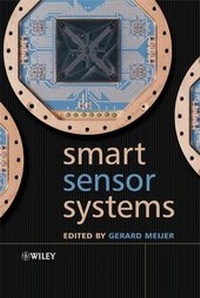
Smart Sensor Systems
Description

Reviews / Votes
"Writing by really stellar internationally-recognized team of experts ... .[This book] provides the reader with a deep understanding of the basic principles and concepts of advanced sensor systems." (Sensors and Transducers, March 2009)More details
Other editions
Additional editions
Person
Professor Gerard C. M Meijer, Electronic Instrumentation Laboratory, Delft University of Technology, The Netherlands.
Content
About the Authors.
1 Smart Sensor Systems: Why? Where? How? (Johan H. Huijsing).
1.1 Third Industrial Revolution.
1.2 Definitions for Several Kinds of Sensors.
1.3 Automated Production Machines.
1.4 Automated Consumer Products.
1.5 Conclusion.
References.
2 Interface Electronics and Measurement Techniques for Smart Sensor Systems (Gerard C.M. Meijer).
2.1 Introduction.
2.2 Object-oriented Design of Sensor Systems.
2.3 Sensing Elements and Their Parasitic Effects.
2.4 Analog-to-digital Conversion.
2.5 High Accuracy Over a Wide Dynamic Range.
2.6 A Universal Transducer Interface.
2.7 Summary and Future Trends.
Problems.
References.
3 Silicon Sensors: An Introduction (Paddy J. French).
3.1 Introduction.
3.2 Measurement and Control Systems.
3.3 Transducers.
3.4 Transducer Technologies.
3.5 Examples of Silicon Sensors.
3.6 Summary and Future Trends.
References.
4 Optical Sensors Based on Photon Detection (Reinoud F. Wolffenbuttel).
4.1 Introduction.
4.2 Photon Absorption in Silicon.
4.3 The Interface: Photon Transmission Into Silicon.
4.4 Photon Detection in Silicon Photoconductors.
4.5 Photon Detection in Silicon pn Junctions.
4.6 Detection Limit.
4.7 Photon Detectors with Gain.
4.8 Application Examples.
4.9 Summary and Future Trends.
Problems.
References.
5 Physical Chemosensors (Michael J. Vellekoop).
5.1 Introduction.
5.2 Physical Chemosensing.
5.3 Energy Domains.
5.4 Examples and Applications.
5.5 Examples of in situ Applications.
5.6 Microfluidics Devices.
5.7 Conclusions.
Problems.
References.
6 Thermal Sensors (Sander (A.W.) van Herwaarden).
6.1 The Functional Principle of Thermal Sensors.
6.2 Heat Transfer Mechanisms.
6.3 Thermal Structures.
6.4 Temperature-Difference Sensing Elements.
6.5 Sensors Based on Thermal Measurements.
6.6 Summary and Future Trends.
Problems.
References.
7 Smart Temperature Sensors and Temperature-Sensor Systems (Gerard C.M. Meijer).
7.1 Introduction.
7.2 Application-related Requirements and Problems of Temperature Sensors.
7.3 Resistive Temperature-sensing Elements.
7.4 Temperature-sensor Features of Transistors.
7.5 Smart Temperature Sensors and Systems.
7.6 Case Studies of Smart-sensor Applications.
7.7 Summary and Future Trends.
Problems.
References.
8 Capacitive Sensors (Xiujun Li and Gerard C.M. Meijer).
8.1 Introduction.
8.2 Basics of Capacitive Sensors.
8.3 Examples of Capacitive Sensors.
8.4 The Design of Electrode Configurations.
8.5 Reduction of Field-bending Effects: Segmentation.
8.6 Selectivity for Electrical Signals and Electrical Parameters.
8.7 Summary and Future Trends.
Problems.
References.
9 Integrated Hall Magnetic Sensors (Radivoje S. Popovi¿c and Pavel Kejik).
9.1 Introduction.
9.2 Hall Effect and Hall Elements.
9.3 Integrated Hall Sensor Systems.
9.4 Examples of Integrated Hall Magnetic Sensors.
Problems.
References.
10 Universal Asynchronous Sensor Interfaces (Gerard C.M. Meijer and Xiujun Li).
10.1 Introduction.
10.2 Universal Sensor Interfaces.
10.3 Asynchronous Converters.
10.4 Dealing with Problems of Low-cost Design of Universal Interface ICs.
10.5 Front-end Circuits.
10.6 Case Studies.
10.7 Summary and Future Trends.
Problems.
References.
11 Data Acquisition for Frequency- and Time-domain Sensors (Sergey Y. Yurish).
11.1 Introduction.
11.2 DAQ Boards: State of the Art.
11.3 DAQ Board Design for Quasi-digital Sensors.
11.4 Universal Frequency-to-digital Converters (UFDC).
11.5 Applications and Examples.
11.6 Summary and Future Trends.
Problems.
References.
12 Microcontrollers and Digital Signal Processors for Smart Sensor Systems (Ratcho M. Ivanov).
12.1 Introduction.
12.2 MCU and DSP Architectures, Organization, Structures, and Peripherals.
12.3 Choosing a Low-Power MCU or DSP.
12.4 Timer Modules.
12.5 Analog Comparators, ADCs, and DACs as Modules of Microcontrollers.
12.6 Embedded Networks and LCD Interfacing.
12.7 Development Tools and Support.
12.8 Conclusions.
References Sites.
Appendix A Material Data.
Appendix B Conversion for non-SI Units.
Index.
