

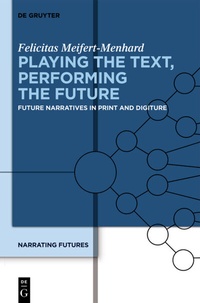
Playing the Text, Performing the Future
Future Narratives in Print and Digiture
1st Edition
Published on 14. October 2013
IX, 237 pages
978-3-11-027239-0 (ISBN)
Description

This volume examines the structure of text-based Future Narratives in the widest sense, including choose-your-own-adventure books, forking-path novels, combinatorial literature, hypertexts, interactive fiction, and alternate reality games. How 'radical' can printed Future Narratives really be, given the constraints of their media? When exactly do they not only play with the mere idea of multiple continuations, but actually stage genuine openness and potentiality? Process- rather than product-oriented, text-based Future Narratives are seen as performative and contingent systems, simulating their own emergence.
More details
Other editions
Additional editions
Felicitas Meifert-Menhard
Playing the Text, Performing the Future
Future Narratives in Print and Digiture
Book
08/2013
1st Edition
De Gruyter
€124.95
Shipment within 7-9 days
Person
Felicitas Meifert-Menhard, Ludwig-Maximilians-Universität München, Germany.
Content
1 - 1 Introduction: Narrating the Future in Text [Seite 11]
2 - 2 The Tellability of the Future [Seite 20]
2.1 - 2.1 The Shape of Narrative - The Shape of Experience [Seite 21]
2.2 - 2.2 The Shape of the Future [Seite 26]
2.3 - 2.3 What If.? Thinking Beyond Actuality [Seite 35]
2.4 - 2.4 Pre-Text and Prototype: Cybertext and Ergodics [Seite 37]
2.5 - 2.5 Shaping and Experiencing the Storyworld: Agency and Immersion [Seite 39]
3 - 3 Textual Future Narratives - Form and Structure [Seite 43]
3.1 - 3.1 Narrating the 'Not-Yet': Issues of Mediality [Seite 44]
3.1.1 - 3.1.1 Tempting Teleology [Seite 47]
3.1.2 - 3.1.2 Problematical Presence [Seite 49]
3.1.3 - 3.1.3 Imagining Optionality [Seite 51]
3.2 - 3.2 Nodes and Bifurcation: The Essence of Future Narratives [Seite 55]
3.3 - 3.3 Architecture, Run, Protocol: A Three-Level Narratological Model for FNs [Seite 57]
3.4 - 3.4 The Responsiveness of the System: Activity vs. Interactivity [Seite 63]
3.5 - 3.5 A Word on the Reader or: The Reader as Player [Seite 67]
3.6 - 3.6 The Necessity of Possibility: Do We Have to Play? [Seite 70]
3.7 - 3.7 A Typology of Textual Nodal Situations [Seite 72]
3.8 - 3.8 Transitions Between Nodal Situations [Seite 74]
3.8.1 - 3.8.1 Internal Page Transitions [Seite 74]
3.8.2 - 3.8.2 Page-to-Page Transitions [Seite 76]
3.8.3 - 3.8.3 Shuffling [Seite 77]
3.8.4 - 3.8.4 Link-to-Link Transitions [Seite 78]
3.8.5 - 3.8.5 Dynamic Input [Seite 78]
3.9 - 3.9 The Visibility of Nodes: Indication [Seite 79]
3.10 - 3.10 How to Choose? Information [Seite 81]
3.11 - 3.11 Narrative Negotiation of Possibility: Mediation [Seite 85]
3.12 - 3.12 Nodal Power [Seite 88]
3.13 - 3.13 Nodal Structures in Textual Future Narratives [Seite 92]
3.13.1 - 3.13.1 Directedness: The Arborescent Structure [Seite 93]
3.13.2 - 3.13.2 Circulation: The Network Structure [Seite 95]
3.13.3 - 3.13.3 Exploring and Returning: The Axial Structure [Seite 98]
3.14 - 3.14 Issues of Navigation and Space [Seite 100]
3.14.1 - 3.14.1 The Spatial Topology of Future Narratives [Seite 103]
3.14.2 - 3.14.2 Spatiality in Textual FNs [Seite 104]
4 - 4 A Typology of Future Narratives in Print and Digiture [Seite 108]
4.1 - 4.1 Imaginative Explorations of the Future: Chance, Choice, and the Resistance to Closure [Seite 110]
4.2 - 4.2 What Next? Open-Ended Narrative [Seite 112]
4.3 - 4.3 Testing the Boundaries of the Printed Format: Multi-Linearity, Multifurcation [Seite 116]
4.3.1 - 4.3.1 Non-linearity vs. Multi-linearity [Seite 117]
4.3.2 - 4.3.2 Problematical Presence: Multiple Endings [Seite 119]
4.3.3 - 4.3.3 Crucial Junctures: Forking Paths [Seite 122]
4.3.4 - 4.3.4 Choose-Your-Own-Adventure Stories [Seite 127]
4.4 - 4.4 Text as Play: Games, Combinatorics, Multimodality [Seite 134]
4.4.1 - 4.4.1 Game Novels and Combinatorics [Seite 135]
4.4.2 - 4.4.2 The Multimodal Novel [Seite 141]
4.5 - 4.5 Moving Into the Electronic Medium: Digital Multiplicity [Seite 144]
4.5.1 - 4.5.1 Interactive Fiction [Seite 145]
4.5.2 - 4.5.2 Hypertext Fiction [Seite 152]
4.5.3 - 4.5.3 The Visual Novel [Seite 163]
4.6 - 4.6 Approaching the Boundaries of Textuality: Narrative as Collaborative Performance [Seite 165]
4.6.1 - 4.6.1 Pen-and-Paper Role Playing [Seite 167]
4.6.2 - 4.6.2 Alternate Reality Gaming [Seite 170]
4.6.3 - 4.6.3 Forecasting Games [Seite 173]
4.7 - 4.7 Where Will We Go From Here? [Seite 174]
5 - 5 Selected Readings of Future Narratives: From Print to Digiture [Seite 177]
5.1 - 5.1 The Imaginative Exploration of Chance and Possibility: Paul Auster's The Music of Chance (1990) [Seite 177]
5.2 - 5.2 Pick Your Own Path, Then and Now: An Inside Look at Choose-Your-Own-Adventure [Seite 186]
5.2.1 - 5.2.1 Edward Packard, The Cave of Time (1979) [Seite 186]
5.2.2 - 5.2.2 Anson Montgomery, The Golden Path Volume One: Into the Hollow Earth (2008) [Seite 192]
5.3 - 5.3 The Novel as Branching Structure: Svend Åge Madsen's Days With Diam or Life at Night (1994) [Seite 197]
5.4 - 5.4 Prose as Path: Jacques Roubaud's The Great Fire of London (1991) [Seite 207]
5.5 - 5.5 Temporal Experiments in the Digital Web: Stuart Moulthrop's Hegirascope (1995/1997) and Pax (2003) [Seite 215]
5.6 - 5.6 Do It Again, and Better This Time: Andrew Plotkin's Spider and Web (1997-98) [Seite 223]
6 - Works Cited [Seite 233]
7 - Index [Seite 245]
2 - 2 The Tellability of the Future [Seite 20]
2.1 - 2.1 The Shape of Narrative - The Shape of Experience [Seite 21]
2.2 - 2.2 The Shape of the Future [Seite 26]
2.3 - 2.3 What If.? Thinking Beyond Actuality [Seite 35]
2.4 - 2.4 Pre-Text and Prototype: Cybertext and Ergodics [Seite 37]
2.5 - 2.5 Shaping and Experiencing the Storyworld: Agency and Immersion [Seite 39]
3 - 3 Textual Future Narratives - Form and Structure [Seite 43]
3.1 - 3.1 Narrating the 'Not-Yet': Issues of Mediality [Seite 44]
3.1.1 - 3.1.1 Tempting Teleology [Seite 47]
3.1.2 - 3.1.2 Problematical Presence [Seite 49]
3.1.3 - 3.1.3 Imagining Optionality [Seite 51]
3.2 - 3.2 Nodes and Bifurcation: The Essence of Future Narratives [Seite 55]
3.3 - 3.3 Architecture, Run, Protocol: A Three-Level Narratological Model for FNs [Seite 57]
3.4 - 3.4 The Responsiveness of the System: Activity vs. Interactivity [Seite 63]
3.5 - 3.5 A Word on the Reader or: The Reader as Player [Seite 67]
3.6 - 3.6 The Necessity of Possibility: Do We Have to Play? [Seite 70]
3.7 - 3.7 A Typology of Textual Nodal Situations [Seite 72]
3.8 - 3.8 Transitions Between Nodal Situations [Seite 74]
3.8.1 - 3.8.1 Internal Page Transitions [Seite 74]
3.8.2 - 3.8.2 Page-to-Page Transitions [Seite 76]
3.8.3 - 3.8.3 Shuffling [Seite 77]
3.8.4 - 3.8.4 Link-to-Link Transitions [Seite 78]
3.8.5 - 3.8.5 Dynamic Input [Seite 78]
3.9 - 3.9 The Visibility of Nodes: Indication [Seite 79]
3.10 - 3.10 How to Choose? Information [Seite 81]
3.11 - 3.11 Narrative Negotiation of Possibility: Mediation [Seite 85]
3.12 - 3.12 Nodal Power [Seite 88]
3.13 - 3.13 Nodal Structures in Textual Future Narratives [Seite 92]
3.13.1 - 3.13.1 Directedness: The Arborescent Structure [Seite 93]
3.13.2 - 3.13.2 Circulation: The Network Structure [Seite 95]
3.13.3 - 3.13.3 Exploring and Returning: The Axial Structure [Seite 98]
3.14 - 3.14 Issues of Navigation and Space [Seite 100]
3.14.1 - 3.14.1 The Spatial Topology of Future Narratives [Seite 103]
3.14.2 - 3.14.2 Spatiality in Textual FNs [Seite 104]
4 - 4 A Typology of Future Narratives in Print and Digiture [Seite 108]
4.1 - 4.1 Imaginative Explorations of the Future: Chance, Choice, and the Resistance to Closure [Seite 110]
4.2 - 4.2 What Next? Open-Ended Narrative [Seite 112]
4.3 - 4.3 Testing the Boundaries of the Printed Format: Multi-Linearity, Multifurcation [Seite 116]
4.3.1 - 4.3.1 Non-linearity vs. Multi-linearity [Seite 117]
4.3.2 - 4.3.2 Problematical Presence: Multiple Endings [Seite 119]
4.3.3 - 4.3.3 Crucial Junctures: Forking Paths [Seite 122]
4.3.4 - 4.3.4 Choose-Your-Own-Adventure Stories [Seite 127]
4.4 - 4.4 Text as Play: Games, Combinatorics, Multimodality [Seite 134]
4.4.1 - 4.4.1 Game Novels and Combinatorics [Seite 135]
4.4.2 - 4.4.2 The Multimodal Novel [Seite 141]
4.5 - 4.5 Moving Into the Electronic Medium: Digital Multiplicity [Seite 144]
4.5.1 - 4.5.1 Interactive Fiction [Seite 145]
4.5.2 - 4.5.2 Hypertext Fiction [Seite 152]
4.5.3 - 4.5.3 The Visual Novel [Seite 163]
4.6 - 4.6 Approaching the Boundaries of Textuality: Narrative as Collaborative Performance [Seite 165]
4.6.1 - 4.6.1 Pen-and-Paper Role Playing [Seite 167]
4.6.2 - 4.6.2 Alternate Reality Gaming [Seite 170]
4.6.3 - 4.6.3 Forecasting Games [Seite 173]
4.7 - 4.7 Where Will We Go From Here? [Seite 174]
5 - 5 Selected Readings of Future Narratives: From Print to Digiture [Seite 177]
5.1 - 5.1 The Imaginative Exploration of Chance and Possibility: Paul Auster's The Music of Chance (1990) [Seite 177]
5.2 - 5.2 Pick Your Own Path, Then and Now: An Inside Look at Choose-Your-Own-Adventure [Seite 186]
5.2.1 - 5.2.1 Edward Packard, The Cave of Time (1979) [Seite 186]
5.2.2 - 5.2.2 Anson Montgomery, The Golden Path Volume One: Into the Hollow Earth (2008) [Seite 192]
5.3 - 5.3 The Novel as Branching Structure: Svend Åge Madsen's Days With Diam or Life at Night (1994) [Seite 197]
5.4 - 5.4 Prose as Path: Jacques Roubaud's The Great Fire of London (1991) [Seite 207]
5.5 - 5.5 Temporal Experiments in the Digital Web: Stuart Moulthrop's Hegirascope (1995/1997) and Pax (2003) [Seite 215]
5.6 - 5.6 Do It Again, and Better This Time: Andrew Plotkin's Spider and Web (1997-98) [Seite 223]
6 - Works Cited [Seite 233]
7 - Index [Seite 245]
