

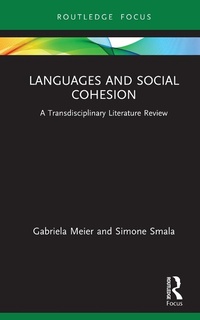
Languages and Social Cohesion
A Transdisciplinary Literature Review
1st Edition
Published on 29. August 2021
156 pages
978-1-000-44282-3 (ISBN)
Description

A critical and systematic review of existing research located at the crossroads of sociology, social psychology and applied linguistics, Languages and Social Cohesion offers valuable insights for social contexts in which decision makers and researchers grapple with questions of social cohesion in the presence of linguistic diversity.
Based on a thematic analysis of 285 studies from 50 countries (references available), this book emphasises the crucial role languages play in understanding social cohesion and provides a framework of perspectives to aid exploration of these complex interlinkages. Through interpreting the literature, the authors establish language repertoires as tools that facilitate social networks and access to resources. Furthermore, language norms and allegiances can subjectively shape the way groups use their language resources, which can result in social inclusion, exclusion and mediation between language groups.
Education in particular is highlighted as a policy tool that implements linguistic decisions and norms, and steers status, hierarchies and distribution of languages in society. The theory-informed and accessible tools featured can be used to guide and inform further research, workshops or projects that investigate social cohesion and languages. This book is relevant to diverse and intersecting spheres of influence, such as groups, communities, institutions and authorities at local, regional, national and international levels.
Based on a thematic analysis of 285 studies from 50 countries (references available), this book emphasises the crucial role languages play in understanding social cohesion and provides a framework of perspectives to aid exploration of these complex interlinkages. Through interpreting the literature, the authors establish language repertoires as tools that facilitate social networks and access to resources. Furthermore, language norms and allegiances can subjectively shape the way groups use their language resources, which can result in social inclusion, exclusion and mediation between language groups.
Education in particular is highlighted as a policy tool that implements linguistic decisions and norms, and steers status, hierarchies and distribution of languages in society. The theory-informed and accessible tools featured can be used to guide and inform further research, workshops or projects that investigate social cohesion and languages. This book is relevant to diverse and intersecting spheres of influence, such as groups, communities, institutions and authorities at local, regional, national and international levels.
Reviews / Votes
"Comprehensive and in-depth, this transdisciplinary meta-analysis sheds light on the complex interplays between languages and social cohesion in an increasingly fragmenting world. A must read for policy makers, teachers, researchers, and students in education, and language sciences as well as political and cultural sciences."Angel M. Y. Lin, Professor and Tier 1 Canada Research Chair in Plurilingual and Intercultural Education, Simon Fraser University, Canada
"This book contributes to our understandings of how the ways in which language is conceptualized, used and accessed by different linguistic groups in various national contexts facilitates or hinders social cohesion. After conducting a rigorous study of the existing literature on language and social cohesion, Meier and Smala not only summarize and analyze the themes in the literature, but they provide readers with a much-needed conceptual framework to carefully question and evaluate their own situations."
Ofelia Garcia, Emeritus Professor in Urban Education, Hispanic and Luso-Brazilian Literatures and Languages at The Graduate Center, City University of New York, USA
"Meier and Smala's compelling framework lays bare societal risks - and opportunities - that arise in contexts where diverse languages meet and where struggles around individual and societal belonging occur. This state-of-the-art overview of current knowledge critically reconstructs an impressive body of peer-reviewed literature from 50 countries: a go-to book for anyone globally who, like me, is concerned about the risk of proposing simple answers to complex societal problems."
Itesh Sachdev, Emeritus Professor of Languages and Communication, School of Languages, Cultures and Linguistics, School of Oriental and African Studies, University of London, UK
More details
Series
Edition
1. Auflage
Language
English
Place of publication
London
United Kingdom
Publishing group
Taylor & Francis Ltd
Target group
College/higher education
Illustrations
5 Tables, black and white; 4 Line drawings, black and white; 4 Illustrations, black and white
ISBN-13
978-1-000-44282-3 (9781000442823)
Copyright in bibliographic data and cover images is held by Nielsen Book Services Limited or by the publishers or by their respective licensors: all rights reserved.
Schweitzer Classification
Other editions
Additional editions
Book
01/2023
1st Edition
Routledge
€30.90
Shipment within 15-20 days
Book
08/2021
Routledge
Unfortunately, price unknown
Available (delivery time upon request)
Book
07/2021
1st Edition
Routledge
€76.90
Shipment within 15-20 days
Persons
Gabriela Meier is a senior lecturer in Language Education in the Graduate School of Education of the College for Social Sciences and International Studies at the University of Exeter, UK. She has worked as a researcher, language teacher educator and supervisor of doctoral projects at the universities of Bath and Exeter (UK). She has published in English, German and French in fields related to language education and social cohesion. Recent publications include Multilingual Socialisation in Education (2018) and The Multilingual Turn as a Critical Movement in Education (2017).
Simone Smala is a senior lecturer in Education in the School of Education in the Faculty of Humanities, Arts and Social Sciences at the University of Queensland, Australia. Her research on languages and cultural capital is set in Content and Language Integrated Learning (CLIL) and Bilingual Education programmes, with a focus on curriculum choices and language learning strategies. She publishes in English and German.
Simone Smala is a senior lecturer in Education in the School of Education in the Faculty of Humanities, Arts and Social Sciences at the University of Queensland, Australia. Her research on languages and cultural capital is set in Content and Language Integrated Learning (CLIL) and Bilingual Education programmes, with a focus on curriculum choices and language learning strategies. She publishes in English and German.
Content
1. Introduction: Researching languages and social cohesion
2. Languages and Social Cohesion: Key concepts and disciplinary overlaps
3. Studies linking languages and social cohesion: Developing a body of research
4. Linking languages and social cohesion: Analysis, themes and examples
5. Transdisciplinary language and social cohesion framework: Tools to support further explorations
2. Languages and Social Cohesion: Key concepts and disciplinary overlaps
3. Studies linking languages and social cohesion: Developing a body of research
4. Linking languages and social cohesion: Analysis, themes and examples
5. Transdisciplinary language and social cohesion framework: Tools to support further explorations
