

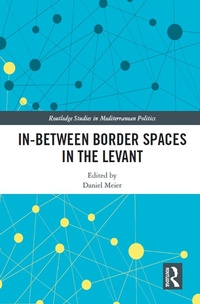
In-Between Border Spaces in the Levant
1st Edition
Published on 17. December 2020
154 pages
978-1-000-28780-6 (ISBN)
Description

This book focuses on interstitial spaces or in- between borders in the Middle East. Using various case studies, it raises the question how actors living in these regions perform their belonging despite the apparent constraints of history and politics.
In recent years, the Middle East has seen States attempts to shape buffer zones or safe zones in border regions, for example, in Syria's borderlands in the aftermath of the civil war. Typically studies on in- between borders refer to three interrelated aspects: space (territorial, symbolic), power (states or non-state actors) and identity (definition of the self/other). In this volume, the authors investigate these axes of research through the notions of sovereignty and belonging in order to assess how these concepts may highlight in-betweenness through a political dimension. Stemming from a perception of the borders as processes, these various studies aim to explore the theoretical potential of in- between border spaces to re-think sovereignty and identity belonging in such interstitial zones. While notions such as heterotopia, margins, liminality, borderlands, buffer zones, no man's land or frontiers will be explored, each case study highlights how actors, territory and powers relate to each other in order to improve our understanding of historical and political process that are shaping identities under spatial constraints.
The chapters in this book were originally published as a special issue of the journal, Mediterranean Politics.
In recent years, the Middle East has seen States attempts to shape buffer zones or safe zones in border regions, for example, in Syria's borderlands in the aftermath of the civil war. Typically studies on in- between borders refer to three interrelated aspects: space (territorial, symbolic), power (states or non-state actors) and identity (definition of the self/other). In this volume, the authors investigate these axes of research through the notions of sovereignty and belonging in order to assess how these concepts may highlight in-betweenness through a political dimension. Stemming from a perception of the borders as processes, these various studies aim to explore the theoretical potential of in- between border spaces to re-think sovereignty and identity belonging in such interstitial zones. While notions such as heterotopia, margins, liminality, borderlands, buffer zones, no man's land or frontiers will be explored, each case study highlights how actors, territory and powers relate to each other in order to improve our understanding of historical and political process that are shaping identities under spatial constraints.
The chapters in this book were originally published as a special issue of the journal, Mediterranean Politics.
More details
Series
Edition
1. Auflage
Language
English
Place of publication
London
United Kingdom
Publishing group
Taylor & Francis Ltd
Target group
College/higher education
Product notice
Reflowable
ISBN-13
978-1-000-28780-6 (9781000287806)
Copyright in bibliographic data and cover images is held by Nielsen Book Services Limited or by the publishers or by their respective licensors: all rights reserved.
Schweitzer Classification
Other editions
Additional editions
Daniel Meier
In-Between Border Spaces in the Levant
Book
09/2023
1st Edition
Routledge
€64.70
Shipment within 15-20 days
Daniel Meier
In-Between Border Spaces in the Levant
Book
11/2020
1st Edition
Routledge
€205.80
Shipment within 15-20 days
Person
Daniel Meier is a political scientist in Middle Eastern studies. He is Associate Professor at Sciences Po Grenoble and teaches regularly in Geneva, Beirut, Venice and Turin. His research are focuses on identity and spatial issues, with a dedication for borders and borderlanders. He recently edited Bordering the Middle East (Routledge, 2019).
Content
Introduction: In-between spaces in the Levant: Conceptual reflections
Daniel Meier
1. Bedouins and in-between border space in the northern Sinai
Evrim Goermues
2. Exploring the 'in-between' in Nicosia's Buffer Zone: Local practices of de-bordering
Zinovia Foka
3. Stretching the margins: Identity, power and new 'frontiers' in Lebanon's Maronite community
Rosita Di Peri
4. 'Disputed territories' in northern Iraq: The frontiering of in-between spaces
Daniel Meier
5. Endless borders: Detaining Palestinians and managing their movements in the occupied territories
Stephanie Latte Abdallah
6. Borderland studies, frontierization, and the Middle East's in-between spaces
Richard Schofield
Daniel Meier
1. Bedouins and in-between border space in the northern Sinai
Evrim Goermues
2. Exploring the 'in-between' in Nicosia's Buffer Zone: Local practices of de-bordering
Zinovia Foka
3. Stretching the margins: Identity, power and new 'frontiers' in Lebanon's Maronite community
Rosita Di Peri
4. 'Disputed territories' in northern Iraq: The frontiering of in-between spaces
Daniel Meier
5. Endless borders: Detaining Palestinians and managing their movements in the occupied territories
Stephanie Latte Abdallah
6. Borderland studies, frontierization, and the Middle East's in-between spaces
Richard Schofield
