

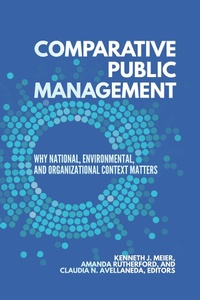
Comparative Public Management
Description

While the field of public management has become increasingly international, research and policy recommendations that work for one country often do not work for another. Why, for example, is managerial networking important in the United States, moderately effective in the United Kingdom, and of little consequence in the Netherlands? Comparative Public Management argues that scholars must find a better way to account for political, environmental, and organizational contexts to build a more general model of public management. The volume editors propose a framework in which context influences the types of managerial actions that can be used effectively in public organizations.
After introducing the innovative framework, the book offers seven empirical chapters-cases from seven countries and a range of policy areas (health, education, taxation, and local governance)-that show how management affects performance in different contexts. Following these empirical tests, the book examines themes that emerge across cases and seeks to set an agenda for future research. Intended for students and scholars of public administration and public policy, this book will be the first to provide a comprehensive comparative assessment of management's impact on organizational performance.
More details
Other editions
Additional editions
Persons
Kenneth J. Meier is the Charles H. Gregory Chair in Liberal Arts and Distinguished Professor of Political Science at Texas A&M University. He is also the editor in chief of the Journal of Public Administration Research and Theory.
Amanda N. Rutherford is an assistant professor in the School of Public and Environmental Affairs at Indiana University.
Claudia N. Avellaneda is an associate professor in the School of Public and Environmental Affairs at Indiana University.
Content
Preface
Introduction
Comparative Public Management: A Framework for Analysis
Laurence J. O'Toole Jr. and Kenneth J. Meier
1. Administrative Capacity and Health Care in Africa: Path Dependence as a Contextual Variable
Cameron Wimpy, Marlette Jackson, and Kenneth J. Meier
2. Environmental Complexity and Public Service Performance in England: Does Organizational Strategy Matter?
Rhys Andrews
3. Do Public/Private Differences Matter? Managerial Characteristics and Organizational Performance across Sectors of US Higher Education
Claire Stieg and Amanda Rutherford
4. The Better You Look, the More You See: Nonlinear Effects of Managerial Networking Hidden in the Research Setting of Dutch Primary Education
René Torenvlied and Agnes Akkerman
5. Loyal Agents or Saboteurs? Performance-Increasing Policies and Public Service Motivation among Hospital Workers in Denmark
Mads Leth Jakobsen, Anne Mette Kjeldsen, and Thomas Pallesen
6. The delegation of Municipal Spending in Honduras: Does the Decision Context Matter?
Claudia N. Avellaneda
7. Explaining the Expansion of Brazilian Municipal Revenues: Does Political Context or Managerial Background Influence Grant Acquisition?
Ricardo C. Gomes and Claudia N. Avellaneda
Conclusion
The Future Role of Context: The International Research Agenda
Amanda Rutherford, Laurence J. O'Toole Jr., and Kenneth J. Meier
References
List of Contributors
Index
