

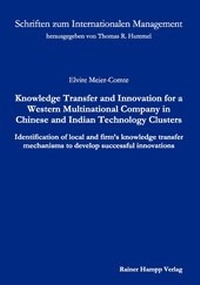
Knowledge Transfer and Innovation for a Western Multinational Company in Chinese and Indian Technology Clusters
Identification of local and firm's knowledge transfer mechanisms to develop successful innovations
1st Edition
Published on 1. September 2012
324 pages
978-3-86618-902-7 (ISBN)
Description

Compared to local and global Asian competitors, Western Multinational Companies struggle to offer successful innovations in emerging markets. This research aims to define, understand and explain the specific knowledge transfer mechanisms at the local level compared to Western Countries and how Western Companies integrate knowledge coming from a culturally different environment internally. The research focuses on four clusters in China and India with high relevance for their research and development activities: Bangalore, Beijing, Shanghai and Shenzhen. Especially interesting is the consideration of knowledge transfer mechanisms in Asian territories and for Western MNCs with respect to cross-cultural challenges. Basis for the research is a retrospective analysis of successful innovations and actors involved in the innovation process for each cluster. Results from the interviews with these key agents elucidate the most important knowledge transfer mechanisms for developing successful innovations in each of the economically, culturally and socially different clusters and draw a new typology of clusters in emerging and developed countries. Additionally and in comparison, formal and informal knowledge transfer mechanisms for communicating and integrating knowledge from the foreign subsidiary to headquarters are highlighted. This overall approach leads to new conclusions on the type of innovation strategies and organizations Western MNCs need to adopt to bring about successful innovation in Asia.
More details
Other editions
Additional editions
Elvire Meier-Comte
Knowledge Transfer and Innovation for a Western Multinational Company in Chinese and Indian Technology Clusters
Identification of local and firm's knowledge transfer mechanisms to develop successful innovations
Book
08/2012
1st Edition
Edition Rainer Hampp
€32.80
Shipment within 5-7 days
Person
Elvire Meier-Comte is Senior Consultant at the Innovation Strategy Department of Siemens Corporate Technology in Munich. Prior to joining this department, she took over different consulting and leadership positions in Siemens' businesses in Germany, USA, France, Singapore and China. Elvire Meier-Comte earned a Masters degree in Political Science and Law from the Institut d'Etudes Politiques Lyon and the University Salzburg followed by a postgraduate study in International Management at the University Metz. After ten years professional experience, she completed a doctoral thesis (Dr. rer. pol.) in Innovation Management with Prof. D. Wagner from the University Potsdam and Prof. M. v. Zedtwitz from the Research Center for Global R&D Management and Reverse Innovation (GLORAD) in St. Gallen / Shanghai.
Content
- Elvire Meier-Comte: Knowledge Transfer and Innovation for a Western Multinational Company in Chinese and Indian Technology Clusters. Identification of local and firm's knowledge transfer mechanisms to develop successful innovations
- Geleitwort
- Acknowledgements
- Table of Contents
- 1 Introduction
- 1.1 Motivation: Chinese and Indian MNCs are competing with knowledge and innovation for their large and fast growing markets
- 1.2 Definition of innovation versus market categories and the balance between technology and customer needs
- 1.3 The challenge of tapping and transferring knowledge in a cross-cultural context
- 1.4 The research question
- 1.5 Outline of the thesis
- 2 Knowledge spillovers and the economic geography of context
- 2.1 Cluster as "territory" to boost innovation (intra-cluster mechanisms- active)
- 2.1.1 Economic geography, geographic concentration of industry
- 2.1.2 Regional Innovation Systems
- 2.2 The social dimension of cluster and understanding of the local environment (intra-cluster mechanisms - passive)
- 2.2.1 Concept of social embeddedness and its application to innovative clusters
- 2.2.2 Localized knowledge spillovers and the role of workers and communities
- 2.2.3 Social relations and local institutional framework as key lever to be innovative
- 2.2.4 The innovative milieu approach
- 2.3 Formal and informal extra-cluster mechanisms
- 2.3.1 The International System of Innovation (ISI)
- 2.3.2 The global dimension of clusters, notion of trans-local pipelines and endogenous growth theory
- 2.3.3 Networking and the institutional environment
- 2.3.4 Firms, workers, community of practice as a trans-local highway
- 2.4 Characteristics and typologies of clusters in developing countries
- 2.4.1 From cluster's models to trajectories, learning regions
- 2.4.2 Characteristics and particularities of clusters in developing countries
- 2.4.3 Collective efficiency, cluster absorptive capacity and the role of firms in the cluster
- 2.4.4 Summary of the research on clusters in developing countries and comparison with developed countries
- 2.5 Summary of key levers, organizational and relational mechanisms for spillovers
- 2.5.1 Overview and definition of categories for the research
- 2.5.2 Conclusion: challenge of entry modes to maximize the appropriation of agglomeration economies
- 3 Multinationals in technological clusters: knowledge transfer and learning mechanisms leading to innovation
- 3.1 Firms' capacities and capabilities to be innovative in diverse environments
- 3.1.1 Core competences and absorptive capacity
- 3.1.2 Importance of firms' knowledge stocks
- 3.1.3 Firms' view: liability of foreignness
- 3.2 Knowledge transfer mechanisms for a multinational: from a local subsidiary to the headquarters
- 3.2.1 Strategies for and types of R&D internationalization: their consequences for locally transferred knowledge and within the MNC
- 3.2.2 Organizational mechanisms
- 3.2.2.1 Agency theory and behavioral control mechanisms
- 3.2.2.2 Effect of headquarters control mechanisms on subsidiary embeddedness
- 3.2.2.3 Organizational structure for achieving "creative subsidiaries:" autonomy, entrepreneurship and motivational mechanisms
- 3.2.2.4 Organizational systems or transmission channels: innovation process, managerial tools and IT
- 3.2.3 Socialization mechanisms
- 3.2.3.1 Structural dimension: social interaction with HQ and local social interaction
- 3.2.3.2 Relational dimension: value of trust and language
- 3.2.3.3 Cognitive dimension: shared vision, common values, routines, attitudes
- 3.2.3.4 Leadership and entrepreneurial culture
- 3.2.3.5 Limits of social capital
- 3.2.4 Workers, networks and communities
- 3.2.5 Summary of knowledge transfer and learning mechanisms in a Multinational Company
- 3.3 Challenges and specificities of transfer mechanisms in the Asian environment
- 3.3.1 Cognitive capacities and ability to learn in the Asian environment
- 3.3.1.1 Typologies of cultural dimensions to be considered for knowledge flows in Asian and Western countries
- 3.3.1.2 Country-specific differences in knowledge flows in Asia and Europe
- 3.3.1.3 Structure of communication in Western and Asian countries
- 3.3.2 Particularities of firms' knowledge transfer in Asia
- 3.3.2.1 Organizational mechanisms in Asian environments
- 3.3.2.2 Tacit knowledge, socialization and informal mechanisms in the Asian environment
- 3.3.2.3 Imitation and replication
- 3.3.2.4 Social networks and communities
- 3.3.2.5 The black-box of Japanese vs. US MNC to tap local knowledge in different cultural environments
- 3.3.2.6 Summary of knowledge transfer and learning mechanisms in Asia
- 3.3.3 Summary of challenges and barriers to knowledge transfer from a local context to the organization
- 3.4 Integrated frameworks considering clusters and firms for knowledge transfer and innovation in emerging countries
- 3.4.1 Status of the research for an integrated approach
- 3.4.1.1 Integrated framework of cluster vs. firm's organization and integration of knowledge: status of research
- 3.4.1.2 Summary of authors with integrated frameworks
- 3.4.2 Framework to be adopted
- 3.4.2.1 Bell and Albu, 1999
- 3.4.2.2 The modified framework from Bell and Albu, 1999
- 3.4.2.3 Bell's work on technological capabilities in developing countries
- 3.4.3 Mechanisms to be tested for the empirical analysis
- 4 Methodology - Research design
- 4.1 Preliminaries
- 4.2 Research design
- 4.2.1 Research question and empirical approach
- 4.2.2 Methodology: qualitative case study through Action research and interviews
- 4.2.2.1 The qualitative case study approach
- 4.2.2.2 Reasons to adopt an "action research" for the case study
- 4.2.2.3 Semi-structured interviews as "acting again"
- 4.2.2.4 Definition of "high local knowledge inside"
- 4.2.2.4.1 New business models in China and importance of local knowledge and social context if targeting the "bottom of the pyramid"
- 4.2.2.4.2 Definition that high market share for a product in Asia means high "local inside," and therefore, successful knowledge flows
- 4.2.2.5 Validity of the construct and reliability of the data
- 4.2.2.6 Overview of the analysis
- 4.2.3 Criteria for selecting the case studies
- 4.2.3.1 Economically and technologically dynamic clusters
- 4.2.3.2 Knowledge-intensive industries with successful products or services in these clusters
- 4.3 Sample design and data collection
- 4.3.1 Overview on successful products for the industries in China and India
- 4.3.1.1 Successful products
- 4.3.1.2 Summary of industries and products
- 4.3.2 The interview sample
- 4.3.3 Semi-structured questionnaire
- 4.3.4 Measurement of the construct and expected overview
- 4.3.4.1 Measurement of the construct
- 4.3.4.2 Overview of expected / possible typologies of knowledge acquisition and transfer
- 5 Results of the research on knowledge transfer mechanisms in Chinese and Indian clusters
- 5.1 Indian history and regionalism modeling today's innovation ecosystem
- 5.1.1 The emergence of agglomerations as part of the global innovation system (GIS): the Indian paradigm
- 5.1.1.1 Role of the State before and after 1991
- 5.1.1.2 Challenge of regionalism and socio-economical diversity
- 5.1.1.3 Role of private industry and local heroes to build a "network community"
- 5.1.1.4 R&D centers and investment in India: half of the presence is in Bangalore
- 5.1.2 Bangalore: cluster effect due to industry agglomeration, worker mobility and intensive inside- and outside-networks
- 5.1.2.1 Bangalore and its attractiveness for R&D in India
- 5.1.2.2 Innovations to be analyzed
- 5.1.2.3 Key mechanisms for knowledge transfer in a Western MNC in Bangalore: the roles of customers and workers
- 5.1.2.3.1 Customers and workers, value of labor
- 5.1.2.3.2 Characteristics and history of the cluster
- 5.1.2.3.3 Industry-University liaison, firms and networks
- 5.1.2.3.4 The role of worker migration, extra-cluster mechanism
- 5.1.2.3.5 Mechanisms with a medium score for relevance to innovation
- 5.1.2.3.6 Mechanisms with a low rate for their relevance for the innovation
- 5.1.2.4 Knowledge transfer mechanisms within the Western MNC: mainly passive mechanisms and networks
- 5.1.2.4.1 Mechanisms of high relevance to the firm: passive mechanisms only
- 5.1.2.4.2 Mechanisms with a middle rate for their relevance to the firm
- 5.1.2.4.3 Mechanisms with a low rate of relevance to the firm
- 5.1.3 Conclusion and overview of the results of the integrated framework
- 5.1.3.1 Conclusion for innovations in Bangalore
- 5.1.3.2 Positioning in the integrated framework of innovative products and solutions in Bangalore
- 5.1.3.3 Assumption of innovations in other Indian cities
- 5.1.3.4 Limits of the assumption
- 5.2 China: the emergence of the triple helix model in China and government influence
- 5.2.1 Introduction: speed and systematic growth
- 5.2.1.1 Decentralization through "one way" targeting
- 5.2.1.1.1 Role of the state: state actors (Zhuguan danwei)
- 5.2.1.1.2 Decentralized organizational structure with variable autonomy
- 5.2.1.2 Innovation eco-system in China
- 5.2.1.2.1 Innovation capabilities of private vs. public enterprises
- 5.2.1.2.2 Limited industry-research collaboration
- 5.2.1.2.3 Universities and public research institutes in China
- 5.2.1.2.4 Increasing foreign R&D and the MNC R&D centers in China
- 5.2.1.2.5 Workers and personal networks
- 5.2.1.3 From "imitation to innovation": systematic build-up of the Silicon Valley Model
- 5.2.1.4 R&D centers and investment in China: importance of Shanghai and Beijing
- 5.2.2 Beijing: undeniably "real" cluster effects through government/universities/industries and innovation capabilities
- 5.2.2.1 Beijing as the center for R&D activities in China
- 5.2.2.2 Innovation analyzed
- 5.2.2.3 Key mechanisms for knowledge transfer for a Western MNC in Beijing: the role of customers, the value of the cluster, the workers and the government
- 5.2.2.3.1 Customers, history of the cluster and value of workers and labor
- 5.2.2.3.2 Government and language
- 5.2.2.3.3 Mechanisms with medium relevance for the innovation
- 5.2.2.3.4 Mechanisms with low relevance for the innovation
- 5.2.2.4 Knowledge transfer mechanisms within Western MNCs in Beijing: institutions and networks
- 5.2.2.4.1 Mechanisms with a high relevance rate for the firm
- 5.2.2.4.2 Mechanisms with a medium relevance rate for the firm
- 5.2.2.4.3 Mechanisms with a low rate of relevance for the firm
- 5.2.2.5 Conclusion and overview of the results on the integrated framework
- 5.2.2.5.1 Conclusion for the TCM innovation in Beijing
- 5.2.2.5.2 Positioning innovative products and solutions in Beijing in the integrated framework
- 5.2.2.5.3 Limits of the research in Beijing
- 5.2.3 Shanghai: local agglomeration effects and internal synergies
- 5.2.3.1 Role of State-owned enterprise and "verticalized" agglomeration
- 5.2.3.1.1 Local Government and state-owned enterprises
- 5.2.3.1.2 Industrial history and role of MNC investing from the 1990s on
- 5.2.3.1.3 Workers and social networks
- 5.2.3.2 Innovation to be analyzed
- 5.2.3.3 Key mechanisms for knowledge transfer for the Western MNC in Shanghai: workers, customers and the role of firms
- 5.2.3.3.1 Value of workers and customers
- 5.2.3.3.2 Local business and suppliers, role of firms outside of the cluster and characteristics of the cluster
- 5.2.3.3.3 Mechanisms with medium relevance for the innovations
- 5.2.3.3.4 Mechanisms with low relevance for the innovations
- 5.2.3.4 Knowledge Transfer mechanisms within the Western MNC: majority of organizational mechanisms and importance of workers and social interactions
- 5.2.3.4.1 Workers and social interaction with headquarters, firm's social capital
- 5.2.3.4.2 Organizational systems, organizational structure and innovation process
- 5.2.3.4.3 Mechanisms with middle relevance for the firm
- 5.2.3.4.4 Mechanisms with low relevance for the firm
- 5.2.3.5 Conclusion for innovation in Shanghai
- 5.2.3.5.1 Conclusion for the CT innovations in Shanghai
- 5.2.3.5.2 Positioning in the integrated framework of CT innovations in Shanghai
- 5.2.3.5.3 Limits of the research in Shanghai
- 5.2.4 Shenzhen: an attractive node in a worldwide expert network
- 5.2.4.1 Characteristics of Shenzhen: relatively independent but still close to Beijing, few interactions with Hong Kong, Chinese and Western MNCs
- 5.2.4.2 Innovations to be analyzed
- 5.2.4.3 Key mechanisms for knowledge transfer for the Western MNC in Shenzhen: importance of workers and firms inside and outside of the cluster
- 5.2.4.3.1 Value of workers locally, importance of customers and characteristics of the cluster
- 5.2.4.3.2 Local business and inter-firm networks, type of firms and business groups in Shenzhen and role of firms outside of the cluster
- 5.2.4.3.3 Mechanisms with middle relevance for the knowledge transfer in Shenzhen
- 5.2.4.3.4 Mechanisms with low relevance for the knowledge transfer in Shenzhen
- 5.2.4.4 Knowledge transfer mechanisms within the Western MNC: importance of organizational mechanisms and social interaction with the headquarters
- 5.2.4.4.1 Importance of the organizational structure, processes and systems but also of the social interaction with the headquarters and workers
- 5.2.4.4.2 Mechanisms with middle importance for the knowledge transfer between the local entity and headquarters
- 5.2.4.4.3 Mechanisms with low importance for knowledge transfer between the local entity and headquarters
- 5.2.4.5 Conclusion for innovation in Shenzhen
- 5.2.4.5.1 Conclusion for the MRI innovations in Shenzhen
- 5.2.4.5.2 Positioning in the integrated framework of CT innovations in Shenzhen
- 5.2.4.5.3 Limits of the research in Shenzhen
- 5.2.5 Conclusion on clusters in China
- 5.2.5.1 Overview of three clusters in China: key mechanisms locally and within the firm
- 5.2.5.1.1 Key levers for knowledge transfer in Chinese clusters
- 5.2.5.1.2 Key levers to integrate local knowledge from Chinese clusters in a Western-MNC: conclusion on organizational models to be adopted
- 5.2.5.2 Limits of the assumption
- 5.3 Summary of key knowledge transfer categories and mechanisms at the cluster and at the firm level
- 5.3.1 Summary of cluster's key knowledge transfer categories to drive successful innovation
- 5.3.2 Particularities of knowledge transfer mechanisms at the firm level for the four innovations analyzed
- 6 Implication for a Western Multinational Company strategy in China and India
- 6.1 Cluster typology in emerging vs. developed countries
- 6.1.1 Comparison of key mechanisms for the four clusters analyzed
- 6.1.2 Comparison with a high-tech cluster in the medical imaging field and characteristics in Europe, Germany
- 6.1.2.1 Research landscape in Germany and the importance of the healthcare industry
- 6.1.2.2 The Medical Valley in Nuremberg: excellence and cooperation for innovation
- 6.1.2.3 Key learning and comparison of the Western cluster "Medical Valley Nuremberg" with Indian and Chinese clusters
- 6.1.3 Summary of key mechanisms for emerging countries and for developed countries and extension of the cluster typology from Giuliani
- 6.2.1 Overview of key mechanisms for the four firms and innovations analyzed
- 6.2.2 Revision and extension of the framework for the Multinational Company's research and development strategy in emerging countries
- 6.2.2.1 Firms' R&D strategy and organizational models (Bartlett, 1989
- Zedtwitz v., 2002)
- 6.2.2.2 Similarities and differences with Western or Asian models of organization of Multinational Companies (Lam, 2008
- Lehrer and Asakawa, 2003)
- 6.3 The use of IT and Web 2.0: the possible impact of using a mechanism with high future potential
- 6.3.1 IT and social media and their intensive and exponential use in India and China
- 6.3.1.1 Traditional IT solutions vs. social media platforms enabling new way to exchange knowledge
- 6.3.1.2 Asia leading the way in the use of social media
- 6.3.1.3 Role of social media and mobile phone in India
- 6.3.1.4 Role and use of IT and social media in China
- 6.3.1.5 Conclusion and important learning in the use of social media in India and China
- 6.3.2 IT and social media to reinforce identified key mechanisms in the future
- 6.3.2.1 Possible impact of IT and social media at the cluster level
- 6.3.2.2 Possible impact of IT and social media at the firm level
- 6.3.3 Conclusion and limits of the assumption
- 6.4 Implications for a Western Multinational Company in China and India and new challenges
- 6.4.1 Consider and appreciate clusters in emerging countries differently to really benefit from the local knowledge
- 6.4.2 Select cluster depending on the innovation strategy and consider knowledge transfer mechanisms identified
- 6.4.2.1 Criteria to select clusters in India and China depending on the innovation strategy
- 6.4.2.2 Apply knowledge transfer mechanisms identified if Western MNC follows a "customer innovation" strategy
- 6.4.2.2.1 Consequences at the cluster level: using unconventional means to understand local customer needs, workers as key nodes in a worldwide network
- 6.4.2.2.2 Consequences at the firm level: socialization mechanisms are more important than organizational mechanisms
- 6.4.2.3 Apply knowledge transfer mechanisms identified if Western-MNC follows a high-technology strategy in China
- 6.4.2.3.1 Consequences at the cluster level: formal collaboration mechanisms with customers and importance of extra-cluster knowledge
- 6.4.2.3.2 Consequences at the firm level: organization mechanisms are more important than socialization mechanisms
- 6.4.3 Be fast and flexible to reflect dynamism and speed of change of Asian markets in the adoption of new technologies and media compared to developed markets
- 7 Conclusion
- 7.1 Findings related to the research question
- 7.1.1 Research question 1: What are the context-specific knowledge spillovers and cross-border organization learning processes for a Western MNC with R&D presence in Asia? How to use them to be more innovative?
- 7.1.2 Research questions 2 and 3: Are there differences between spillovers in European and Asian technology clusters with the example of technology clusters in Germany, China, and India? Based on successful innovations in the medical industry, what are the context-specific mechanisms and processes? Are there differences between spillovers in European and Asian countries depending on the industries?
- 7.1.3 Research question 4: How can Western Multinationals insure an optimal integration of knowledge coming from Chinese and Indian clusters? Are there specific learning mechanisms linked to each cluster, country, region and culture?
- 7.2 Theoretical implications for the integrated framework and final key findings
- 7.2.1 Revision and extension of the integrated framework from Bell, 1999
- 7.2.2 Final key findings
- 7.2.2.1 New definition of innovation for emerging markets and importance of customer relationship management
- 7.2.2.2 Asian clusters need to be selected considering the innovation strategy of the MNC and the characteristics of the cluster rather than innovation capability
- 7.2.2.3 Importance of workers and their social networks at the local and at the firm level
- 7.2.2.4 Importance of specific processes locally and within the firm
- 7.2.2.5 Importance of extra-cluster mechanisms at the worker and firm level
- 7.2.2.6 New models of organization should reflect a "high-technology" or "customer innovation" strategy
- 7.2.2.7 Speed of change and adaptability in emerging countries
- 7.2.2.8 Lessons-learned for Western clusters to position themselves toward clusters in emerging markets
- 7.2.2.9 Cross-cultural challenges could be overcome through the extended use of social media
- 7.3 Strengths and weaknesses of the research
- 7.4 Suggestions for future research
- 8 Appendices
- 8.1 Questionnaires for interviews
- 8.2 Detailed Table of content
- 9 Bibliography
