

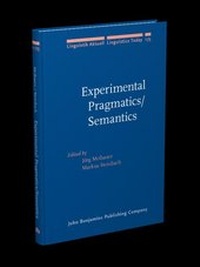
Experimental Pragmatics/Semantics
1st Edition
Published in 2011
X, 240 pages
978-90-272-8715-1 (ISBN)
Description

In recent years, a lively debate ensued on an old issue, namely the proper distinction between semantics and pragmatics against the background of the classical Gricean distinction between 'what is said' and 'what is implicated'. From a linguist's point of view, however, there has always been a regrettable lack of empirical data in this otherwise sophisticated debate. Recently, a new strand of research emerged under the name of experimental pragmatics, the attempt to gain experimental data on pragmatic and semantic issues by using psycholinguistic and neurolinguistic methods. This volume brings together work by scholars engaging in experimental research on the semantics/pragmatics distinction. The contribution of experimental pragmatics to pragmatic and semantic theory is discussed from a number of different angles, ranging from implicature and pragmatic enrichment to pragmatic acquisition, pragmatic impairment, and pragmatic processing. In addition, methodological issues are discussed. The contributions will appeal to theoretical linguists, psycholinguists, neurolinguists, and language philosophers.
More details
Other editions
Additional editions
Joerg Meibauer | Markus Steinbach
Experimental Pragmatics/Semantics
Book
04/2011
John Benjamins Publishing Co
€100.70
Shipment within 10-15 days
Persons
Content
- Experimental Pragmatics/Semantics
- Editorial page
- Title page
- LCC data
- Table of contents
- Preface
- List of contributors
- Introduction
- 1. Introduction
- 2. Testing for scalar implicatures
- 3. Varieties of pragmatic enrichment
- 4. Developmental pragmatics
- 5. Pragmatic impairment
- 6. Processing and the neuronal system
- 7. Variety of methodologies
- 8. The contributions to this volume
- Selected bibliography
- The development of conversational competence in children with Specific Language Impairment
- 1. Introduction
- 1.1 Children with Specific Language Impairment
- 1.2 Grice's maxims
- Quantity
- Quality
- Relation: Be relevant.
- Manner
- 2. Language-impaired children's conversational skills
- 2.1 General characteristics
- 2.2 Social skills of children with SLI
- 2.3 Adult interaction with language-impaired children
- 3. Language development and early performance on the maxims
- 3.1 Findings of previous studies
- 3.2 Limitations of previous studies
- 4. The present study
- 4.1 Research questions
- 4.2 Participants
- 4.3 Procedure
- 4.4 Results
- 5. Discussion
- 5.1 Violation categories and the maxims
- 5.2 Conversational skills of a language impaired child with higher cognitive and language skills
- 5.3 Quantifying and categorizing conversational violations by Children with SLI
- 5.4 Future directions
- 6. Summary
- References
- Appendix
- The impact of literal meaning on what-is-said
- 1. Contextualism: The state of the debate
- 2. Experimental approaches
- 2.1 Noveck and Sperber
- 2.2 Gibbs and Moise
- 2.3 Nicolle and Clark
- 2.4 The status of implicatures
- 3. The method of the study
- 4. Discussion of the results
- 5. Summary
- References
- Appendix
- Discourse under control in ambiguous sentences
- 1. Introduction
- 2. Satisfaction of the Question-Answer-Requirement
- 3. Non-adult interpretations with modals
- 3.1 Experiment I: Children's interpretation of potere and negation in Italian
- 3.2 Experiment II: Evaluation of the Question-Answer-Requirement
- 4. General discussion
- 5. Summary
- References
- Pragmatic children
- 1. Introduction
- 2. Focus particles and children's acquisition task
- 3. Previous studies on children's comprehension of sentences with only
- 4. The study
- 4.1 Experiment 1
- 4.1.1 Participants
- 4.1.2 Materials and procedure
- 4.1.3 Results
- 4.1.4 Discussion
- 4.2 Experiment 2
- 4.2.1 Participants
- 4.2.2 Material and procedure
- 4.2.3 Results
- 4.2.4 Discussion
- 5. General Discussion
- References
- Appendix A
- Appendix B
- Adult response uniformity distinguishes semantics from pragmatics
- 1. Introduction
- 2. Some of) the semantic and pragmatic meanings of coordination
- 2.1 Truth-conditional semantic meaning
- 2.2 Pragmatic meaning
- 2.3 Non-truth-conditional arbitrary meaning
- 3. Hypotheses and predictions
- 3.1 Hypotheses and predictions for adults
- 3.2 Hypotheses and predictions for children
- 4. The experiment
- 4.1 The task and materials
- 4.1.1 Condition 1
- 4.1.2 Condition 2
- 4.1.3 Condition 3
- 4.1.4 Condition 4
- 4.1.5 Condition 5
- 4.1.6 Condition 6
- 4.2 Participants
- 5. Results and discussion
- 5.1 The adult results
- 5.1.1 Semantic meaning
- 5.1.2 Pragmatic meaning
- 5.2 The child results
- 5.2.1 Semantic meaning
- 5.2.2 Pragmatic meaning
- 5.3 Summary of results
- 6. Summary and general discussion
- 6.1 Adult response (non)uniformity for semantics and pragmatics
- 6.2 Interpreting child responses to tests of semantic and pragmatic meaning
- 7. Response uniformity cross-linguistically
- 8. Theoretical and experimental criteria for distinguishing semantics and pragmatics
- 9. Conclusions
- References
- Numerals and scalar implicatures
- 1. Introduction
- 2. An overview of theoretical approaches to Scalar Implicatures
- 3. Numerals and Scalar Implicatures
- 4. Experiment 1: An off line semantic judgment test
- 5. Experiment 2: An online processing experiment
- 6. Conclusions
- References
- Meaning in the objects
- 1. Introduction
- 1.1 A symbol influences object perception
- 1.2 Semiotic character of objects
- 2. Method
- 2.1 Subjects
- 2.2 Stimuli
- 2.3 Procedure
- 2.4 Category system for nonverbal performance
- 3. Results and Discussion
- 3.1 Cross-linguistic findings on age, lexicon and performance
- 3.2 Gestural type in canonical vs. noncanonical settings
- 3.3 Discussion
- 3.4 Conclusions
- References
- Appendix
- Blocking modal enrichment (Tatsächlich)
- 1. Introduction
- 2. Modal enrichment
- 3. Blocking modal enrichment
- 4. Discussion
- 5. Conclusion
- References
- The hepatitis called .
- 1. Introduction
- 2. Enriched composition
- 3. Revious electrophysiological evidence
- 4. Empirical evidence for enriched composition during reference transfer
- 4.1 ERP study
- 4.2 Norming study
- 5. General Discussion
- The role of QUD and focus on the scalar implicature of most
- 1. Introduction
- 2. Experiment 1
- 2.1 Setup and items
- 2.2 Design
- 2.3 Participants and procedure
- 2.4 Results and discussion
- Results of the wh-QUD conditions
- Results of the yes/no-QUD conditions
- 3. Experiment 2
- 3.1 Setup, items, design and procedure
- 3.2 Participants
- 3.3 Results and Discussion
- 4. General Discussion
- 5. Conclusion
- References
- Index
- The series Linguistik Aktuell/Linguistics Today
