

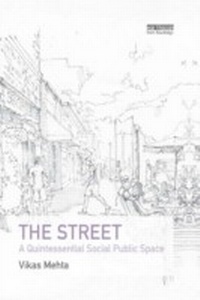
The Street
A Quintessential Social Public Space
1st Edition
Published on 5. March 2013
256 pages
978-1-135-07989-5 (ISBN)
Description

Received the Environmental Design Research Association's 2014 Place Book Award
Shortlisted for the UDG Francis Tibbalds Book Award 2014
Good cities are places of social encounter. Creating public spaces that encourage social behavior in our cities and neighborhoods is an important goal of city design. One of the cardinal roles of the street, as public space, is to provide a setting for sociability.
How do we make sociable streets? This book shows us how these ordinary public spaces can be planned and designed to become settings that support an array of social behaviors. Through carefully crafted research, The Street systematically examines people's actions and perceptions, develops a comprehensive typology of social behaviors on the neighborhood commercial street and provides a thorough inquiry into the social dimensions of streets.
Vikas Mehta shows that sociability is not a result of the physical environment alone, but is achieved by the relationships between the physical environment, the land uses, their management, and the places to which people assign special meanings.
Scholars and students of urban design, planning, architecture, geography and sociology will find the book a stimulating resource. The material is also directly applicable to practice and should be widely read by professional urban designers, planners, architects, and others involved in the design, planning, and implementation of commercial streets.
Shortlisted for the UDG Francis Tibbalds Book Award 2014
Good cities are places of social encounter. Creating public spaces that encourage social behavior in our cities and neighborhoods is an important goal of city design. One of the cardinal roles of the street, as public space, is to provide a setting for sociability.
How do we make sociable streets? This book shows us how these ordinary public spaces can be planned and designed to become settings that support an array of social behaviors. Through carefully crafted research, The Street systematically examines people's actions and perceptions, develops a comprehensive typology of social behaviors on the neighborhood commercial street and provides a thorough inquiry into the social dimensions of streets.
Vikas Mehta shows that sociability is not a result of the physical environment alone, but is achieved by the relationships between the physical environment, the land uses, their management, and the places to which people assign special meanings.
Scholars and students of urban design, planning, architecture, geography and sociology will find the book a stimulating resource. The material is also directly applicable to practice and should be widely read by professional urban designers, planners, architects, and others involved in the design, planning, and implementation of commercial streets.
Reviews / Votes
Mehta's description of the street as social space is a welcome reminder to those who see it simply as pattern or movement channel. The book is required reading for all who want more livable cities. - Sidney Brower, Professor Emeritus, School of Architecture, Planning & Preservation, University of MarylandA readable and engaging people-focused book about high streets - Marc Furnival, Urban Design, Issue 128, Autumn 2013
With his fine-grained analysis of the design and use of three Massachusetts streets, Vikas Mehta reveals the particular qualities of road way, sidewalk and building frontage that together create vibrant public spaces - for people and for businesses. - Karen A. Franck, Professor, School of Architecture and Department of Humanities, New Jersey Institute of Technology
This important book returns designers' and policy-makers' attention back to the street as a place of social, economic, and cultural exchange. Using empirical observation and survey methods in the tradition of Lynch, Whyte, and Gehl, urban designer Vikas Mehta defines factors associated with socially successful, multi-use streets. They range from seating and shade (crucial) to economic policy to support the critical ingredient of independent, speciality businesses that add cultural and visual interest. Required reading for anyone concerned with re-animating the public realm of the city. - Robin C. Moore, Professor of Landscape Architecture, College of Design, North Carolina State University
A fresh take... [Mehta] conducted user interviews and performed multiple regression analysis on his frontage variables to determine the relative contribution of each to social activity. I cannot do justice to this full-length book in a short column, but I can say from experience that the book goes well with a glass of merlot while seated at an outdoor cafe. - Reid Ewing, Journal of the American Planning Association
[...] few books on urban design cover the details of social behaviour, and even fewer do so with reference to the street. And this is exactly what Metha aims to do in this book: provide readers with the tools to create 'sociable streets'. - Iris Levin, Southgate Institute, Flinders University, Australia, in the Australian Planner
"Whilst The Street is academic in tone, Dr Mehta's years as a practitioner, both in the US and India, combined with an observational perspective make this a readable and engaging people-focused book about high streets."- Marc Furnival, Urban Design Group Journal
"The book contributes to the existing scholarship about public space and streets. It is a good text for urban design graduate students and also for practicing community planners. Overall, the book is very easy to read. It is a well-researched case study of three main streets in the Boston metropolitan area that sheds light on some of the problems facing our public social spaces." - Journal of Planning Education and Research, Torsha Bhattacharya, University of Hawaii
More details
Language
English
Place of publication
London
United Kingdom
Publishing group
Taylor & Francis Ltd
Target group
College/higher education
Professional and scholarly
Illustrations
20 Tables, black and white; 100 Illustrations, black and white
File size
3,63 MB
ISBN-13
978-1-135-07989-5 (9781135079895)
Copyright in bibliographic data and cover images is held by Nielsen Book Services Limited or by the publishers or by their respective licensors: all rights reserved.
Schweitzer Classification
Other editions
Additional editions
Book
02/2014
1st Edition
Routledge
€95.80
Shipment within 15-20 days
Book
02/2013
1st Edition
Routledge
€267.31
Shipment within 15-20 days
Person
Vikas Mehta, PhD, is the Fruth/Gemini Chair, the Ohio Eminent Scholar of Environment/Urban Design and?Associate Professor at the School of Planning, College of Design, Architecture, Art and Planning at the University of Cincinnati.
Content
Introduction 1. A Ubiquitous Urban Space for People 2. The Street Evolving: A Brief Social History 3. Everyday Social Behavior as a Basis for Design 4. Three Streets 5. Sociable Streets: A Typology of Social Behaviors 6. Needs for Social Behavior on Streets 7. Making Sociable Streets: Guidelines and Application Appendices
