

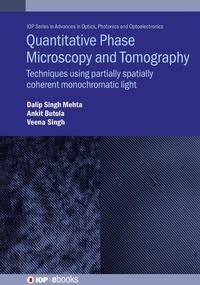
Quantitative Phase Microscopy and Tomography
Description

Quantitative phase Microscopy (QPM) has become a vital imaging technique in biology for investigating cells and tissues. QPM is an optical interference or holographic microscopic technique in which an input light beam is divided into two beams, and one passes through the object and the other acts as a reference beam. Both beams are interfered and recorded using a solid-state area detector, such as, a charged coupled device (CCD) or complementary metal oxide semiconductor (CMOS) detector. The recorded interferogram or hologram is then post-processed using Fourier Transform fringe analysis or phase shifting fringe analysis to reconstruct the phase map of the light field interrogated with the sample.
Traditionally, QPM techniques use lasers (highly spatially and temporally coherent) as their light source. This leads to speckle and spurious interference fringes, which results in poor spatial phase sensitivity, inaccuracy in optical path length measurement and non-uniform illumination. These imaging obstacles are overcome using partially spatially coherent monochromatic light as the light source instead, thus the reason for dedicating an entire book to the subject. In addition to being used in various imaging applications, QPM is also complementary to established fluorescence microscopy, exhibiting lower phototoxicity and no photobleaching.
This book describes the most advanced QPM techniques and computational imaging techniques using partially spatially coherent monochromatic light rather than lasers. It covers topics, such as, speckle-free QPM both off-axis and common path interferometric configurations, structured illumination phase microscopy (SIPM), chip-based nanoscopy, machine learning, deep learning, and artificial intelligence (AI) in phase microscopy and OCT and Multi-spectral and hyper-spectral phase microscopy. This coherent-artifacts free QPM leads to an order of magnitude improved spatial phase sensitivity, space-bandwidth product, and high temporal phase stability. The technique was utilized for sperm cells, red blood cells, macrophages, liver sinusoidal endothelial cells, and cancer cells. Recent advancements in speckle-free multi-spectral and hyperspectral QPM techniques are also discussed.
The text is useful to researchers, doctoral and post-doctoral students working in the area of Biomedical Optics, Bio-photonics, Advance Microscopy, Holography and Optical Metrology.
More details
Other editions
Additional editions

Persons
Dr. Dalip Singh Mehta is currently a Professor at the Department of Physics, Indian Institute of Technology Delhi. He has been actively working in the areas of Bio-photonics (Quantitative Phase Microscopy, Optical Coherence Tomography, Fluorescence Microscopy, White Light Interference Microscopy, Optical Multimodal Techniques for Disease Detection, and Optical Tweezers), Green Photonics: Laser Based Solid State Lighting, Sunlight Harvesting, Optics of LEDs and OLEDs and Optical Metrology.
Dr. Ankit Butola received his Ph.D. from the Indian Institute of Technology Delhi. He was a Senior Project Scientist at Indian Institute of Technology Delhi and is currently a Postdoctoral researcher at UiT The Arctic University of Norway. His current research interests are Quantitative Phase Microscopy, Optical Coherence Tomography, Super-resolution Optical Imaging and Computational imaging Techniques.
Dr. Veena Singh received her Ph.D. from the Indian Institute of Technology Delhi, India. She is currently Scientist under BIRAC project funded by Department of Biotechnology, Govt. of India and working on point-of-care devices for Oral Breast Cancer screening and diagnostics.
Content
1. Introduction
2. Partially spatially coherent off-axis quantitative phase microscopy
3. Partially spatially coherent common-path quantitative phase microscopy
4. Structured illumination phase microscopy (SIPM)
5. Chip-based nanoscopy and quantitative phase microscopy.
6. Longitudinal spatial coherence gated tomography using partially spatially coherent
monochromatic light
7. Low-coherence (white light) interference microscopy with colour fringe analysis
8. Machine learning, deep learning and AI in phase microscopy and OCT.
9. Multi-spectral and hyper-spectral phase microscopy
10. Conclusions and Future scope
APPENDIX
INDEX
