

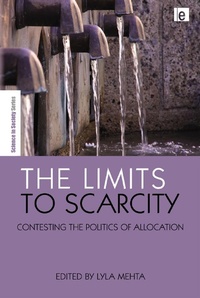
The Limits to Scarcity
Contesting the Politics of Allocation
1st Edition
Published on 13. May 2013
296 pages
978-1-136-53893-3 (ISBN)
Description

Scarcity is considered a ubiquitous feature of the human condition. It underpins much of modern economics and is widely used as an explanation for social organisation, social conflict and the resource crunch confronting humanity's survival on the planet. It is made out to be an all-pervasive fact of our lives - be it of housing, food, water or oil. But has the conception of scarcity been politicized, naturalized, and universalized in academic and policy debates? Has overhasty recourse to scarcity evoked a standard set of market, institutional and technological solutions which have blocked out political contestations, overlooking access as a legitimate focus for academic debates as well as policies and interventions?
Theoretical and empirical chapters by leading academics and scholar-activists grapple with these issues by questioning scarcity's taken-for-granted nature. They examine scarcity debates across three of the most important resources - food, water and energy - and their implications for theory, institutional arrangements, policy responses and innovation systems.
The book looks at how scarcity has emerged as a totalizing discourse in both the North and South. The 'scare' of scarcity has led to scarcity emerging as a political strategy for powerful groups. Aggregate numbers and physical quantities are trusted, while local knowledges and experiences of scarcity that identify problems more accurately and specifically are ignored. Science and technology are expected to provide 'solutions', but such expectations embody a multitude of unexamined assumptions about the nature of the 'problem', about the technologies and about the institutional arrangements put forward as a 'fix.' Through this examination the authors demonstrate that scarcity is not a natural condition: the problem lies in how we see scarcity and the ways in which it is socially generated.
Theoretical and empirical chapters by leading academics and scholar-activists grapple with these issues by questioning scarcity's taken-for-granted nature. They examine scarcity debates across three of the most important resources - food, water and energy - and their implications for theory, institutional arrangements, policy responses and innovation systems.
The book looks at how scarcity has emerged as a totalizing discourse in both the North and South. The 'scare' of scarcity has led to scarcity emerging as a political strategy for powerful groups. Aggregate numbers and physical quantities are trusted, while local knowledges and experiences of scarcity that identify problems more accurately and specifically are ignored. Science and technology are expected to provide 'solutions', but such expectations embody a multitude of unexamined assumptions about the nature of the 'problem', about the technologies and about the institutional arrangements put forward as a 'fix.' Through this examination the authors demonstrate that scarcity is not a natural condition: the problem lies in how we see scarcity and the ways in which it is socially generated.
Reviews / Votes
'Scarcity, like abundance, is not a neutral fact. It has powerful meanings and uses. In this timely and provocative book, Lyla Mehta follows the political career of scarcity in the modern world and, in turn, makes us look at the shape of that world in a new light.'Frank Trentmann, author of Free Trade Nation and Professor of History, Birkbeck College, University of London
'As environmental and economic challenges trigger the latest round of doom-laden scares about the scarcities facing humanity, leading thinkers offers us a vital, timely reminder that these are created by people and institutions, enwrapped with power, and lead to winners and losers. Definitely required reading for all seeking serious and realistic ways to meet sustainability challenges without undermining social justice.'
Melissa Leach, Director, ESRC STEPS Centre and Professorial Fellow, Institute of Development Studies (IDS), University of Sussex
More details
Series
Language
English
Place of publication
London
United Kingdom
Publishing group
Taylor & Francis Ltd
Target group
College/higher education
Product notice
Reflowable
File size
4,98 MB
ISBN-13
978-1-136-53893-3 (9781136538933)
Copyright in bibliographic data and cover images is held by Nielsen Book Services Limited or by the publishers or by their respective licensors: all rights reserved.
Schweitzer Classification
Other editions
Additional editions
Book
12/2010
1st Edition
Earthscan Ltd
€60.60
Shipment within 3-4 weeks
Book
12/2010
1st Edition
Earthscan Ltd
€232.10
Shipment within 3-4 weeks
Person
Lyla Mehta is a sociologist and Research Fellow with the Institute of Development Studies at the University of Sussex, UK and an Adjunct Professor at the Department of International Environment and Development Studies (Noragric), Norwegian University of Life Sciences.
Content
Foreword by Steve Rayner
Acknowledgements
Introduction
Part I: Why Does Scarcity Matter?
Commentary
1. The Scare, Naturalization and Politicization of Scarcity
2. Everybody's Got the Fever: Scarcity and US National Energy Policy
3. The Ghosts of Malthus: Narratives and Mobilizations of Scarcity in the US Political Context
Part II: Economics and Scarcity
Commentary
4. Economics and Scarcity: With Amartya Sen as Point of Departure?
5. Deconstructing Economic Interpretations of Sustainable Development: Limits, Scarcity and Abundance
6. Water Can and Ought to Run Freely: Reflections on the Notion of Scarcity in Economics
7. A Bit of the Other: Why Scarcity Isn t All It's Cracked up to Be
Part III Resource Scarcity, Institutional Arrangements and Policy Responses: Food, Agriculture, Water and Energy
Commentary
8. Scarcity as Political Strategy: Reflections on Three Hanging Children
9. Seeing Scarcity: Understanding Soil Fertility in Africa
10. Chronic Hunger: A Problem of Scarcity or Inequity?
11. A Share Response to Water Scarcity: Moving beyond the Volumetric
12. Advocacy of Water Scarcity: Leakages in the Argument
13. The Construction and Destruction of Scarcity in Development: Water and Power Experiences in Nepal
14. Afterword: Looking beyond Scarcity?
Acknowledgements
Introduction
Part I: Why Does Scarcity Matter?
Commentary
1. The Scare, Naturalization and Politicization of Scarcity
2. Everybody's Got the Fever: Scarcity and US National Energy Policy
3. The Ghosts of Malthus: Narratives and Mobilizations of Scarcity in the US Political Context
Part II: Economics and Scarcity
Commentary
4. Economics and Scarcity: With Amartya Sen as Point of Departure?
5. Deconstructing Economic Interpretations of Sustainable Development: Limits, Scarcity and Abundance
6. Water Can and Ought to Run Freely: Reflections on the Notion of Scarcity in Economics
7. A Bit of the Other: Why Scarcity Isn t All It's Cracked up to Be
Part III Resource Scarcity, Institutional Arrangements and Policy Responses: Food, Agriculture, Water and Energy
Commentary
8. Scarcity as Political Strategy: Reflections on Three Hanging Children
9. Seeing Scarcity: Understanding Soil Fertility in Africa
10. Chronic Hunger: A Problem of Scarcity or Inequity?
11. A Share Response to Water Scarcity: Moving beyond the Volumetric
12. Advocacy of Water Scarcity: Leakages in the Argument
13. The Construction and Destruction of Scarcity in Development: Water and Power Experiences in Nepal
14. Afterword: Looking beyond Scarcity?
