

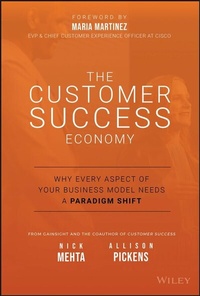
The Customer Success Economy
Description

The Customer Success Economy offers examples and specifics of how companies can transform. It addresses the pains of transforming organizational charts, leadership roles, responsibilities, and strategies so the whole company works together in total service to the customer.
* Shows leaders how their digital implementations will make them more Amazon-like
* Helps you deliver recurring revenue
* Shows you how to embrace customer retention
* Demonstrates the importance of "churning" less
Get that competitive advantage in the most relevant and important arena today--making and cultivating happy customers.
More details
Other editions
Additional editions
Persons
ALLISON PICKENS has served as COO at Gainsight, an investor at Bain Capital, and a strategy consultant at BCG. One of the world's leading experts on the business transformation that accompanies shifting to the cloud, she has coached thousands of executives at public companies and startups alike. Allison has a degree in ethics, politics, and economics from Yale and an MBA from Stanford.
Content
Maria Martinez, Executive vice president & chief customer experience officer at Cisco
Part I Why Customer Success Became Standard 1
Chapter 1 Customer Success: What It is and Why It Affects Everything 3
Chapter 2 Customer Success: It's Not Just for Silicon Valley 21
Chapter 3 The Customer Success Job Market is Taking Off 35
Chapter 4 Reason #1: Customer Success Stops Churn--The Silent Business Killer 45
Chapter 5 Reason #2: Customer Success is a Growth Engine--If You Move from Defense to Offense 53
Chapter 6 Reason #3: Your Customers Want It 65
Chapter 7 Reason #4: Even the Money People Are in Love with Customer Success 79
Part II Baking Customer Success Into Every Aspect of Your Business Model 89
Chapter 8 It Can't Be Delegated 91
Chapter 9 Product: Design from the Start for Customer Success 103
Chapter 10 Marketing: Your Job Doesn't End with the Lead 121
Chapter 11 Sales: Customer Success is Your Differentiator 129
Chapter 12 Services: Go from Hours to Outcomes 141
Chapter 13 Support: Go from Reactive to Proactive 151
Chapter 14 Finance: The New Scoreboard 161
Chapter 15 IT: The New Mission for the CIO 171
Chapter 16 HR: Happy Employees Take Better Care of Customers 179
Chapter 17 Avoiding Customer Success Silos 191
Part III Implementation Issues 195
Chapter 18 The First Step: Launching CS in an Established Business 197
Chapter 19 Leadership: What Kind of Leader Do I Need for Customer Success? 215
Chapter 20 Organizational Structure: Should Customer Success Be Part of Sales or Its Own Org? 227
Chapter 21 Roles and Responsibilities: Who Owns Renewals and Revenue? 239
Chapter 22 Budget: How Much Should I Spend on Customer Success? 251
Chapter 23 Monetization: Should I Charge for Customer Success to Boost Profitability? 263
Chapter 24 Metrics: How Do I Measure Customer Success? 273
Chapter 25 Scaling: How Do I Grow Customer Success without Throwing People at It? 295
Chapter 26 Technology: What System Do I Use? 301
Chapter 27 Professional Development: How Can I Develop My Leaders and My Team? 317
Chapter 28 Inclusion: How Can I Create a Diverse Team? 333
Chapter 29 Next Steps to Take 339
Notes 345
Acknowledgments 347
About the Authors 351
Index 353
1
Customer Success: What It Is and Why It Affects Everything
When you are finished changing, you are finished.
-Benjamin Franklin
What really matters in business? Every day we receive hundreds of emails, calls, and meeting invitations; knowing what's important can be a challenge. And every 24 hours, the world around us changes in infinite ways. Dissecting the most important trends can be hard. If you're like us, picking out the signal from the noise is a huge chunk of the job of leading a business. And it can be overwhelming.
That quest for what matters most in business brought both of us to the field of Customer Success, from different starting points. We'll each tell the story of how a discovery of Customer Success pushed our own thinking on what mattered in business. And we think these stories will resonate with you. Let's start with Nick.
Making and Selling Aren't the Only Things That Matter Anymore, Dad
When I was 8 years old, I vividly remember a "take your child to work day" with my entrepreneur dad. The thing I recall best from that event is him saying, "Nick, there are just two jobs that matter in business: the jobs of the people who make the stuff you sell and the jobs of the people who sell the stuff you make; everything else is overhead."
As oversimplified as that may sound, my dad was accurately describing the business model of pretty much every major corporation from 1900 to 2000. Making stuff and selling stuff drove the global economy. The sale was a one-time activity, and anything "post-sale" was a cost to the company (customer service centers, repair people dealing with broken machines, fleets of company vehicles, etc.). My dad's advice fared well for me in my early career as a leader in enterprise software.
Then in 2008, during the depth of the financial crisis, I was hired to run a company where we sold our software "as a service" (SaaS). I was finally in the cloud! I remember my first day meeting the employees and recalling my dad's advice. I wanted to immediately talk to the leaders of Sales and Engineering, the people who "sold stuff" and "made stuff."
I also met Steve, the person responsible for making sure our existing customers were successful. I thought to myself at the time, "Great. Steve's got that covered so I don't have to worry about it."
But what I learned over the four years of running that company was that the SaaS business model had fundamentally shifted power to our customers. They weren't "buying" stuff anymore, they were renting it. This changed the way I needed to operate as a CEO. Making and selling still mattered a lot. But our customers now had the "power of the purse." If they weren't satisfied, they could leave us at any time. As the CEO of this customer-powered company, I ended up spending way more time with Steve than I did with his counterparts in Sales and Engineering.
And that shift that I observed toward customer-centricity is why I was excited to join Gainsight and help launch the company in 2013, with our mission being to enable businesses to embrace Customer Success as the leading strategic differentiator of the next phase of the economy. And if you follow me online, you know I am fired up about the Customer Success movement!
But, that's not just my story and my irrational enthusiasm. That's an industry story-actually, that's the entire economy's story. Up until now, the history of business can be condensed down to two phases: the making stuff phase (starting with the industrial revolution), followed by the selling stuff phase (the Internet has pushed this last phase by making it possible to market your stuff globally, instantly, constantly). Now we've moved into a third phase. We still need to make and sell, but that's not enough. Our customers in the modern economy are looking for success-for their goals to be achieved-not just for "stuff" to be purchased.
And if you're reading this, it's probably your story, too. You may be dealing with "vendors" that don't seem to have a clue about what you really want. You might be running a sales organization and realizing that the end-of-quarter heroics can't go on much longer. You may be in the Customer Success profession and trying to get your company to wake up to the movement.
But no matter who you are, you probably cringe at the tools and systems you use at work, only to hop into an Uber or Lyft and be magically whisked wherever you want once you step outside of the office.
In short, we all know the story needs to change.
The Business of Business Is Helping People
Here's how Allison found herself at the dawn of the Customer Success movement, which fundamentally changed her outlook on business.
When I was in college, I spent much of my day poring over ancient philosophical texts, searching for the secrets of "the good life" and for the pillars of a healthy society. Like my peers, I hoped to do good in the world in some way. When an internship on Capitol Hill proved to be more about mailing form responses to constituents-leveraging a mechanical contraption to replicate my Senator's signature-than creating innovation, I realized that my eagerness to build things that helped people might be better suited at that point for the private sector.
Two subsequent jobs in management consulting and private equity investing offered an incredible bootcamp in business knowledge and membership in a community of talented, inspiring people. But something nagged at me. How could I translate the skills I was learning into the positive societal impact that motivated me at my core? In an attempt to get back to my roots of trying to "do good," I recruited a friend to help build a tech product with the aspiration of helping industrial workers-often underdogs in our economy-showcase their skills to get jobs more easily. But the market wasn't ripe. I was back to the drawing board and told myself I was too naive to think that business could be anything but that-business.
Soon after, I met Nick after my old investment firm led an early funding round, when Gainsight had about 30 customers in a new market called Customer Success. As I learned about the industry, I soon realized that this was a new group of underdogs. Here was a fledgling community of people-many of them women-who knew they had greater value than their companies and investors recognized. Tectonic shifts in the market were in their favor. They just needed some support.
I soon joined their ranks as I took on the Customer Success team at Gainsight. We incubated ideas for how to make our own customers successful and shared the results of our experiments-the good and the bad-with the CS community in hundreds of blog posts and podcasts. (In one experiment, we accidentally sent a "welcome email" to all of our clients, even the tenured ones. Whoops.) We also learned a great deal from our clients and other friends in the field, who conducted their own experiments and gave feedback on our ideas as well.
The biggest learning-to my happy surprise-was that doing good didn't have to be at odds with building a great business. In fact, it could be a differentiator. Genuinely helping your clients propels stronger revenue growth, market leadership, profitability, consistency, employee retention, and valuation multiples-as we witnessed across the Customer Success community. Now the underdogs (CS professionals) were helping other historical underdogs (clients) and generating incredible business results.
So back to the question: What really matters in business? Doing good for the human beings who are your clients.
That might sound soft. But actually, it's the hard reality of business today. This book is about how to compete and win in an ever-more-challenging business environment. Notably, it's not about "making your clients happy." It's about making them successful so that you can succeed. Let's discuss what we mean by that.
Why Customer Success Is About More Than Happy Customers
Not surprisingly, the Internet is the reason for the change in the relationship between customers and businesses. Everyone knows the basics: whether we are at home as "consumers" or at work as "businesspeople," we demand a great customer experience. This concept is so commonly said that it's now trite.
But in some ways, talk of customer experience or "making customers happy" is missing the core point. The power of the Internet didn't just empower customers to be "satisfied." Customers in the modern world demand that their goals are achieved. The fancy management consulting term for this is desired outcomes.
What do we mean by outcomes? Well, whenever anyone, a consumer or a businessperson, looks at doing business with another company, they have a goal in mind. Maybe they are on a trip and trying to get from one part of a city to another. Maybe they are hoping to get in better shape. Or perhaps they are an executive looking to drive more engagement from their teammates.
Whether you consider B2C (business-to-consumer) or B2B (business-to-business), the trend toward outcomes is unstoppable. If you are on a trip in New York, Uber and Lyft turn a product (car) into an outcome...
