

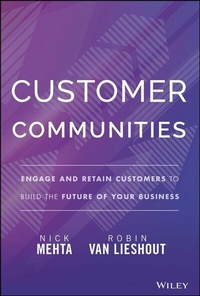
Customer Communities
Description

In Customer Communities: Engage and Retain Customers to Build the Future of Your Business, Nick Mehta and Robin Van Lieshout deliver an actionable playbook on how to cultivate meaningful communities that fuel quantifiable business growth. In the book, you'll learn how to capitalize on this new growth strategy to scale your company and develop excitement around your products and your firm.
The authors outline the 10 foundational Laws of Community, explaining why community development does not need to be expensive and how to integrate community in the heart of your customer journey. You'll also find:
* Strategies for creating a cross functional customer engagement team
* Techniques for building community in places that aren't the web or on social media
* Ways to bring your organization's culture and values into your community with a human-first alignment
An essential roadmap to community development for customer success, marketing, support and product teams, and other entrepreneurs, founders, and executive business leaders. Customer Communities will earn a place on the bookshelves of anyone with a stake in organizational growth and resilience.
More details
Other editions
Additional editions
Persons
ROBIN VAN LIESHOUT is CEO and Founder of inSided, a leading community software company.
Content
Preface: Two CEOs Growing Up Lonely xi
Acknowledgments xv
Part I Community Is the Future of Your Business 1
Chapter 1 An Introduction to the World of Communities 3
Creating a Sense of Belonging
Chapter 2 Communities as a Business Growth Strategy 9
The Only Sustainable Long-Term Differentiator Companies Have
Chapter 3 How the Next Generation of Communities Drives Success 29
The New Company-Wide Strategy to Drive Net Revenue Retention
Chapter 4 A Community for Customer Success, Support, Marketing, and Product Teams 41
How Every Department Can Benefit from a Next-Generation Community
Part II The 10 Laws of Community Building 55
Chapter 5 Law 1: You Can Start Anytime 57
It Doesn't Have to Be Expensive and Everyone in Your Organization Can Help
Chapter 6 Law 2: You Have to Own the Platform 65
Engage Your Customers Beyond Borrowed Ground
Chapter 7 Law 3: Community Should Be the Heart of the Customer Journey 75
Activate and Engage Your Customers at Scale
Chapter 8 Law 4: Create Content That Educates and Inspires 95
Be the Best Thought Leader You Can Be
Chapter 9 Law 5: Build on Your Advocates 109
Your Most Loyal Customers Are the Gateway to Success
Chapter 10 Law 6: Everybody Owns the Customer 121
Community Is a Company-Wide Strategy, Not a Department
Chapter 11 Law 7: Offline Counts More Than You Think 139
An Online Community Is Strengthened with Offline Events
Chapter 12 Law 8: Tie It All Together in One Customer Hub 153
Prevent a Disjointed Customer Experience by Integrating Engagement and Content
Chapter 13 Law 9: Community Should Drive Real Business Outcomes 171
Don't Get Fooled by Vanity Metrics--Demand Real Business Metrics
Chapter 14 Law 10: Bring Your Culture and Values to Your Community 183
Build with a Human-First Mindset
Part III How to Get Started 195
Chapter 15 Building Blocks to Successfully Starting a Community 197
Putting Together a Strong Strategy in Five Steps
Chapter 16 Common Objections and How to Overcome Them 209
Answers to Nine Common Objections
Epilogue 217
References 219
Index 225
1
An Introduction to the World of Communities: Creating a Sense of Belonging
In the popular TED Talk "How to live to be 100+" (2009), author and speaker Dan Buettner attempts to tackle a question that most of us have pondered: How do we live a long and healthy life?
His Blue Zones Project is an effort to understand the parts of the world where people live unusually well and determine what we can learn and apply to our own lifestyles. Most of his conclusions about diet and exercise are reassuring but not surprising.
But his claim about the Japanese archipelago of Okinawa definitely got us thinking. Okinawa, per Buettner, has the oldest living female population in the world, the longest disability-free life expectancy, and trounces other regions on many measures, including the rates of colon cancer, breast cancer, and cardiovascular disease.
So what's in the water in Okinawa? It turns out it's the Okinawans themselves. Buettner shares the Japanese concept of ikigai, which translates to "life's worth" or, as the speaker suggests, "the reason you wake up in the morning." Many Okinawans have their meaning tied up in a group of others called a moai. This cohort is often the same collection of people you live with and laugh with from childhood to careers to centenarian days.
In short, the communities the Okinawans live in seem to literally save their lives.
Buettner isn't alone in his thought process. In Together: The Healing Power of Human Connection in a Sometimes Lonely World (2020), the surgeon general of the United States, Vivek Murthy, contends that the greatest epidemic endangering our health, life span, and connection isn't a traditional disease. Instead, Dr. Murthy shares volumes of research shining a light on what ails us as a society-our collective loneliness and lack of community.
None of this comes as a shock because the basis of human society and civilization is community. We left the caves and prairies and built towns and cities to be together. We formed institutions-religious, civic, educational, and athletic-founded on the idea of connection and shared belonging. As the philosopher Aristotle once said:
Man is by nature a social animal; an individual who is unsocial naturally and not accidentally is either beneath our notice or more than human. Society is something that precedes the individual. (Politics, 1253a)
Indeed, the need for community is only becoming more apparent as it disappears. Dr. Murthy's book, and many others like it, point to our loneliness and loss of community in an increasingly disconnected and divided world. We didn't know what we'd had until it was gone.
Even the most cursory of Google searches show a myriad of anecdotes to reinforce this point:
- Nearly half of Americans report sometimes or always feeling alone or "left out" (Cigna, 2018).
- Loneliness has the same impact on your life expectancy as smoking 15 cigarettes a day (Holt-Lunstad et al., 2015).
- Socially isolated individuals crave company in the same way that hunger states trigger the search for food (Tomova et al., 2020).
While we'll leave the future of our governments and life span to other books written by many more experienced and educated authors, we wrote this one because we believe community is also vital to the future of business.
But what is a community, exactly? The Oxford English Dictionary defines it in two ways:
- A group of people living in the same place or having a particular characteristic in common
- A feeling of fellowship with others, as a result of sharing common attitudes, interests, and goals
In this book, we'll use the second definition. "Fellowship," based upon "common attitudes, interests, and goals," is what we believe a community is all about. Think of a personal community that you're a part of. Fellowship captures the feeling you have when you are with your people.
This fellowship is already there in your business, whether intentionally created or accidentally enabled. Your local coffee shop is a living, breathing community. Every show you watch and band you love has a business model that depends on the community of the fans. The Disney community is apparent whenever you visit one of their parks and see parents and children decked out head to toe in Mickey Mouse gear. Most modern "gig economy" businesses like ridesharing, delivery, and Airbnb are layered on top of a community of providers (drivers, deliverers, and hosts, respectively). This is community.
Each of these communities layers on a series of emotions:
- Feeling a sense of belonging: "I am meant to be here."
- Feeling understood: "People get me here."
- Feeling supported: "People want to help me here."
- Feeling less alone: "There are others like me."
- Feeling purpose: "We share a common goal."
Those might feel like lofty goals for a business book, but keep reading, and we'll share lots of examples of where this happens in business today.
Let's examine Starbucks. In his book The Good Place (1989), sociologist Ray Oldenburg coined the term "third place"-beyond work and home-to explain why communities like coffee shops provide connections and belonging. In the mid-1990s, Starbucks incorporated this idea into its mission: "We want our stores to be the third place." Starbucks is fundamentally a community-first business.
For business-to-consumer (B2C) businesses like Starbucks, which sell directly to consumers, the communities are apparent and vivid. You can see them as fellow shoppers in your local store or as fans standing next to you at a concert.
In this book, we will argue that the concept of community is just as foundational to the business-to-business (B2B) world, even if these communities are sometimes less apparent.
Businesses, even of the B2B variety, are fundamentally business-to-human (B2H). In the B2B world, whether we are selling software, services, or shop-floor machinery, we often spend too much time on the "B," and not enough on the "H." Human beings at your company work with, sell to, and provide services to human beings that work for your clients. Of course, both sets of people have corporate goals, key performance indicators (KPIs), and other important goals. But they are also all brilliant, flawed people trying to get through this one life we have to live.
Erica Kuhl is one of the true pioneers of B2B community. In 2006, Kuhl launched what is now the Trailblazers community at software pioneer Salesforce.com. It's now one of enterprise technology's largest, most thriving, and strategically important communities. She defines community this way:
The coming together over some like-minded passion, whether it's a product or whether it's a service or whether it's a movement. What I'm always looking for when I'm building a community with anyone is, what is that special thing you have that can drive people together, to rally behind?
The impact is that if you are a B2B leader, community is a superpower hiding in plain sight:
- Your teammates want to belong to a community.
- Your customers want that too.
- Your partners want that as well.
Indeed, let's go back to the origins of community. When you're watching a riveting play, you feel the connected energy of the audience around you. As you root for your favorite sports team in a stadium, the cheers of your fellow fans make you feel like you're part of something. Your local religious group might embody a tradition that brings your life richness and fulfillment. All these communities allow us to feel a little less lonely in this big, anonymous world.
But these feelings don't stop when you leave your house or join your virtual meeting. People in newer or niche professions working in companies often feel alone since their coworkers may not really "get" what they do. Solo entrepreneurs or small business owners toil away, having to figure out nearly everything independently. Innovators in new technology areas feel like their colleagues around them think they're crazy. Even CEOs like us sometimes have no one to talk to.
In short, work-like our personal lives-can be lonely.
Elissa Fink, former chief marketing officer of data analytics software company Tableau, echoed this emotion-driven definition of community:
The thing that brings people together around a successful community is a shared purpose. But I think there's also this sense of you found your people. Then I think there's an element of passion. This is who I am; this is what I love. There's an expression element to it, too. I also think there's a thing about achievement. There's a sense of, "I'm proud to be part of this, and I become better."
As entrepreneurs, we have founded and built our businesses with community at the core. This has shown up in multiple ways, including:
- Building the biggest community around one of the world's fastest-growing professions (customer success management)
- Creating high-energy events to bring these professionals together-growing from 300 to 20,000 attendees
- Developing software to enable business people to network...
