

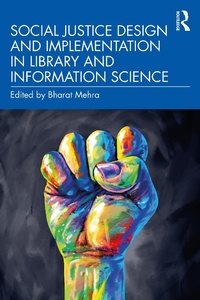
Social Justice Design and Implementation in Library and Information Science
1st Edition
Published on 29. December 2021
332 pages
978-1-000-52818-3 (ISBN)
Description

Social Justice Design and Implementation in Library and Information Science presents a range of case studies that have successfully implemented social justice as a designed strategy to generate community-wide changes and social impact.
Each chapter in the collection presents innovative practices that are strategized as intentional, deliberate, systematic, outcome-based, and impact-driven. They demonstrate effective examples of social justice design and implementation in LIS to generate meaningful outcomes across local, regional, national, and international settings. Including reflections on challenges and opportunities in academic, public, school, and special libraries, museums, archives, and other information-related settings, the contributions present forward-looking strategies that transcend historical and outdated notions of neutral stance and passive bystanders. Showcasing the intersections of LIS concepts and interdisciplinary theories with traditional and non-traditional methods of research and practice, the volume demonstrates how to further the social justice principles of fairness, justice, equity/equality, and empowerment of all people, including those on the margins of society.
Social Justice Design and Implementation in Library and Information Science will be of great interest to LIS educators, scholars, students, information professionals, library practitioners, and all those interested in integrating social justice and inclusion advocacy into their information-related efforts to develop impact-driven, externally focused, and community-relevant outcomes.
Each chapter in the collection presents innovative practices that are strategized as intentional, deliberate, systematic, outcome-based, and impact-driven. They demonstrate effective examples of social justice design and implementation in LIS to generate meaningful outcomes across local, regional, national, and international settings. Including reflections on challenges and opportunities in academic, public, school, and special libraries, museums, archives, and other information-related settings, the contributions present forward-looking strategies that transcend historical and outdated notions of neutral stance and passive bystanders. Showcasing the intersections of LIS concepts and interdisciplinary theories with traditional and non-traditional methods of research and practice, the volume demonstrates how to further the social justice principles of fairness, justice, equity/equality, and empowerment of all people, including those on the margins of society.
Social Justice Design and Implementation in Library and Information Science will be of great interest to LIS educators, scholars, students, information professionals, library practitioners, and all those interested in integrating social justice and inclusion advocacy into their information-related efforts to develop impact-driven, externally focused, and community-relevant outcomes.
More details
Edition
1. Auflage
Language
English
Place of publication
London
United Kingdom
Publishing group
Taylor & Francis Ltd
Target group
College/higher education
Professional and scholarly
Illustrations
3 Tables, black and white; 3 Line drawings, black and white; 4 Halftones, black and white; 7 Illustrations, black and white
ISBN-13
978-1-000-52818-3 (9781000528183)
Copyright in bibliographic data and cover images is held by Nielsen Book Services Limited or by the publishers or by their respective licensors: all rights reserved.
Schweitzer Classification
Other editions
Additional editions
Book
12/2021
1st Edition
Routledge
€61.90
Shipment within 15-20 days

Book
12/2021
1st Edition
Routledge
€207.00
Shipment within 15-20 days
Person
Bharat Mehra is EBSCO Endowed Chair in Social Justice and Professor in the School of Library and Information Studies at the University of Alabama, USA. His many research interests include diversity and inclusion advocacy, intercultural communication and communicative action, social justice in library and information science, community-engaged scholarship, and critical and cross-cultural studies. He has applied action research to further community-engaged scholarship while collaborating with racial/ethnic groups, international diaspora, sexual minorities, rural communities, low-income families, small businesses, and others, to represent their experiences and perspectives in the design of community-based information systems and services.
Content
Figures; Tables; Contributors; Foreword: The Legacy of Promoting Social Justice in Library and Information Science (Paul T. Jaeger); Introduction (Bharat Mehra); I. EMERGING NEW RESPONSIBILITIES ; 1. Libraries Fighting for Social Justice During the COVID-19 Pandemic (Nicole A. Cooke, Cyndee Sturgis Landrum, and Jocelyn Pettigrew); 2. Role of Rural Libraries in Supporting Social Well-being in their Communities: Participatory Research to Promote Social Justice (Eli M. Guinnee and Margo E. Gustina); II. REFLECTIVE CASE PRACTICES; 3. Understanding the Librarian Identity: The Common Agency Within the Diversity of Public Librarianship (Vanessa Irvin); 4. Wilkes County Public Library's Involvement in the Food Justice Movements in Rural North Carolina (Noah Lenstra and Rebecca Floyd); 5. A Public Library's Response to Substance Abuse Recovery: Blount County Recovery Court Life Skills Program (Kaurri C. Williams-Cockfield); 6. Digital Archives and Inclusion of Underrepresented Groups: Case Studies of the Voices Out Loud and Black in Appalachia Projects (Scott Sikes); III. REACHING OUT: NEW RESEARCH APPROACHES AND STRATEGIES; 7. Positioning Social Justice in a Black Feminist Information Activist Community Context: A Case Study of African American Activist-Mothers in Chicago's Public Housing (LaVerne Gray and Yiran Duan); 8. Everyday Information Practices of Migrant Latinas Living in Boston (Monica Colon-Aguirre and Janet Ceja Alcala); 9. Conceptualizing Co-mapping Knowledges to Promote Social Justice Outcomes with Aboriginal Communities through Design Pedagogy (Jia Tina Du, Julie Nichols, Stefan Peters, Darren Fong, Angelica Harris-Faull, Ning Gu, Anna Leditschke, and Jannatul Fardous); 10. Multidisciplinary Perspectives for an Integrative Critical Gerontology Information Framework (Joseph Winberry and Bharat Mehra); IV. TRANSFORMING LIS EDUCATION; 11. The Mis-Education of the Librarian: Addressing Curricular Injustice in the LIS Classroom through Social Justice Pedagogy (Beth Patin, Melinda Sebastian, Jieun Yeon, Danielle Bertolini, and Alexandra Grimm; 12. Creating Accessible Learning Environments and Informing Social Justice through Inclusive Course Design (Clayton A. Copeland and Kim M. Thompson); 13. Social Responsibility of Libraries to Address Community Homelessness: Social Justice Actions in Two LIS Courses (Julie Ann Winkelstein); 14. Indigenous-Engaged Education: A Canadian Case (Toni Samek); 15. Designing for Social Justice in the MLIS Curriculum: A Case Study of the University of Maryland (Morgan Adle, Paul T. Jaeger, and Ursula Gorham); V. INSTRUMENTS OF ACTION AND CHANGE; 16. An Autoethnographic Narrative of Institutional Injustice: Queer Resilience through Use of Evidence and Memory (Donna Braquet); 17. Inspiring Information Communities to Advance the UN Sustainable Development Goals: Information Action Briefs for Social Transformation (Kendra S. Albright, Clara M. Chu, Jia Tina Du, and Bharat Mehra); 18. Implementation of Social Justice Design in Developing International Guidelines for LGBTQ+ Library Resources, Services, and Programming (Rachel Wexelbaum, Julie Winkelstein, and Michael David Miller); Index
