

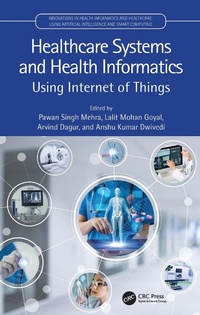
Healthcare Systems and Health Informatics
Using Internet of Things
1st Edition
Published on 20. February 2022
265 pages
978-1-000-54147-2 (ISBN)
Description

This book covers the fundamentals of IoT and healthcare systems for carrying out system architectures, protocols, wearable devices, and interoperability. It explores major challenges in artificial intelligence (AI) and smart computing in resource-constrained IoT-based applications along with cost, energy efficiency, and the availability of quality service.
Healthcare Systems and Health Informatics: Using Internet of Things explores the role of AI and smart computing in health informatics and healthcare with an emphasis on clinical data management and analysis for precise prediction and prompt action. It presents cutting-edge tracking, monitoring, real-time assistance, and security for IoT in healthcare and broadly discusses wearable sensors and IoT devices and their role in smart living assistance. The book goes on to describe a system model and architecture for a clear picture of energy conservation-based IoT in healthcare and explains the challenges and opportunities with IoT-based healthcare industries. A study of the threats and impacts, along with the need for information security, is also included.
The chapters are written by experts in the field, and this book provides a comprehensive description of the important aspects of IoT and health from a beginner- to advanced-level perspective and is ideal for researchers, academicians, students, persons in industry, technologists, and entrepreneurs.
Healthcare Systems and Health Informatics: Using Internet of Things explores the role of AI and smart computing in health informatics and healthcare with an emphasis on clinical data management and analysis for precise prediction and prompt action. It presents cutting-edge tracking, monitoring, real-time assistance, and security for IoT in healthcare and broadly discusses wearable sensors and IoT devices and their role in smart living assistance. The book goes on to describe a system model and architecture for a clear picture of energy conservation-based IoT in healthcare and explains the challenges and opportunities with IoT-based healthcare industries. A study of the threats and impacts, along with the need for information security, is also included.
The chapters are written by experts in the field, and this book provides a comprehensive description of the important aspects of IoT and health from a beginner- to advanced-level perspective and is ideal for researchers, academicians, students, persons in industry, technologists, and entrepreneurs.
More details
Series
Edition
1. Auflage
Language
English
Place of publication
London
United Kingdom
Publishing group
Taylor & Francis Ltd
Target group
College/higher education
Professional and scholarly
Illustrations
19 Tables, black and white; 38 Line drawings, black and white; 47 Halftones, black and white; 85 Illustrations, black and white
ISBN-13
978-1-000-54147-2 (9781000541472)
Copyright in bibliographic data and cover images is held by Nielsen Book Services Limited or by the publishers or by their respective licensors: all rights reserved.
Schweitzer Classification
Other editions
Additional editions
Pawan Singh Mehra | Lalit Mohan Goyal | Arvind Dagur
Healthcare Systems and Health Informatics
Using Internet of Things
Book
10/2024
1st Edition
CRC Press
€71.30
Shipment within 15-20 days
Pawan Singh Mehra | Lalit Mohan Goyal | Arvind Dagur
Healthcare Systems and Health Informatics
Using Internet of Things
Book
02/2022
1st Edition
CRC Press
€172.20
Shipment within 15-20 days
Persons
Pawan Singh Mehra is currently working as Assistant Professor in Delhi Technological University, New Delhi, India. He received his Ph.D. degree in Computer Engineering from Jamia Millia Islamia and M.Tech(Hons). degree in Computer Science and Engineering from Center for Development of Advanced Computing (CDAC). He completed Bachelor of Engineering from RJIT, Gwalior. He has approx. 10 years of Teaching and Research Experience. He has authored more than 15 publications in International conferences and journals indexed in SCI, Scopus, ESCI, Web of Science. His research interests include Wireless Sensor Network, Internet of Things, Image processing, Cryptography and Network security & Block chain.
Lalit Mohan Goyal has completed Ph.D. from Jamia Millia Islamia, New Delhi in Computer Engineering, M.Tech (Honors) in Information Technology from Guru Gobind Singh Indraprastha University, New Delhi and B.Tech (Honors) in Computer Engineering from Kurukshetra University, Kurukshetra. He has 16 years of teaching experience in the area of Theory of Computation, Parallel and Random algorithms, Distributed Data Mining & Cloud Computing. He has completed a project sponsored by Indian Council of Medical Research, Delhi. He has published many research papers in SCI indexed & Scopus indexed journals, and Conferences. Two patents filed by him are also now published online. He is reviewer of many reputed journals & conferences. He has given many invited talks in FDP and conferences. Presently, he is working at J. C. Bose Univ. of Sc. & Tech. YMCA Faridabad in the department of Computer Engineering.
Arvind Dagur has approx. 15 years of experience in teaching and research in various reputed engineering colleges such as AKGEC, Ghaziabad and Galgotias College of Engineering and Technology, Gr. Noida. He completed his Ph.D. (Computer Engineering) from Jamia Millia Islamia, New Delhi, M.Tech. CSE from MNNIT Allahabad and B.Tech. CSE from UPTU Lucknow. His area of research is Fault Tolerance, Real time System, Energy harvesting and minimization, Cloud computing, IoT etc.
Anshu Kumar Dwivedi received the B.Tech Degree in Computer Science & Engineering from Uttar Pradesh Technical University Lucknow, India, in 2007 and M.Tech (HONS) degree in Computer Engineering from YMCA University of Science & Technology, Faridabad, India, in 2012. Currently, he is a research Scholar in Department of computer science & Engineering at Madan Mohan Malaviya University of Technology, Gorakhpur (India). His current research interests are Wireless Sensor Network, Ad-Hoc Network, Internet of Things, and Theory of computation. He has served on various IEEE conferences as a technical program committee member.
Lalit Mohan Goyal has completed Ph.D. from Jamia Millia Islamia, New Delhi in Computer Engineering, M.Tech (Honors) in Information Technology from Guru Gobind Singh Indraprastha University, New Delhi and B.Tech (Honors) in Computer Engineering from Kurukshetra University, Kurukshetra. He has 16 years of teaching experience in the area of Theory of Computation, Parallel and Random algorithms, Distributed Data Mining & Cloud Computing. He has completed a project sponsored by Indian Council of Medical Research, Delhi. He has published many research papers in SCI indexed & Scopus indexed journals, and Conferences. Two patents filed by him are also now published online. He is reviewer of many reputed journals & conferences. He has given many invited talks in FDP and conferences. Presently, he is working at J. C. Bose Univ. of Sc. & Tech. YMCA Faridabad in the department of Computer Engineering.
Arvind Dagur has approx. 15 years of experience in teaching and research in various reputed engineering colleges such as AKGEC, Ghaziabad and Galgotias College of Engineering and Technology, Gr. Noida. He completed his Ph.D. (Computer Engineering) from Jamia Millia Islamia, New Delhi, M.Tech. CSE from MNNIT Allahabad and B.Tech. CSE from UPTU Lucknow. His area of research is Fault Tolerance, Real time System, Energy harvesting and minimization, Cloud computing, IoT etc.
Anshu Kumar Dwivedi received the B.Tech Degree in Computer Science & Engineering from Uttar Pradesh Technical University Lucknow, India, in 2007 and M.Tech (HONS) degree in Computer Engineering from YMCA University of Science & Technology, Faridabad, India, in 2012. Currently, he is a research Scholar in Department of computer science & Engineering at Madan Mohan Malaviya University of Technology, Gorakhpur (India). His current research interests are Wireless Sensor Network, Ad-Hoc Network, Internet of Things, and Theory of computation. He has served on various IEEE conferences as a technical program committee member.
Content
Unit 1: Introduction to IoT-Based Healthcare Devices 1. Internet of Things: A Smart Technology for Healthcare Industries 2. IoT Devices for Measuring Pulse Rates and ECG Signals Unit 2: IoT-Based Systems for Healthcare Sector: AI and Smart Computing 3. Machine Learning and Deep Learning in IoT-Based Healthcare Support Systems 4. An IoT-Based Smart Environment for Sustainable Healthcare Management Systems 5. Predictive Model for Brain Tumour Detection Based on IoT MRI Scan 6. A Comparative Analysis of Parametric and Non-Parametric Video Object Segmentation Methods for IoT and Other Applications Areas 7. IoMT-Based Computational Approach for Semantic Segmentation of Brain Tumour MRI Images Unit 3: IoT-Based Systems for Healthcare Industries: Opportunities and Challenges 8. Internet of Medical Things: Smart Healthcare Monitoring Systems and Their Potential Implementations 9. How Artificial Intelligence and IoT Are Facing Covid-19: An Overview 10. IoT-Based Healthcare Monitoring Practices during Covid-19: Prospects and Approaches 11. Impact of IoT-Based Urban Agriculture on Healthcare: Smart Farms for Homes 12. Identification of Heavy Drinking by Using IoT Devices and Artificial Intelligence Unit 4: Security and Privacy in IoT-Based Systems for Healthcare Sector 13. Cyber Security for Handling Threats in Healthcare Devices 14. Security Challenges and Solutions for Healthcare in the Internet of Things
