

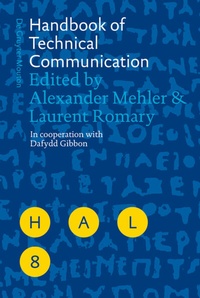
Handbook of Technical Communication
Description

The
Handbook of Technical Communication
brings together a variety of topics which range from the role of technical media in human communication to the linguistic, multimodal enhancement of present-day technologies. It covers the area of computer-mediated text, voice and multimedia communication as well as of technical documentation. In doing so, the handbook takes professional and private communication into account.
Special emphasis is put on technical communication by means of web 2.0 technologies and its standardization in system development. In summary, the handbook deals with theoretical issues of technical communication and its practical impact on the development and usage of text and speech technologies.
More details
Other editions
Additional editions
Persons
Content
2 - Introduction: Framing Technical Communication [Seite 21]
3 - I. Basic communication technologies & infrastructures [Seite 47]
3.1 - 1. Document Authoring: from Word Processing to Text Generation [Seite 49]
3.2 - 2. Representation of Documents in Technical Communication [Seite 75]
3.3 - 3. Foundations of markup languages [Seite 103]
3.4 - 4. Controlled Language Structures in Technical Communication [Seite 141]
3.5 - 5. Document Classification, Information Retrieval, Text and Web Mining [Seite 161]
3.6 - 6. Multimodal and Speech Technology [Seite 209]
3.7 - 7. Resources for technical communication systems [Seite 275]
3.8 - 8. Evaluation of Technical Communication [Seite 305]
4 - II. Technical communication management [Seite 335]
4.1 - 9. Lexicography, terminology and ontologies [Seite 337]
4.2 - 10. Multilingual Computing [Seite 367]
4.3 - 11. Scholarly Communication [Seite 399]
4.4 - 12. Verbal communication protocols in safety-critical system operations [Seite 423]
4.5 - 13. Multimodal Communication [Seite 455]
4.6 - 14. Decentralized Online Social Networks [Seite 481]
4.7 - 15. Digital Curation as Communication Mediation [Seite 527]
5 - III. Communication by means of technology [Seite 551]
5.1 - 16. Internet-Based Communication [Seite 553]
5.2 - 17. Tutoring Systems and Computer-Assisted Language Learning (CALL) [Seite 591]
5.3 - 18. Framing Multimodal Technical Communication [Seite 611]
5.4 - 19. Barrier-free communication [Seite 665]
5.5 - 20. Artificial Interactivity [Seite 727]
5.6 - 21. Ubiquitous computing [Seite 755]
5.7 - 22. P2P-based Communication [Seite 791]
6 - Bibliographical notes [Seite 817]
7 - Index [Seite 827]
