

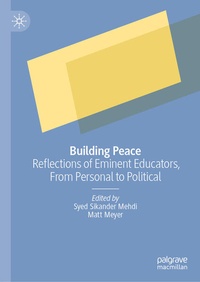
Building Peace
Description

This book fulfills a long-standing gap in the global literature on educating for peace. In documenting the reflections of the world's leading teachers of peace, including some of the field's founders, the book sheds light on both the process and the products that have brought the study of peace to its fifty-year mark. The examination of the dynamic connections between peacemaking, education, individual development, and widespread social change is chronicled through examples from the USA, Japan, China, India, Pakistan, Germany, Argentina, Colombia, Trinidad, New Zealand, Mexico and more, and charts the words and work of scholar-activists including the late Betty Reardon and the granddaughter of Mohandas Gandhi, South Africa's Ela Gandhi. Together, the essays represent, in the words (from the Foreword) of United Nations University for Peace Rector Francisco Rojas Aravena, "a colossal instrument to reaffirm dialogue over force."
More details
Other editions
Additional editions
Persons
Syed Sikander Mehdi was the first person to introduce courses on peace studies in the universities in Pakistan and served for over 30 years at the Department of International Relations of Karachi University. His writings have appeared in many journals and books, including Good Governance and Economic Development: Perspectives from Global North and Global South (Routledge, 2025).
Matt Meyer is an internationally noted historian, educator, and organizer, Secretary General Emeritus of the International Peace Research Association. The author/editor of over a dozen books on peace and human rights, he is Senior Editor of a new book series on Peace Studies from Africa and the Global South. Meyer's primer that served as first installment of that series, launched at Oxford University in 2025, is Beyond Our Current Boundaries (Africa World Press, 2025).
Content
Part I: The Peace Educators.- Chapter 1: Introduction.- Part II: Tribute To a Legendary Peace Educator-Activist.- Chapter 2: Life and Work of Betty A. Reardon: Reflections and Remembrances.- Part III: Peace Ideas, Peace Education and Peace Movements.- Chapter 3: Peace Educators and Politics of Disowning.- Chapter 4: One Too Many Peaces.- Chapter 5: Peace Education through Peace History and Peace Museums.- Chapter 6: Promoting Peace Education - Locally and Globally.- Chapter 7: In Search of a Movement: Education and Peace in our Time.- Chapter 8: "Beyond Our Individual Identities" - Peace based on Ubuntu, Ujamaa, and Friends.- Chapter 9: An Activist Teacher and Researcher Walking the Decolonial Peace Education Path.- Chapter 10: Kia Hora Te Marino I May Peace be Widespread.- Part IV: Peace Educators and Peacebuilders.- Chapter 11: Lifelong Struggle for a Peace Promoting Nuclear-Free Society.- Chapter 12: From Police Officer to Professor of Peace Studies: A Pioneer and Witness of Peace Studies in China.- Chapter 13: Growing up Gandhi in South Africa: From My Grandfather's Teachings to the Struggle Against Apartheid to Building Lasting Peace Today Ela Gandhi.- Chapter 14: Building Peace Day by Day.- Chapter 15: Reflections on Peace Studies and Education in India: A Personal Note.- Chapter 16: My Journey in Life as a Peace Educator, Activist, and Researcher.- Part V: Teaching Peace and Building Peace in Turbulent Times.- Chapter 17: Taking Nothing for Granted: Individual and Collective Peace Education to Diverse Communities.- Chapter 18: The Discovery of Oneself as a Path to Peace in Latin America.- Chapter 19: Peacebuilding by Women in a Convulsing Latin America: Research, Negotiation, and Meditation in Conflicts.- Chapter 20: Learning to Face Up To Violence:Emotional Enlightenment and the Journey to Peace.- Chapter 21: My Journey in Peace-learning: Pursuing Personal and Political Change through a Critical Transformative Praxis.
