

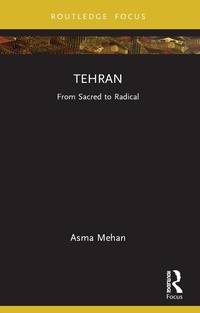
Tehran
From Sacred to Radical
1st Edition
Published on 26. September 2022
130 pages
978-1-000-78448-0 (ISBN)
Description

This book is an interdisciplinary research work designed to be of interest to a broad range of academics. The book examines the relationship between democracy and the (trans)formations of urban spaces through comparative perspective. It engages with the ideas of 'modernity' in architecture and investigates how they might align (or not) with other forms of radical power.
This book offers an understanding of the public spaces through political change, power struggle, and autocratic modernity manifested. It addresses the subject of politics in architecture and built environment by examining the various academic literature in urban studies, architectural history, urban anthropology, urban sociology, cultural geographies, planning history, philosophy, and the broader social and political sciences. Followingly, it will be focused on the less well-known traditions of architecture and democratic values drawing upon western and (non)western perspectives to decolonize the notion of public space in the global south. In better words, the book investigates the mechanisms of power struggles and the transformative dynamism of totalization and state-led modernization, which motivates or shapes a creative tension in the form of the city.
The topic of the work is novel and aims to examine the relationship between the affordances of public spaces, their micro-histories, and the emergence of critical social events and movements. The breadth of the topic demanded engagement with a rich body of architectural theory and history and relevant texts in urban sociology, colonial and postcolonial studies, political geography, and cultural studies, a challenge to which the book has responded outstandingly. The issue is urgent for policymakers and architects, urban designers, political and cultural geographers, and other practitioners working on the built environment to create more democratic public spaces in the global south.
This book offers an understanding of the public spaces through political change, power struggle, and autocratic modernity manifested. It addresses the subject of politics in architecture and built environment by examining the various academic literature in urban studies, architectural history, urban anthropology, urban sociology, cultural geographies, planning history, philosophy, and the broader social and political sciences. Followingly, it will be focused on the less well-known traditions of architecture and democratic values drawing upon western and (non)western perspectives to decolonize the notion of public space in the global south. In better words, the book investigates the mechanisms of power struggles and the transformative dynamism of totalization and state-led modernization, which motivates or shapes a creative tension in the form of the city.
The topic of the work is novel and aims to examine the relationship between the affordances of public spaces, their micro-histories, and the emergence of critical social events and movements. The breadth of the topic demanded engagement with a rich body of architectural theory and history and relevant texts in urban sociology, colonial and postcolonial studies, political geography, and cultural studies, a challenge to which the book has responded outstandingly. The issue is urgent for policymakers and architects, urban designers, political and cultural geographers, and other practitioners working on the built environment to create more democratic public spaces in the global south.
More details
Series
Edition
1. Auflage
Language
English
Place of publication
London
United Kingdom
Publishing group
Taylor & Francis Ltd
Target group
Professional and scholarly
Product notice
Reflowable
Illustrations
2 Tables, black and white; 20 Halftones, black and white; 20 Illustrations, black and white
ISBN-13
978-1-000-78448-0 (9781000784480)
Copyright in bibliographic data and cover images is held by Nielsen Book Services Limited or by the publishers or by their respective licensors: all rights reserved.
Schweitzer Classification
Other editions
Person
Asma Mehan is an architect, researcher, and educator interested in architectural humanities and critical urban studies. She is an Assistant Professor at Texas Tech University, College of Architecture (TTU CoA). She was previously awarded four highly selective fellowships and grants, including the Scientific Employment Stimulus Individual fellowship funded by the Portuguese Foundation for Science and Technology (FCT) and the Urban Citizenship Fellowship supported by the Municipality of Amsterdam and the Netherlands Institute for Advanced Study in the Humanities and Social Sciences (NIAS-KNAW) among others.
She achieved her Ph.D. in the "Architecture, History, and Project" program, in October 2017, from the Politecnico di Torino (Italy). Previously, she worked as a senior researcher at various European universities such as the University of Porto, Leiden University, Politecnico di Torino, and Berlin ZK/U center for Art and Urbanistics.
She has taught at TU Delft and Politecnico di Torino and has been invited as the guest lecturer at TU Munich, ZK/U Berlin Center for Art and Urbanistics, University of Porto, and Deakin University, Melbourne (Australia). Mehan has received several awards from prestigious institutions such as AESOP, EAHN (European Architectural History Network), Society of Architectural Historians (SAH), ZK/U Center for Art and Urbanistics Berlin, and Society of Architectural Historians of Great Britain (SAHGB).
Her primary research and teaching interests include architectural humanities, critical urban studies, spatial planning, and heritage studies. Asma completed research stays in Australia (Deakin University, Melbourne, 2016-2017) and at the EPFL University, Lausanne, Switzerland (2017), and was a researcher in resident at the ZK/U Zentrum fuer Kunst und Urbanistik, Berlin, 2019. She is the co-author of the book Kuala Lumpur: Community, Infrastructure, and Urban Inclusivity (London: Routledge, 2020).
She has authored over fifty articles and essays in scholarly books and professional journals in multiple languages on critical urban studies, architecture, urban planning, housing, and heritage studies. She has also been a member of several international scientific committees and conferences. Her research reaches academic audiences through international exhibitions, artistic venues, policy toolkits, visual media, journalistic blogs, and online outlets.
She achieved her Ph.D. in the "Architecture, History, and Project" program, in October 2017, from the Politecnico di Torino (Italy). Previously, she worked as a senior researcher at various European universities such as the University of Porto, Leiden University, Politecnico di Torino, and Berlin ZK/U center for Art and Urbanistics.
She has taught at TU Delft and Politecnico di Torino and has been invited as the guest lecturer at TU Munich, ZK/U Berlin Center for Art and Urbanistics, University of Porto, and Deakin University, Melbourne (Australia). Mehan has received several awards from prestigious institutions such as AESOP, EAHN (European Architectural History Network), Society of Architectural Historians (SAH), ZK/U Center for Art and Urbanistics Berlin, and Society of Architectural Historians of Great Britain (SAHGB).
Her primary research and teaching interests include architectural humanities, critical urban studies, spatial planning, and heritage studies. Asma completed research stays in Australia (Deakin University, Melbourne, 2016-2017) and at the EPFL University, Lausanne, Switzerland (2017), and was a researcher in resident at the ZK/U Zentrum fuer Kunst und Urbanistik, Berlin, 2019. She is the co-author of the book Kuala Lumpur: Community, Infrastructure, and Urban Inclusivity (London: Routledge, 2020).
She has authored over fifty articles and essays in scholarly books and professional journals in multiple languages on critical urban studies, architecture, urban planning, housing, and heritage studies. She has also been a member of several international scientific committees and conferences. Her research reaches academic audiences through international exhibitions, artistic venues, policy toolkits, visual media, journalistic blogs, and online outlets.
Content
Acknowledgements. Prologue. Chapter 1: City of Politico-Religious Reasons. Chapter 2: City of Modern Reasons. Chapter 3: City of Power Reasons. Chapter 4: Radical Urbanism. Chapter 5: Insurgent Cities. Epilogue. Index.
