

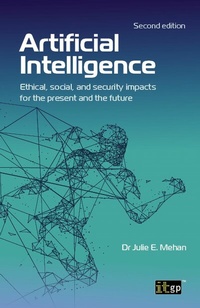
Artificial Intelligence
Ethical, social, and security impacts for the present and the future, Second edition
1st Edition
Published on 8. August 2024
409 pages
978-1-78778-513-7 (ISBN)
Description

A global perspective on AI
The rise of AI and super-intelligent AI raises ethical issues. AI is the power behind Google's search engine, enables social media sites to serve up targeted advertising, gives Alexa and Siri their voices, and enables OpenAI's ChatGPT to produce written responses from just a few prompts by the user. It is also the technology enabling self-driving vehicles, predictive policing, and autonomous weapons that can kill without direct human intervention. All of these bring up complex ethical issues that are still unresolved and will continue to be the subject of ongoing debate.
This book:
Explores the complex topic of AI ethics in a cross-functional way;
Enables understanding of the associated ethical challenges of AI technologies;
Provides an up-to-date overview of the potential positive and negative outcomes of AI implementations; and
Has been updated to reflect the ethical challenges of AI in 2024 and beyond, and the moral imperative of navigating this new terrain.
This book presents a concrete approach to identifying appropriate ethical principles in AI solutions
The rise of AI and super-intelligent AI raises ethical issues. AI is the power behind Google's search engine, enables social media sites to serve up targeted advertising, gives Alexa and Siri their voices, and enables OpenAI's ChatGPT to produce written responses from just a few prompts by the user. It is also the technology enabling self-driving vehicles, predictive policing, and autonomous weapons that can kill without direct human intervention. All of these bring up complex ethical issues that are still unresolved and will continue to be the subject of ongoing debate.
This book:
Explores the complex topic of AI ethics in a cross-functional way;
Enables understanding of the associated ethical challenges of AI technologies;
Provides an up-to-date overview of the potential positive and negative outcomes of AI implementations; and
Has been updated to reflect the ethical challenges of AI in 2024 and beyond, and the moral imperative of navigating this new terrain.
This book presents a concrete approach to identifying appropriate ethical principles in AI solutions
More details
Edition
1. Auflage
Language
English
Place of publication
Ely
United Kingdom
Target group
Professional and scholarly
US School Grade: College Graduate Student
Edition type
Digital original
File size
8,33 MB
ISBN-13
978-1-78778-513-7 (9781787785137)
Copyright in bibliographic data and cover images is held by Nielsen Book Services Limited or by the publishers or by their respective licensors: all rights reserved.
Schweitzer Classification
Other editions
Additional editions
Julie Mehan
Artificial Intelligence
Ethical, social, and security impacts for the present and the future, Second edition
Book
08/2024
2nd Edition
IT Governance Publishing
€48.10
Shipment within 10-20 days
Person
Dr Julie Mehan is semi-retired, but is still a professor at UMGC (University of Maryland Global College), where she teaches digital ethics, cyber terrorism, and information systems in organisations.
Dr Mehan has been a career government service employee, a strategic consultant and an entrepreneur. She has led business operations, as well as IT governance and cyber-security-related services, including designing and leading whitehat and blackhat penetration testing exercises, certification and accreditation, systems security engineering process improvement, and cyber security strategic planning and programme management. She delivered cyber security and related privacy services to the US senior Department of Defense, federal government and commercial clients, working in Italy, Australia, Canada, Belgium, Germany and the US.
Dr Mehan is particularly proud of her role as pro bono president of W2CW (Warrior to Cyber Warrior), a non-profit organisation dedicated to providing cost-free cyber security career transition training to veterans and wounded warriors returning from military campaigns.
Dr Mehan has been a career government service employee, a strategic consultant and an entrepreneur. She has led business operations, as well as IT governance and cyber-security-related services, including designing and leading whitehat and blackhat penetration testing exercises, certification and accreditation, systems security engineering process improvement, and cyber security strategic planning and programme management. She delivered cyber security and related privacy services to the US senior Department of Defense, federal government and commercial clients, working in Italy, Australia, Canada, Belgium, Germany and the US.
Dr Mehan is particularly proud of her role as pro bono president of W2CW (Warrior to Cyber Warrior), a non-profit organisation dedicated to providing cost-free cyber security career transition training to veterans and wounded warriors returning from military campaigns.
Content
Introduction
Chapter 1: AI defined and common depictions of AI - Is it a benevolent force for humanity or an existential threat???
Chapter 2: Is AI really ubiquitous - Does it or will it permeate everything we do???
Chapter 3: Human-machine collaboration - Can we talk to them in English (or any other language)???
Chapter 4: AI, ethics, and society - Are they compatible???
Chapter 5: Bias in AI - Why is it important and potentially dangerous???
Chapter 6: AI and cybersecurity - AI as a sword or a shield???
Chapter 7: AI and our society - Will the result be professional, ethical, and social deskilling, or upskilling???
Chapter 8: AI and privacy - Is anything really private anymore???
Chapter 9: Misinformation, disinformation, fake news, manipulation, and deepfakes - Do we know how to think critically about information???
Chapter 10: AI and social media - How is it affecting us???
Chapter 11: "The measure of a man" - Can AI become more like a human???
Chapter 12: What's next in AI - Less artificial and more intelligent?
Chapter 13: Ethical challenges of AI 2024 and beyond: The moral imperative of navigating this new terrain??
Chapter 14: Final thoughts
Further reading
Chapter 1: AI defined and common depictions of AI - Is it a benevolent force for humanity or an existential threat???
Chapter 2: Is AI really ubiquitous - Does it or will it permeate everything we do???
Chapter 3: Human-machine collaboration - Can we talk to them in English (or any other language)???
Chapter 4: AI, ethics, and society - Are they compatible???
Chapter 5: Bias in AI - Why is it important and potentially dangerous???
Chapter 6: AI and cybersecurity - AI as a sword or a shield???
Chapter 7: AI and our society - Will the result be professional, ethical, and social deskilling, or upskilling???
Chapter 8: AI and privacy - Is anything really private anymore???
Chapter 9: Misinformation, disinformation, fake news, manipulation, and deepfakes - Do we know how to think critically about information???
Chapter 10: AI and social media - How is it affecting us???
Chapter 11: "The measure of a man" - Can AI become more like a human???
Chapter 12: What's next in AI - Less artificial and more intelligent?
Chapter 13: Ethical challenges of AI 2024 and beyond: The moral imperative of navigating this new terrain??
Chapter 14: Final thoughts
Further reading
