

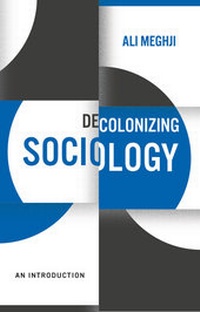
Decolonizing Sociology
Description

This book explores why, and how, sociology needs to be decolonized. It analyses how sociology was integral in reproducing the colonial order, as dominant sociologists constructed theories either assuming or proving the supposed barbarity and backwardness of colonized people. Ali Meghji reveals how colonialism continues to shape the discipline today, dominating both social theory and the practice of sociology, how exporting the Eurocentric sociological canon erased social theories from the Global South, and how sociologists continue to ignore the relevance of coloniality in their work.
This guide will be necessary reading for any student or proponent of sociology. In opening up the work of other decolonial advocates and under-represented thinkers to readers, Meghji offers key suggestions for what teachers and students can do to decolonize sociology. With curriculum reform, innovative teaching and a critical awareness of these issues, it is possible to make sociology more equitable on a global scale.
More details
Other editions
Additional editions
Person
Content
1. The Decolonial Challenge to Sociology
2. Beyond Intellectual Imperialism: Indigenous and Autonomous Sociologies
3. Walking while Asking Questions: Towards a 'Sociology in Conversations'
Conclusion: Sociology and the Decolonial Option
Introduction: Sociology and Coloniality
As someone interested in decolonial theory, I often find myself reflecting on my relationship with sociology. I did not study sociology until part way through my undergraduate degree, and in this regard, I was never formally introduced to the works of Karl Marx, Max Weber or Émile Durkheim. Not having sat down and systematically read Marx, Weber and Durkheim became a secret of mine that I kept close to my chest at the beginning of graduate school. Readers of this book will be pleased to know that since then I have become acquainted with such 'classical' works, but it remains puzzling that three figures, two of whom did not even classify themselves as sociologists, and none of whom were regarded as sociologists by their contemporaries (Connell 1997), have come to hold so much symbolic weight in the field of sociology. Now as an advisor, I regularly get graduate students - much less secretive than I was - declaring anxieties to me that they aren't familiar with the works of Marx, Weber and Durkheim, questioning whether that makes them 'bad sociologists'.
How have we got to the point where students see it as a moral obligation to read Marx, Weber and Durkheim? How have we got to the point where those who are not familiar with these three thinkers are construed as having some form of sociological deficiency? Why is the sociological canon composed as it is, and what does this tell us about the dominant vision of sociology? Do we even need a sociological canon? This book reflects on some of these questions throughout the following chapters. However, in order to fully understand the responses to these questions, and consequently to tackle the wider problem of 'decolonizing' sociology, we need to situate the development of sociology in its proper colonial history. This is because, although we are regularly presented with a picture of sociology as being one of the most 'critical' of the social sciences, sociology became formally institutionalized in the nineteenth century at the height of global colonialism, imperialism and empires. This world of colonialism and empires was not merely background noise to sociology, but rather the discipline came to internalize colonial ways of thinking and representing the world. Over a century later, and this colonial style of knowledge production still shapes sociological practice. In this regard, actions for the future of sociology require a significant examination of the discipline's past.
Sociology, colonialism and colonial difference
Sociology is unlike many of the other disciplines covered in Polity's 'Decolonizing the Curriculum' series - including philosophy, history, natural science, music, theology, economics and English literature - in that sociology did not have a formal existence before European colonialism. While people were certainly thinking sociologically for a very long time, in terms of being a formal academic discipline with institutional recognition, sociology did not arrive on the academic scene until the nineteenth century at the high point of colonialism. Thus, speaking about the US, Julian Go (2016a) points out that the first sociology PhD awarded in the US - William Fremont Blackman's The Making of Hawaii - was published in 1893, the same year that the US overthrew the Hawaiian monarchy. Go (2016a) additionally points out that as the first school of sociology in the US was set up in Chicago in 1893, France was colonizing the Ivory Coast, Laos and Guinea, and as the first issue of the American Journal of Sociology was published in 1895, the Cuban rebellion against the Spanish began. Outside of the US, we may add that the first sociology department set up in the UK, in 1904 at the London School of Economics, was established the same year that we see the first genocide of the twentieth century (the Herero and Nama genocide conducted by the German empire), while the first sociology department set up in mainland Europe (in Bordeaux, 1895) happened in the same year that French West Africa was founded. Simply put, sociology formally developed in a world that was shaped by the processes of colonialism and empire.
In terms of decolonizing sociology, unlike many other disciplines, therefore, sociology did not 'become' colonized; rather, it was always colonial to begin with. By saying that sociology was colonial, I mean that sociology both internalized the logic of a colonial episteme, and also (re)-produced and bolstered that very episteme itself. Epistemes are ways of thinking and knowing, they set the limits of what can be known, as well as dictating what counts as legitimate knowledge and how this knowledge can be legitimately produced (Meghji 2019a). When speaking of a colonial episteme, therefore, I am referring to dominant ways of thinking and knowing that produced and reproduced colonial difference: the idea that the colonized were inherently different from (and inferior to) the Western colonizers.
One of the paradoxes of world history, as Gurminder K. Bhambra (2014: 132) states, is that 'colonization invent[ed] the colonized'. What is evoked in Bhambra's statement is a recognition of the interplay between power, knowledge (epistemology) and being (ontology), and how the imbalances of power created in colonialism had epistemic-ontological dimensions. The idea that colonized people were inherently different from the colonized was not a 'given' fact, but was a form of knowledge that had to be actively produced by colonial empires (Mignolo 2012). The creation of race, as a master-category through which we could categorize the world's population, was a primary mechanism through which colonial difference could be made (Mills 1997). Thus, through the concept of race in the sixteenth century, Spanish colonizers were able to draw links between the indigenous people's1 raza (blood) and their being gente sin razón (people without reason) (Lewis 2012), while the biological revolution in the eighteenth century allowed for a more rigid conception of race that held non-white racialized groups as naturally inferior to whites (Banton and Harwood 1975). The concept of race was thus the glue that stuck the colonial world order together, as it became common-sense knowledge that there was a global racial hierarchy which permitted the colonization of the 'lesser' races by the dominant white Europeans. This global hierarchy is well described by W. E. B. Du Bois (1967 [1899]: 386-7) when he comments:
We grant full citizenship in the World Commonwealth to the 'Anglo-Saxon' (whatever that may mean), the Teuton and the Latin; then with just a shade of reluctance we extend it to the Celt and Slav. We half deny it to the yellow races of Asia, admit the brown Indians to an ante-room only on the strength of an undeniable past; but with the Negroes of Africa we come to a full stop, and in its heart the civilized world with one accord denies that these come within the pale of nineteenth-century Humanity.
What is captured in Du Bois' remark is that colonial difference divided the world through the taxonomy of race. However, this division of the world was not just geographical, and did not aim to just specify where the 'different races' of the world lived. Rather, the colonial difference that ruptured the world also asserted that people in different regions across the world were in different temporal stages of human development, and consequently had essential ontological differences; scholars have referred to these processes as the coloniality of time (Demuro 2015; Mignolo 2012) and the coloniality of being (Maldonado-Torres 2017; Wynter 2003).
In terms of the coloniality of time, the 'myth' of colonial difference relied upon the premise that the colonized were less developed - as a civilization - than those living in the West (Mignolo 2012; Mills 2014). It was this very logic that allowed colonial empires to justify their actions on the pretence of 'bringing civilization' to the rest of the world, and indeed, this temporal grammar is still used in the present day when we continue to refer to the 'undeveloped' regions of the world (rather than, as scholars such as Walter Rodney (2018 [1972]) have argued, using the term 'underdeveloped', which stresses the overdevelopment of the West through colonialism). In terms of the coloniality of being, as Sylvia Wynter (2003) argues, colonial difference relied on the premise that only the white Westerners achieved the full status of 'man', while the colonized people of the world were all varying degrees of sub-human. Overt examples of this may include the evolutionist idea that Black people were closer to animals than mankind, as analysed by Wulf Hund (2015), and the way that colonized people throughout the world were referred to as savages. Indeed, it was through the coloniality of being that imperial powers could support liberal legislation 'at home' while still exploiting people in their colonies. For instance, France's 1789 Declaration of the Rights of Man and of the Citizen claimed that there are certain universal rights to be protected for all people, and yet at the same time France was running a murderous empire (Wilder 2004). As Charles W. Mills (1997) thus points out, colonizers across the world could defend themselves as liberal because colonized people were not considered fully human, so...
