

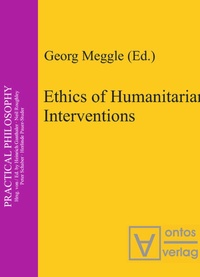
Ethics of Humanitarian Interventions
Description

Humanitarian Interventions - that sounds nice; much nicer than wars, battles and use of military force. Foremost, the phrase makes you think of the delivery of sanitary goods, medication, of soup-kitchens.
Here we are not supposed to think of interventions of this kind; we have to have humanitarian interventions in mind which are humanitarian intervention-wars.
(I) At exactly what point is the use of military force a humanitarian intervention? What is the humanitarian aspect of those interventions? Their occasion? Their motive? Their alleged as well as their actual consequences?
(II) At exactly what point are humanitarian intervention-wars morally justifiable? Are they justifiable even if they are wars of aggression breaching international law?
And finally:
(III) Was the war which was presented to us as the paradigmatic example of a humanitarian-intervention-war, that is: the war in Kosovo in the spring of 1999 (with over 37,000 bombing missions), really justifiable as a humanitarian intervention? Many of us wanted to believe so at the time. Does our ex ante judgement hold today in an ex post reflection? And which lessons for the future should we learn from the success or failure of this humanitarian war?
These are the questions proposed in this book; therefore, it is concerned with problems of semantics (part I), problems of moral assessment (part II) and with the moral, legal and political conclusions we draw from our experiences with the war in Kosovo, our primary example of a humanitarian intervention (part III).
International experts in the areas of philosophy, international law, sociology and peace studies debated these questions vigorously for several days. This is the resulting volume.
More details
Other editions
Additional editions
Content
2 - CONTENTS [Seite 7]
3 - Preface [Seite 9]
4 - ABSTRACTS [Seite 10]
5 - I Basic Issues [Seite 22]
5.1 - MICHAEL WALZER The Argument about Humanitarian Intervention [Seite 23]
5.2 - SEUMAS MILLER Collective Responsibility and Humanitarian Armed Intervention [Seite 39]
5.3 - OLAF L. MÜLLER Reconstructing Pacifism. Different Ways of Looking at Reality [Seite 58]
5.4 - UWE CZANIERA How Far Shall We Go Humanitarian Interventions? [Seite 83]
5.5 - MARTIN FRANK The Dilemmatic Structure of Humanitarian Interventions [Seite 99]
5.6 - WALTER PFANNKUCHE Humanitarian Interventions and Other Duties to Humanitarian Aid1 [Seite 116]
5.7 - RALF STOECKER Help, Intervention and Involvement [Seite 131]
5.8 - ALEKSANDAR PAVKOVIC [Seite ALEKSANDAR PAVKOVIC]
- [Seite ]
Saving Lives in Nationalist Conflicts: - [Seite Saving Lives in Nationalist Conflicts:]
- [Seite ]
A Few Moral Hazards1 - 163 [Seite 163]
5.9 - MIROSLAV PROKOPIJEVIC Humanitarian Intervention [Seite 191]
6 - II International Ethics and Law [Seite 207]
6.1 - RÜDIGER BITTNER Humanitarian Interventions are Wrong [Seite 209]
6.2 - THOMAS MERTENS Humanitarian Intervention: Legal and Moral Arguments [Seite 217]
6.3 - RUDOLF SCHÜSSLER Principles of non-UN Humanitarian Intervention [Seite 235]
6.4 - REINER STEINWEG Early non-Military External Interventions. A Plea for a United Nations Intervention Council (UNIC) [Seite 252]
6.5 - VÉRONIQUE ZANETTI Humanitarian Intervention: An Individual Right or a State Right? [Seite 265]
7 - III Kosova / Kosovo The Moral Combat [Seite 279]
7.1 - ULRICH STEINVORTH* On the Legitimacy of NATO's Kosovo Intervention [Seite 281]
7.2 - GEORG MEGGLE NATO-Morality and the Kosovo-War An Ethical Commentary - ex post [Seite 295]
7.3 - HAJO SCHMIDT "Humanitarian Intervention": Media, Ethics and Law in the Kosovo War [Seite 321]
7.4 - JOHAN GALTUNG Bombing Yugoslavia: Several Readings Text, Supertext, Subtext, Deep Text, Context - and a Pretext (with a Posttext) [Seite 337]
7.5 - DIETER S. LUTZ The Example of Kosovo: Didactics against Humanitarian Interventionism [Seite 360]
8 - CONTRIBUTORS [Seite 382]
